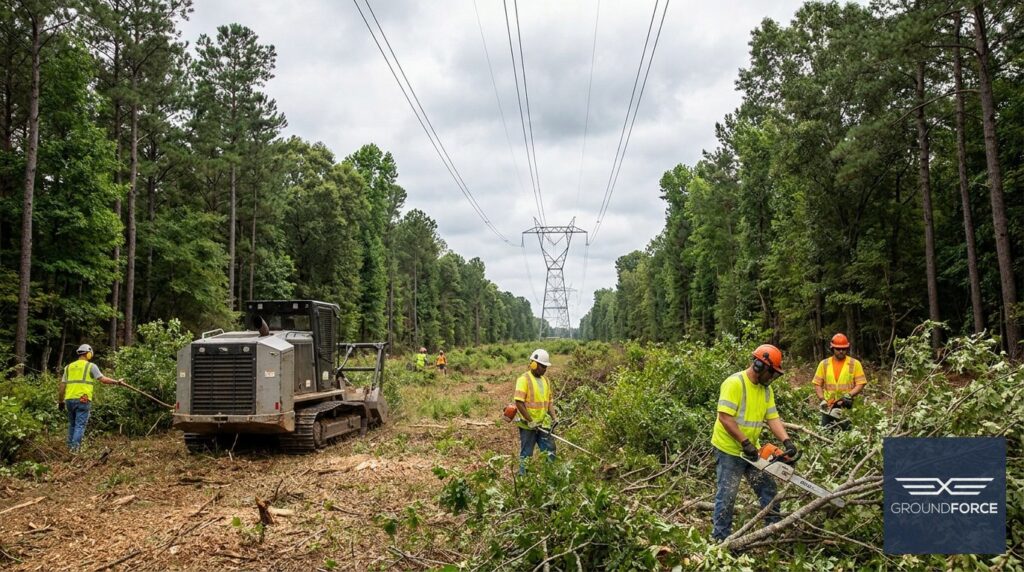
Vegetation management is the science-based discipline of controlling unwanted plant growth to protect infrastructure, public safety, ecological integrity, and property value. Professional vegetation management integrates mechanical, chemical, biological, and cultural methods under federal and state regulations that govern herbicide use, protected species, and water quality. Georgia’s long growing season and severe invasive species pressure make vegetation management more demanding than in most regions, requiring method selection and ecological knowledge that generic landscaping does not provide.
What is vegetation management and how does it differ from landscaping?
Vegetation management is a science-based discipline controlling plant communities to protect infrastructure, safety, and ecological function. Landscaping installs and maintains desired plant material for aesthetic purposes. Vegetation management removes or suppresses unwanted growth. Landscaping adds and nurtures growth.
The core definitions of vegetation management establish plant control as the central activity. Practitioners apply ecological principles, regulatory knowledge, and specialized techniques to keep vegetation from interfering with human systems. The discipline serves four primary goals:
- Safety: Maintaining sight lines along roadways, clearance around structures, and reducing fire fuel loads
- Access: Keeping rights-of-way, utility corridors, and drainage systems passable and functional
- Regulatory compliance: Meeting federal, state, and local requirements for vegetation control near infrastructure
- Ecological protection: Preventing invasive species spread and supporting native plant communities where appropriate
Professional vegetation management becomes necessary when plant growth threatens infrastructure integrity, public safety, or legal compliance. Commercial properties, government facilities, utility corridors, and transportation networks all require this discipline. Standard grounds maintenance handles mowing and trimming for appearance. Vegetation management addresses plant communities that create hazards or violate codes.
Commercial and institutional buyers need discipline-specific providers because the wrong vendor type creates liability and wasted spending. A lawn service lacks the training to identify hazardous trees near power lines or to apply herbicides according to label restrictions and buffer zone requirements. Hiring a landscaper for vegetation management work leads to incomplete control, regulatory violations, and the need to hire a qualified provider afterward. The property pays twice for the same outcome.
What methods are used in professional vegetation management?
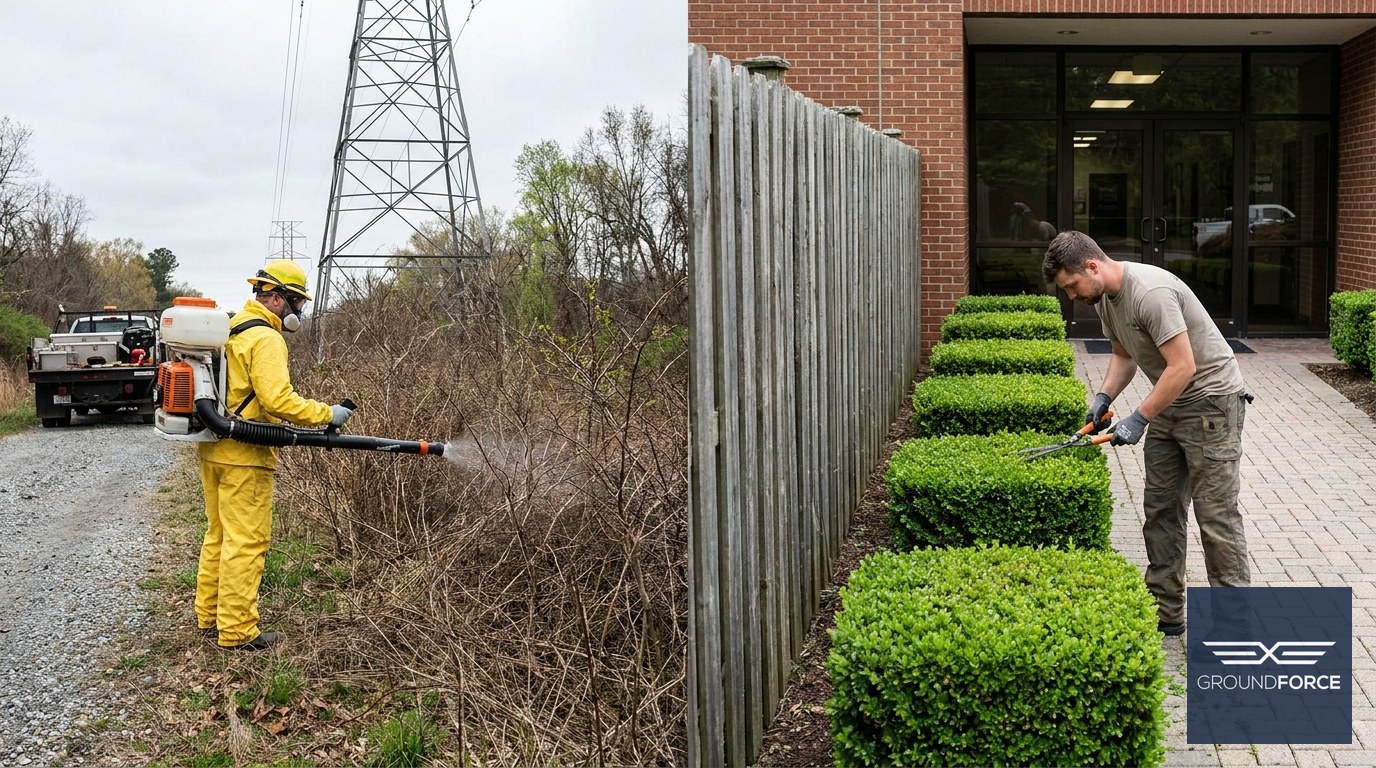
Mechanical, chemical, biological, and cultural methods are the four primary vegetation management method categories used in professional practice. Mechanical control mows, mulches, and cuts vegetation; chemical control applies herbicides; biological control deploys grazing animals and biocontrol agents; cultural control establishes cover crops and native plants.
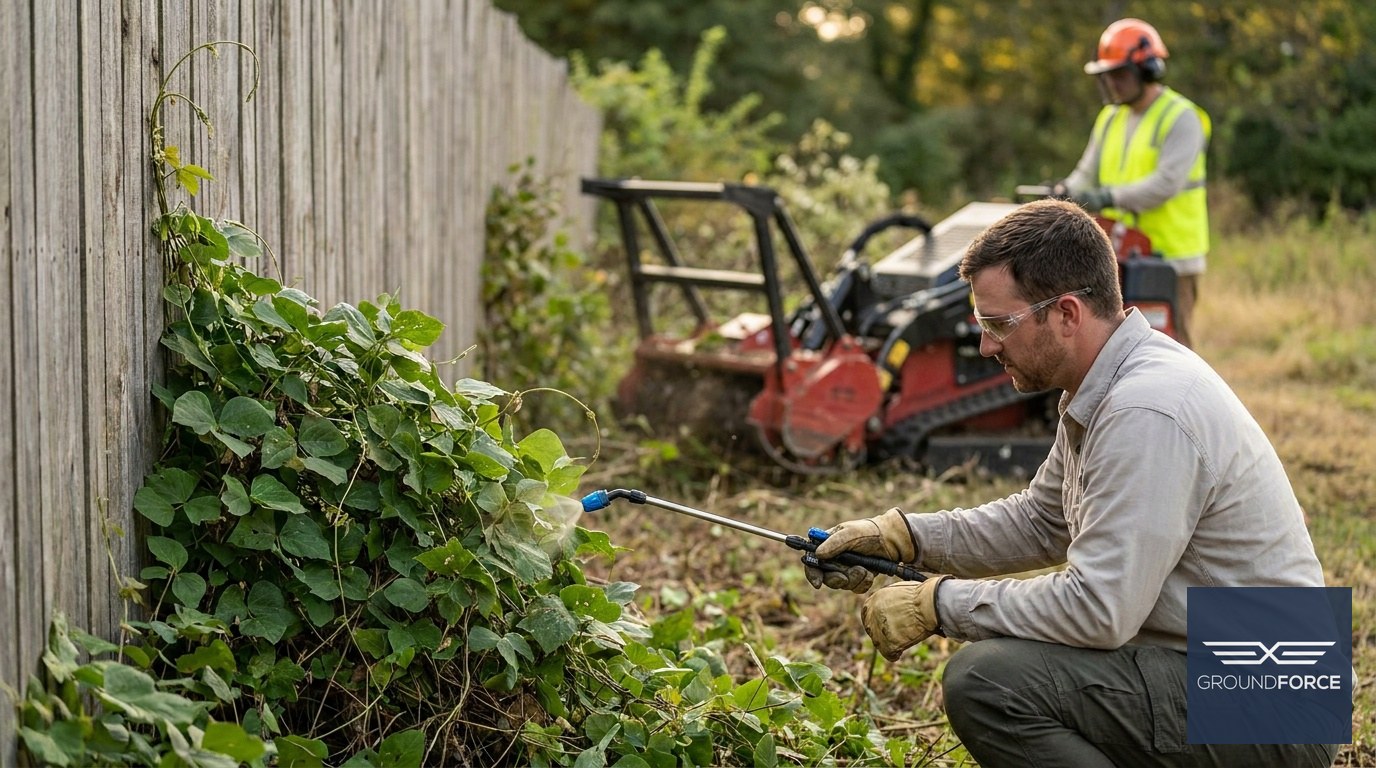
Integrated Pest Management (IPM) applies to vegetation management by prioritizing the least-invasive effective method before escalating to chemical control. Managers begin with prevention and mechanical treatment, then escalate only when lower-impact methods prove insufficient against the target species. The IVM in commercial land management framework formalizes least-invasive-first decision making for rights-of-way, industrial sites, and utility corridors.
Method selection matches site conditions and vegetation pressure. Mechanical methods deliver immediate clearance for construction preparation, firebreaks, and sight-line restoration. Chemical methods suppress persistent or invasive species, such as resprouting kudzu or privet, that regrow after cutting. Biological methods suit long-term, low-maintenance sites where gradual control is acceptable. Conservation grazing, the use of targeted livestock browsing, is a legitimate biological method on large, low-sensitivity sites, though liability exposure, fencing requirements, and urban adjacency make conservation grazing rarely applicable to Georgia commercial properties.
Site conditions, rather than cost, determine the final method choice. Mechanical cutting on a steep right-of-way slope causes erosion that costs more to remediate than the chemical alternative, while state regulations prohibit chemical control within wetland buffers regardless of cost. The herbicide selection within broader vegetation programs framework accounts for these regulatory restrictions before any product reaches a site.
Most professional programs combine methods because single-method approaches leave gaps: mowing alone invites resprouting, and herbicide alone cannot produce immediate clearance. Cost structures reinforce integration. Mechanical treatments carry higher per-visit labor costs but no material cost; chemical programs require less labor per acre but demand licensed applicators and material purchases, so a full-season comparison frequently favors an integrated program.
How does Georgia’s climate and ecology shape vegetation management requirements?
Georgia’s extended growing seasons and high invasive species pressure cause vegetation management demands that exceed those of northern states. Four factors shape every Georgia program: season length, soil variability, invasive plants, and growth-accelerating humidity.
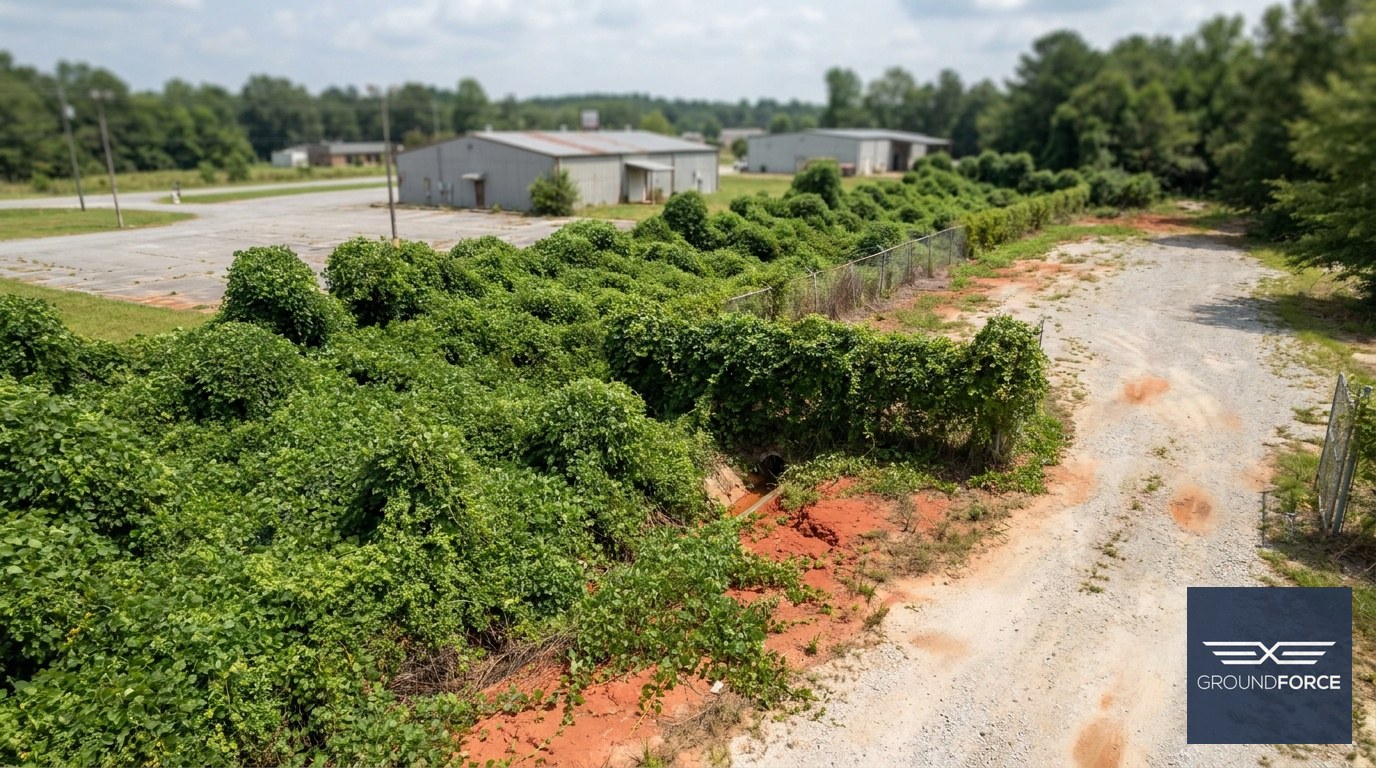
1. Extended growing season. Planta Greenhouses (2024) reports that Georgia’s growing season reaches up to 290 days in its southernmost regions, and the University of Georgia Cooperative Extension places the Tifton area’s first frost between November 1 and December 21 and the last frost between January 26 and March 21. Growth pressure stays active most of the calendar year, which means more treatment cycles and faster re-establishment of unwanted vegetation than in northern markets.
2. Soil variability. Planta Greenhouses (2024) divides Georgia’s soils into clay-heavy Piedmont profiles and sandy Coastal Plain profiles. Because soil type directly affects herbicide uptake rates, persistence, and runoff risk, managers cannot copy a program between sites even within the same county.
3. Invasive species pressure. The Georgia Wildlife Resources Division ranks invasive species second only to habitat destruction as a global threat to biodiversity, and the scope of Georgia’s invasive plant crisis spans kudzu in the Blue Ridge plus cogongrass, Chinese privet, and Japanese honeysuckle in the Coastal Plain and Southeastern Plains. Pennsylvania Sea Grant (2025) reports that kudzu reaches up to 100 feet in length and causes an estimated $100 million to $500 million in annual U.S. forest losses. Cogongrass (Imperata cylindrica), a federally listed noxious weed established in South Georgia, requires a multi-season chemical program because no mechanical method alone achieves control; cogongrass is a case where the IPM hierarchy still concludes with herbicide as the necessary primary tool.
4. Humidity and rainfall. Planta Greenhouses (2024) reports that Georgia’s intense summer heat and humidity promote fungal disease and pest pressure. These conditions accelerate plant growth and require proactive rather than reactive management programs.
What types of properties and industries require professional vegetation management?
Commercial vegetation management in Georgia applies to rights-of-way, industrial corridors, retention ponds, airports, telecom sites, and commercial turf, and each property type carries distinct regulatory and ecological requirements. Four categories account for most professional contracts.
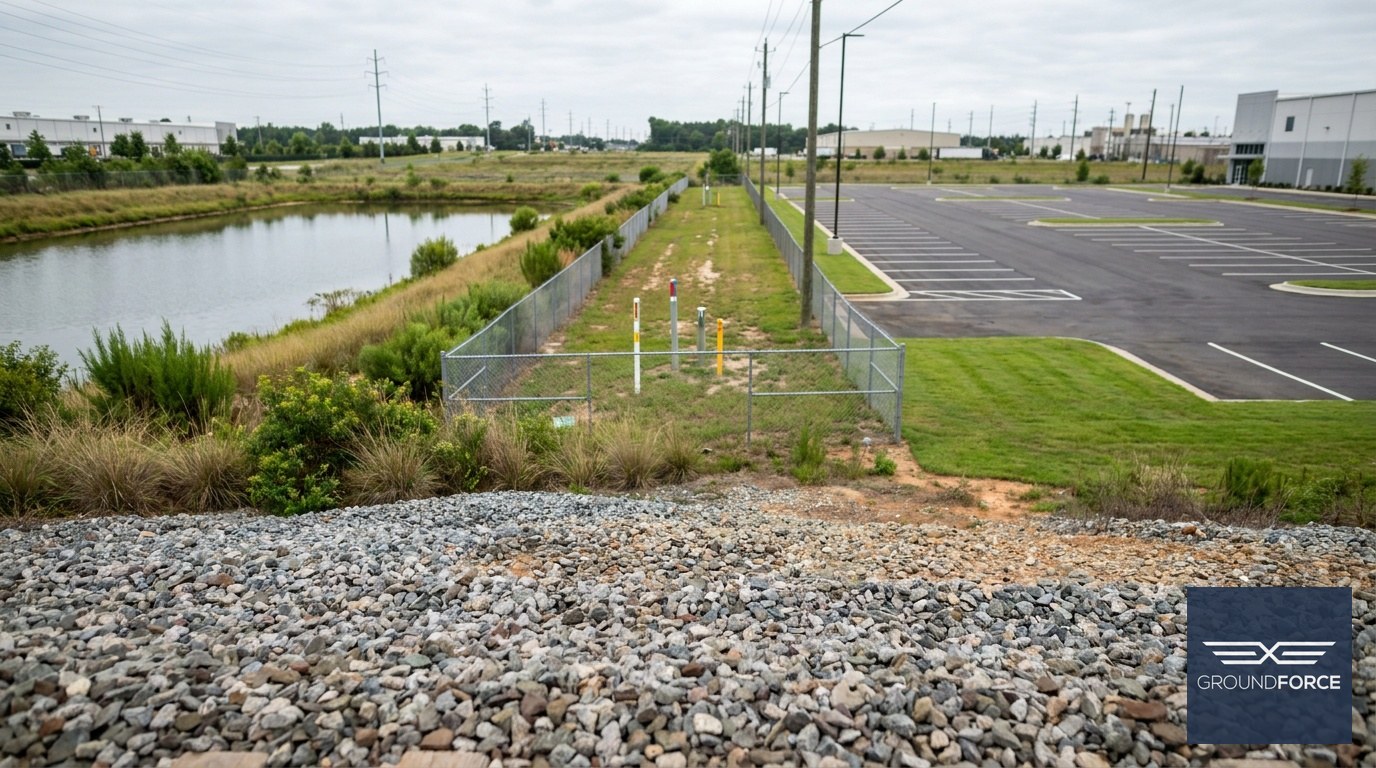
- Linear infrastructure. Electric transmission rights-of-way, pipeline corridors, railroad beds, and roadside rights-of-way require cyclical clearing because vegetation contact with power lines, pipelines, and driver sightlines creates safety and reliability hazards. Clearance failures cause outages. Utilities, pipeline operators, railroads, and the Georgia Department of Transportation run scheduled mowing, herbicide, and tree programs to keep these corridors inspection-ready.
- Industrial and institutional sites. Manufacturing campuses, telecom tower sites, airports, and government facilities need vegetation control for security sightlines, equipment access, and facility compliance. Airports run airfield-specific programs that limit wildlife-attracting vegetation and keep runway and taxiway safety areas clear, while telecom tower sites maintain open perimeters for technician access and protection of equipment compounds and guy-wire anchors.
- Stormwater and water quality facilities. Retention ponds, detention basins, and drainage corridors depend on managed vegetation for hydraulic function. Overgrowth reduces storage capacity, clogs outlet structures, and triggers failed municipal inspections, while properly maintained buffers stabilize banks and filter runoff.
- Commercial properties. Business parks, retail centers, and homeowners associations maintain turf, landscape beds, and perimeter buffers for appearance and liability control, since overgrowth creates trip hazards, fire fuel, and blocked sightlines. Property managers typically scope turf and landscape contracts using the commercial vegetation management cost breakdown that separates mowing, chemical treatments, and specialty services.
Municipal clients, including cities, counties, and water authorities, add a procurement compliance layer to vendor selection. Certified minority and small business preferences, prevailing wage rules, and insurance minimums apply on top of technical qualifications. The Georgia commercial land management guide documents how these property categories translate into service specifications and contract structures across the state.
What regulations govern vegetation management in Georgia?
Vegetation management in Georgia operates under three regulatory layers: state pesticide licensing law, federal herbicide and wetland statutes, and corridor-specific reliability standards. Commercial operators must satisfy all three layers to apply herbicides or clear vegetation legally.
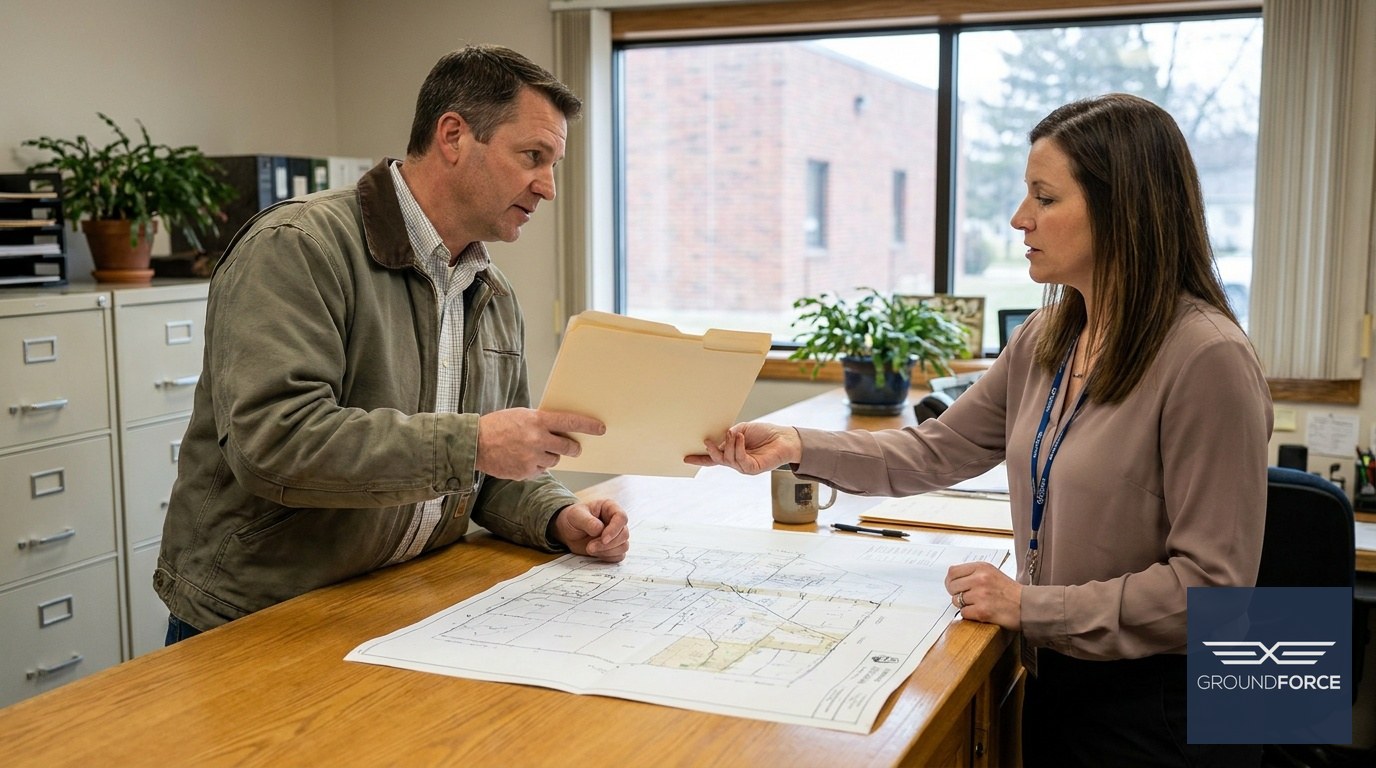
Pesticide applicators in Georgia require licensing and certification through the Georgia Department of Agriculture under the Georgia Pesticide Control Act. The Georgia Pesticide Use and Application Act of 1976 further obligates anyone applying pesticides to another’s land for a fee to hold a pesticide contractor’s license, and the Department requires both a Commercial Applicator License and a Pesticide Contractor License for paid work, including maintenance contracts. A dedicated right-of-way license category covers restricted-use pesticides on public roads, electric power lines, pipelines, and railway rights-of-way. Unlicensed application is a legal violation carrying fines up to $1,000 per violation, according to the Department. Each application may count separately. The Georgia statewide vegetation management rules document these license categories and applicator duties.
Federal statutes add a second layer. The EPA registers every herbicide under the Federal Insecticide, Fungicide, and Rodenticide Act (FIFRA), and Clean Water Act Section 404 restricts chemical application in or near jurisdictional wetlands.
Regulated corridors carry a third layer. The Federal Energy Regulatory Commission is the federal regulator that mandates NERC reliability standards for transmission owners, and FAC-003 exists to prevent vegetation-caused outages by maintaining required clearances between lines and vegetation, according to NERCipedia (2021). FAC-003-2 added a mandatory annual inspection and minimum clearance distances, per the Federal Register (2013); FAC-003-5 became enforceable on April 1, 2024, moving all qualified transmission circuits under Requirement R1, according to TRC Companies (2025). The Georgia Department of Transportation separately specifies vegetation height, species, and clearance along state highway rights-of-way.
These overlapping obligations make compliance a specialized discipline. Hiring a licensed, insured provider shifts licensing, permitting, and clearance accountability to a contractor equipped to document every requirement.
What makes a vegetation management approach genuinely eco-friendly?
Eco-friendly vegetation management combines native plant establishment, targeted herbicide application, mechanical control, and long-term integrated site planning to reduce chemical dependency over time. A genuinely eco-friendly program treats herbicide as one tool among several, not the default response to unwanted vegetation.
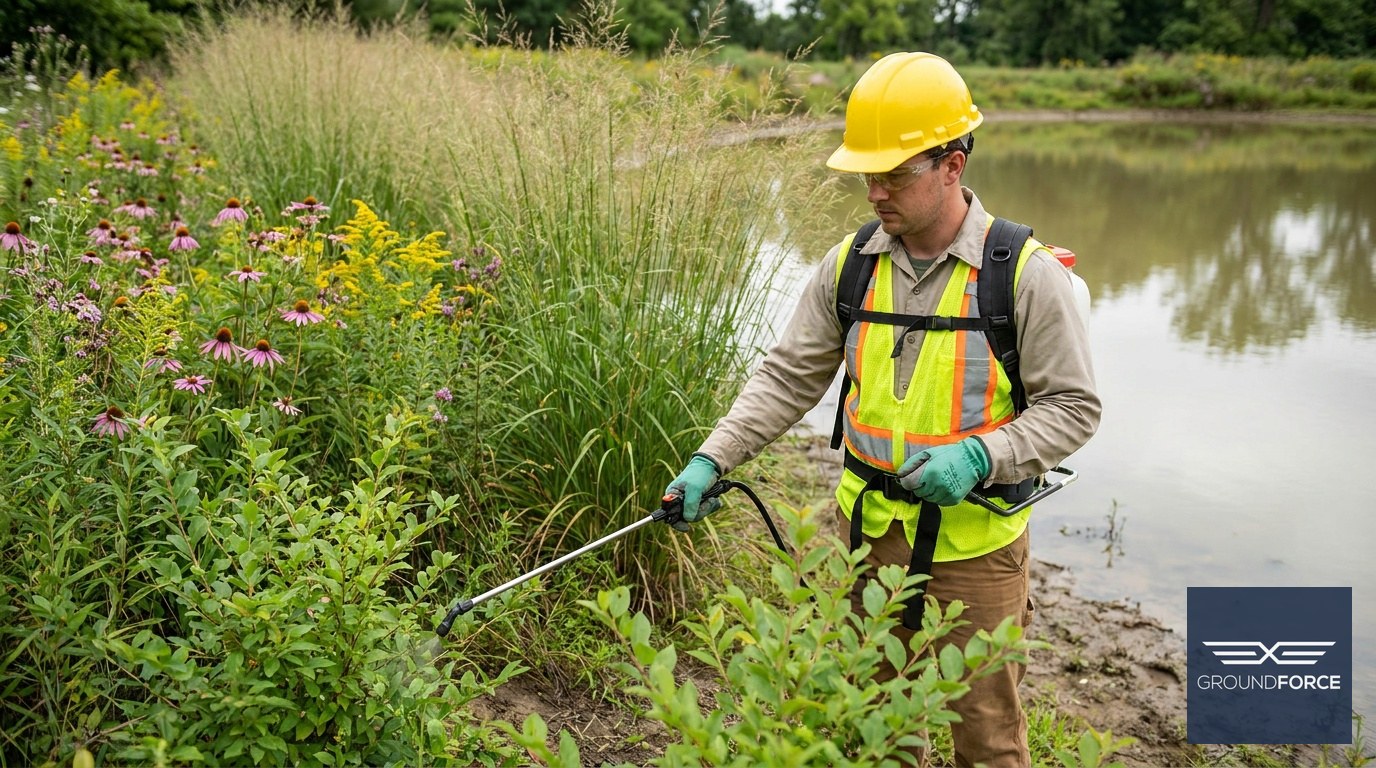
Integrated pest management (IPM) forms the ecological baseline. An IPM program exhausts mechanical and cultural options, such as mowing cycles, mulching, and selective cutting, before any chemical input. When chemistry becomes necessary, applicators use targeted products at the lowest effective registered rate. This distinction matters: eco-friendly does not mean herbicide-free. The ecological harm associated with vegetation control comes from misapplication, drift, and overuse, not from herbicide use itself, and regulators and property managers often misunderstand that difference.
Native plant establishment is the long-term strategy. Replacing invasive or maintenance-intensive cover with site-appropriate Georgia natives reduces treatment frequency over a three to five year horizon, because established native communities outcompete weeds and require fewer interventions each season.
Buffer zone and waterway protection separates responsible providers from the rest. Responsible crews maintain setbacks around streams, ponds, and wetlands, select low-volatility formulations that resist drift, and suspend applications before precipitation events so products never wash into waterways.
Finally, eco-responsibility must be measurable, not marketed. Property managers should request applicator records, material safety data sheets, and treatment maps for every visit, since documentation proves what was applied, where, and at what rate. The vetting vegetation management providers process covers exactly which records to request before signing a contract. The leading Georgia vegetation management company on any commercial account supplies this documentation routinely, without prompting, because verification is part of the service rather than an extra.