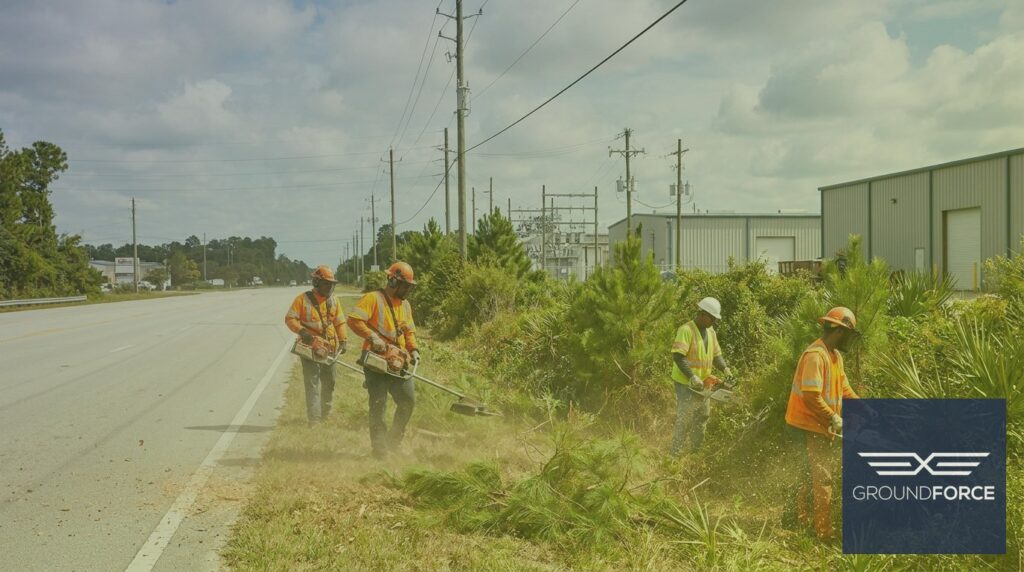
Vegetation management requires sector-specific programs. Airports must meet FAA wildlife-strike rules, utilities must comply with NERC FAC-003 reliability standards, retention ponds carry stormwater permit obligations, and solar farms must limit panel shading. One-size-fits-all vegetation management does not account for these regulatory distinctions. Ground Force provides eco-friendly commercial vegetation management across Georgia, with programs structured around the regulatory requirements, operational constraints, and site conditions of each industry it serves.
Why does vegetation management look different for every industry?
Vegetation management challenges vary by industry sector due to distinct regulatory frameworks, site conditions, and operational risk profiles. A utility corridor, an airport airfield, a solar array, and a stormwater pond each demand different vegetation outcomes, treatment methods, and contractor qualifications.
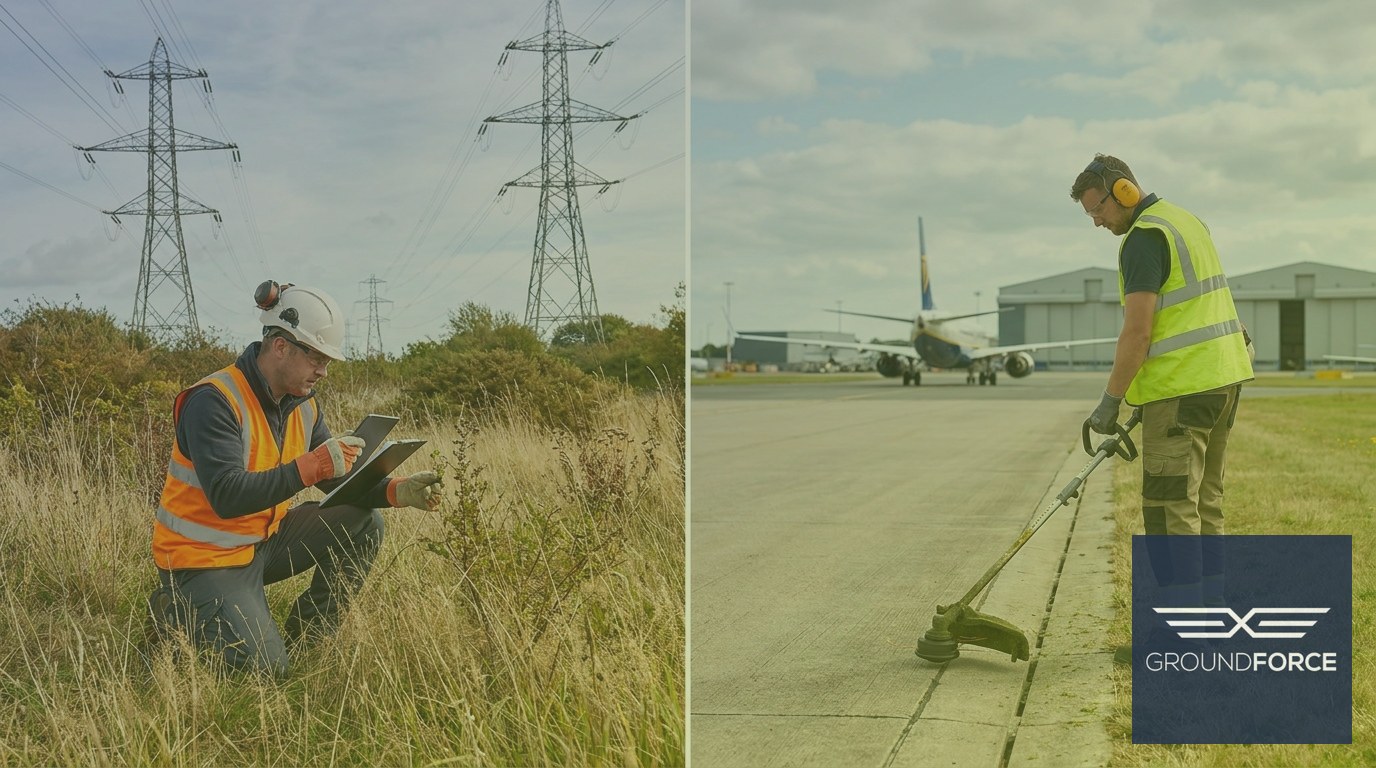
Regulation defines the goal rather than the method. Electric utilities answer to NERC reliability standards that mandate clearance distances around transmission lines. Airports follow FAA wildlife hazard guidance that treats vegetation as an attractant to suppress. Stormwater retention ponds fall under EPA and Georgia EPD rules tying vegetative cover to water quality and embankment integrity, and pipeline corridors carry FERC oversight. Each framework fixes what vegetation control must achieve before any mower or herbicide enters the site.
The failure modes are categorically different. The plants stay the same. A missed treatment on a transmission corridor can trigger a grid outage, unmanaged airfield grass attracts the birds behind wildlife strikes, volunteer growth shades solar panels and cuts output, and overgrown pond embankments flood during storm events. Each sector requires a different end state for identical species.
Integrated Vegetation Management is the common framework across all of them. Integrated Vegetation Management is a best-practice framework combining mechanical, chemical, biological, and cultural methods to achieve long-term vegetation control with minimized environmental impact. The framework stays constant while the proportions change: an airport leans on cultural practices that produce turf inhospitable to wildlife, while a utility corridor cycles mechanical cutting with selective herbicide.
Qualifications do not transfer between sectors. A contractor qualified for roadside right-of-way mowing is not automatically qualified for airside wildlife habitat suppression or NERC-compliant transmission corridor work, because each sector carries distinct licensing, insurance, and regulatory knowledge requirements that a generalist cannot satisfy. The vendor selection for vegetation services guide details the credential checks each industry requires.
Ground Force, a family-owned Georgia company, operates as the multi-industry eco-friendly vegetation provider for commercial and industrial sites statewide. Ground Force serves utilities, airports, solar energy facilities, and stormwater retention pond owners across Georgia with sector-calibrated vegetation management programs that apply IVM science to each industry’s regulatory environment and site ecology. The comprehensive vegetation management reference explains the ecological principles shared across every program, and the full spectrum of commercial industries served by Ground Force maps to a dedicated deep-dive guide for each sector.
Georgia adds a seasonal layer across every sector. The state’s warm-season grass growth calendar, invasive pressure from kudzu and cogongrass, and hurricane-season moisture create a treatment rhythm distinct from national guidance written for cooler climates.
What makes vegetation management for utilities uniquely complex?
Electric utility vegetation management operates under NERC FAC-003, which mandates transmission-line vegetation clearance distances and imposes substantial financial penalties for non-compliance tied to grid reliability events. Georgia utility corridors also cross piedmont forest, wetland margins, and rights-of-way, each requiring distinct control methods and herbicide programs.
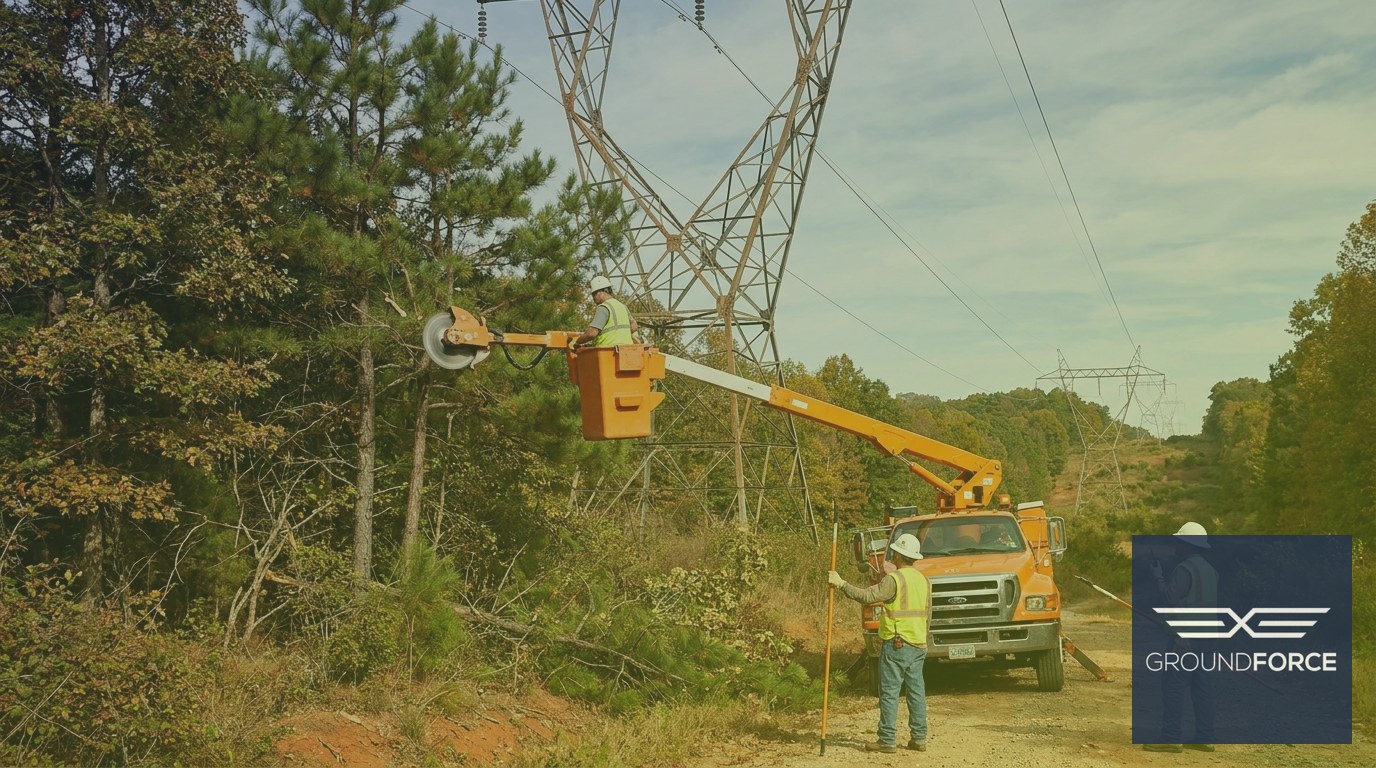
NERC FAC-003 governs electric utility vegetation management because vegetation contact causes transmission outages. NERC (2025) identifies ineffective vegetation management as a major cause of the August 14, 2003 Northeast blackout, the event that led NERC to formalize transmission vegetation management programs and reporting requirements. NERC (2025) also reports 35 vegetation-related transmission outages in 2024 caused by vegetation contact from outside the right-of-way, with 86% tied to weather-related activity. According to TRC Companies (2025), FAC-003-5 became enforceable on April 1, 2024, and brought Generator Owners explicitly under the standard alongside Transmission Owners. ReliabilityFirst, a NERC Regional Entity, reports that FAC-003 violations have carried the highest average penalty per violation of any non-CIP NERC Reliability Standard since 2020.
Georgia corridors compound this regulatory exposure with ecological variety. Piedmont forest segments require control of fast-growing hardwoods, wetland margins restrict herbicide selection and application timing, and open rights-of-way need sustained mowing or selective treatment. A single prescription cannot cover an entire corridor.
Integrated vegetation management for utilities prioritizes low-growing, compatible plant communities that suppress tall-growing incompatible species over the long term, which reduces re-treatment frequency across the corridor. The industry-specific utility vegetation guide details how Georgia utilities structure these programs.
Telecommunications tower sites share some utility-sector characteristics, including access corridor clearing and equipment pad maintenance, but tower sites fall under different regulatory frameworks. Vegetation height limits and sight-line requirements around the tower base also differ from transmission corridor specifications.
What are the vegetation management requirements specific to airports?
Airport vegetation management is governed by FAA Advisory Circular 150/5200-33, which specifies wildlife-deterrent habitat standards within the airport influence area. The circular requires airports to hold grass height between 7 and 14 inches, remove wildlife food and cover attractants, and restrict airside treatment methods.

According to the Federal Aviation Administration (2020), Advisory Circular 150/5200-33C governs hazardous wildlife attractants on or near airports, and compliance is mandatory for every airport that has received federal assistance or holds authority to impose a Passenger Facility Charge. The Federal Aviation Administration (2025) reported total civil aviation wildlife strike costs of $1.48 billion for the period from 1990 to 2023, with adjusted losses potentially reaching $300 million per year.
A compliant airside vegetation program meets three requirement sets:
- Wildlife-deterrent height targets. Programs maintain grass between 7 and 14 inches to deter bird and mammal attractants. The height target is deliberate: the FAA specifies a moderate range because very short turf attracts more birds than mid-height grass, so airside programs suppress attractive habitat rather than mow turf short.
- Attractant elimination. Programs remove seed heads, berry-producing shrub species, tall grass cover, shrub thickets, and standing water in low vegetation. According to Redbird Flight Simulations (2024), the FAA identifies waterfowl, gulls, and raptors as the top bird strike risk species in the United States, and each group feeds or shelters in one or more of these habitat types.
- Operational restrictions. Treatment on or adjacent to airside surfaces must follow FAA and airport authority limits on equipment access, chemical use, and operational timing, so applicators schedule work windows with airport operations staff.
Airport managers can evaluate site-specific obligations through the deep-dive airport vegetation reference guide, which documents attractant control and compliance procedures for airfield environments. Ground Force provides airport vegetation management services in Georgia, covering grass height control, attractant removal, and airside treatment scheduling under FAA and airport authority requirements.
How does vegetation management affect solar energy facilities?
Solar farm vegetation management affects energy production yield when panel shading from uncontrolled vegetation reduces photovoltaic output. According to Solarif, one shaded cell can cut an entire panel’s output by 50% or more because series-connected cells limit total current to the weakest cell. Vegetation control on a solar site is a revenue-protection function, not a cosmetic task.
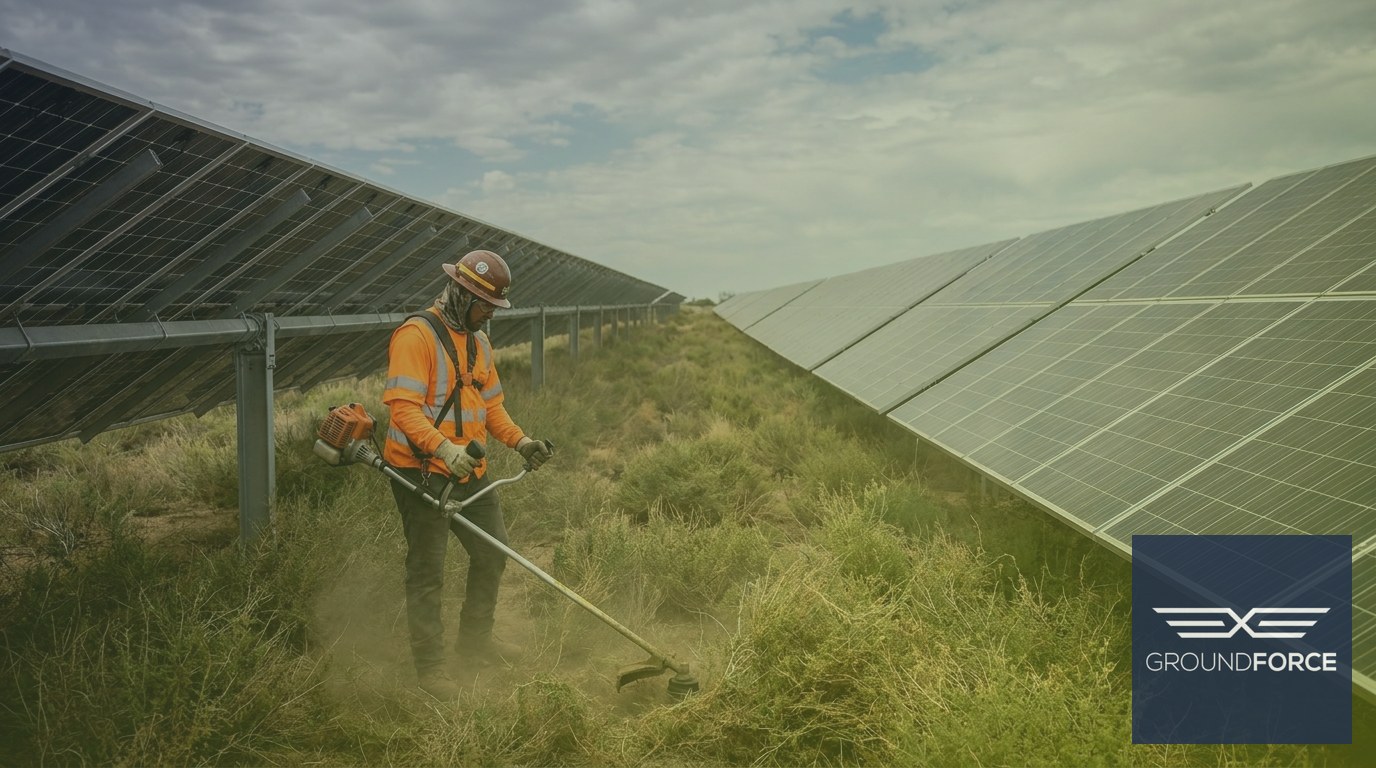
Vegetation management shapes a solar facility’s performance and compliance at three points:
1. Energy yield during operations. Uncontrolled growth shades panels and directly reduces output. Solarif also reports that intermittent shading from swaying vegetation causes power fluctuations that stress electrical components and reduce overall system efficiency.
2. The construction-to-operations transition. Construction-phase erosion control, typically mandated by an NPDES permit, ends at commissioning, and a multi-decade operational ground-cover program begins. The two scopes demand different expertise, and contracts written only for construction leave the operational program unscoped.
3. Pollinator compliance. State incentive programs and offtake agreements increasingly require pollinator-friendly ground cover, so the contractor must establish and maintain native forb mixes under and around the panels.
Some Georgia developers pursue dual-use agrivoltaic configurations where managed grazing or pollinator habitat coexists with energy production. This emerging practice changes the vegetation management brief substantially and requires a contractor with ecological knowledge, not just mowing capacity.
Solar farm operators commonly underestimate operational-phase vegetation costs because contracts focus on construction-phase erosion control. The ongoing ground-cover program, typically 20 to 25 years of panel-level clearance, is the larger lifetime cost and must be scoped at project inception. Ground Force details clearance cycles, native seed mix selection, and inspection schedules in the industry-wide solar farm vegetation practices guide.
What vegetation management challenges are unique to stormwater retention ponds?
Stormwater retention ponds face three unique challenges: emergent vegetation that destroys hydraulic capacity, aquatic weeds that only licensed applicators may treat, and bank erosion that threatens structural integrity. Stormwater retention pond vegetation management is required by Georgia EPD NPDES stormwater permits, which mandate functional pond maintenance to protect downstream water quality.
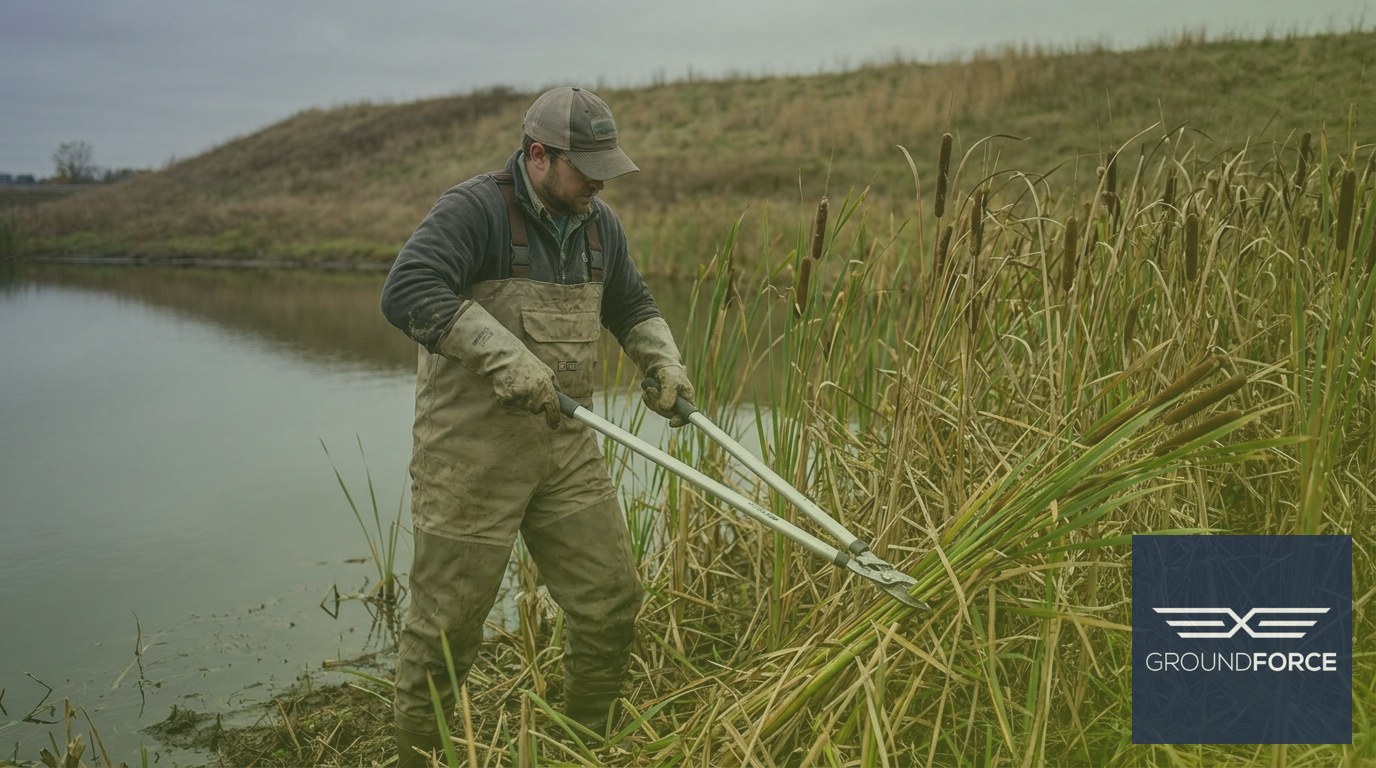
Property managers frequently mistake retention pond vegetation work for aesthetic landscaping. The misconception carries regulatory consequences. Unmanaged cattails and phragmites reduce pond storage capacity and constrict hydraulic flow, and that loss directly triggers stormwater permit violations. The Georgia Environmental Protection Division administers the NPDES permit program in Georgia under EPA authorization, according to the 2026 Addison Excavations guide to Georgia NPDES permitting, and a stormwater BMP inspection in Georgia includes a visual assessment of vegetation health as a required line item, according to Exact Stormwater Management.
Aquatic and emergent vegetation control covering cattails, phragmites, duckweed, and algae requires licensed aquatic herbicide applicators and adherence to Georgia’s buffer and setback rules. Under Georgia NPDES General Permit GAR100001, buffer zones prohibit thinning or trimming of protective vegetative cover, according to the Georgia Environmental Protection Division (2023), and Georgia EPD enforces stream buffer requirements under the Erosion and Sedimentation Act with ongoing BMP maintenance for permitted facilities, according to Exact Stormwater Management. Retention ponds serving industrial properties require additional care in herbicide selection, because not every labeled aquatic product is appropriate when the receiving water contains industrial-use runoff contaminants.
Erosion on pond banks and embankments creates both a structural integrity risk and a sediment-loading compliance issue. Resolution requires vegetation stabilization with deep-rooted plantings rather than clearing alone. The complete pond management reference guide documents inspection schedules and stabilization specifications for these conditions, and the Ground Force retention pond service page describes the aquatic treatment and bank repair programs available to Georgia commercial sites.