Hiring an unqualified vegetation management contractor in Georgia exposes commercial and municipal clients to pesticide liability, property damage, and regulatory violations. A proposal or sales pitch rarely reveals the difference between a qualified and an unqualified vegetation management contractor. Structured pre-hire evaluation of licenses, insurance, experience markers, and behavioral red flags protects Georgia property managers and procurement officers from unqualified vegetation management contractors.
What should you evaluate first when screening a vegetation management contractor in Georgia?
Georgia buyers should evaluate a vegetation management contractor in three sequential layers: legal standing first, verified experience second, and behavioral or contractual red flags third. A contractor that fails the legal layer is disqualified regardless of experience, reputation, or price.

Layer one covers legal standing: current Georgia licensure for the category of work being bid, plus insurance certificates that show the coverage types commercial and municipal contracts require. Layer two covers verified experience: documented projects, reference contacts, and crew and equipment capacity that match the scope of the buyer’s site. Layer three covers red flags, such as reluctance to produce certificates, vague scope language, or pressure to sign before verification. The order matters because the layers carry different weights. Legal standing is binary. A contractor either holds valid licenses and insurance or does not, and no depth of experience compensates for missing coverage.
Proposals and sales pitches systematically hide layer-one gaps. Price competition pushes contractors to lead with a low number and polished crew descriptions, while license numbers and policy limits sit in attachments that buyers rarely read. Most facility and procurement managers in Georgia are unfamiliar with state licensing rules for vegetation work, so a missing or expired credential passes unnoticed when the pitch emphasizes equipment fleets and recognizable client logos.
Price alone cannot separate a cheap-efficient contractor from a cheap-uninsured one. An efficient vegetation management contractor lowers bids through route density, trained crews, and owned equipment. An uninsured or unlicensed contractor lowers bids by skipping premiums, license fees, and compliance labor. Both proposals arrive at similar numbers, and the difference only surfaces when the buyer checks legal standing directly.
This three-layer sequence anchors the screening stage of the broader buyer’s guide for Georgia commercial vegetation management, and two resources carry each layer deeper. The contractor credentials and red flag guide details layers one and three: which Georgia license categories apply to which types of work, what valid insurance documentation looks like, and which contract behaviors predict disputes. The pre-hire screening questions for Georgia vendors covers layer two, supplying the structured questions that convert a contractor’s claimed experience into verifiable project history and reference checks.
What licenses does a Georgia vegetation management contractor legally need?
Georgia law requires two credentials for applying pesticides to another person’s property for a fee: a Commercial Applicator License held by the individual applicator and a Pesticide Contractor License held by the business, according to the Georgia Department of Agriculture.

The Georgia Department of Agriculture issues these licenses by category. Category 27 (Right-of-Way Pest Control) covers commercial applicators maintaining public roads, electric powerlines, pipelines, and railway rights-of-way, while Category 23 (Forest Pest Control) and Category 24 (Ornamental and Turf) cover other common vegetation sites. Georgia vegetation management contractors must hold a Georgia Department of Agriculture pesticide applicator license for commercial and right-of-way categories.
The Certified Training Institute confirms that the Commercial Applicator License belongs to the individual applicator, while the Pesticide Contractor License covers the company. A licensed owner can legally deploy unlicensed crew members for application work, so buyers must ask whether the licensed applicator is physically present on each job, not merely employed by the firm. The University of Georgia Cooperative Extension requires at least one full-time licensed applicator at each business location to supervise all applications.
Buyers verify both credentials through the Georgia Department of Agriculture’s public license lookup tool; the required licenses for Georgia vegetation contractors lists the category codes a bid should show. Proposals should disclose applicator license numbers, and the how to read a vegetation management proposal shows where those credentials appear.
Commercial clients are exposed to pesticide liability and regulatory violations when they hire unlicensed applicators, and they share civil liability for improper application. Subcontractors operating under a parent company’s license, common among national chains using regional crews, require the same verification as direct hires: the subcontractor performing the application must be licensed or supervised by a licensed applicator physically present at the work site. PLANET, now the National Association of Landscape Professionals, and ISA arborist credentials are value-adds, not substitutes for the legally required Georgia Department of Agriculture pesticide applicator license.
What insurance should a Georgia vegetation management contractor carry?
A Georgia vegetation management contractor should carry three coverage types: general liability insurance at a minimum of $1 million per occurrence, workers’ compensation when the contractor employs three or more people, and pesticide applicator liability for chemical drift or misapplication damage.

General liability insurance pays for bodily injury and property damage a contractor’s operations cause on a commercial site, and $1 million per occurrence is the accepted minimum for commercial work in Georgia. Standard general liability policies often exclude pesticide drift and chemical misapplication claims, a gap that pesticide applicator liability insurance closes.
Workers’ compensation insurance protects both the crew and the property owner. Georgia law (O.C.G.A. Section 34-9-203) requires every employer with three or more employees to carry coverage, effective January 1, 2026, according to Work Injury Columbus (2026). The Georgia State Board of Workers’ Compensation counts officers and members of incorporated companies and LLCs toward the employee total, and Lawsuit Information Center (2025) reports the threshold includes full-time, part-time, and seasonal workers. Sole proprietors with no employees are exempt, but buyers hiring small operators should confirm the exemption status in writing. When a contractor lacks workers’ compensation and a worker is injured on site, liability transfers to the property owner or client; The Hartford confirms an uninsured business becomes liable for any on-the-job injury.
A certificate of insurance alone is not enough. The standard ACORD 25 certificate is a point-in-time document, and BCS (2026) confirms the form guarantees cancellation notice only when the policy is specifically endorsed. The current form states notice “will be delivered in accordance with the policy provisions,” according to IA Magazine (2026). Buyers should require additional insured status plus a policy endorsement granting the certificate holder the same cancellation notice rights as the named insured, which Lexology identifies as the safest protection.
Buyers can verify each coverage type against the insurance requirements for vegetation contractors before signing a contract.
What experience markers distinguish a qualified vegetation management contractor?
A qualified vegetation management contractor proves experience on the buyer’s specific site type, produces documented treatment records from prior programs, supplies verifiable commercial or municipal references in Georgia, and holds IPM training that governs chemical decisions.
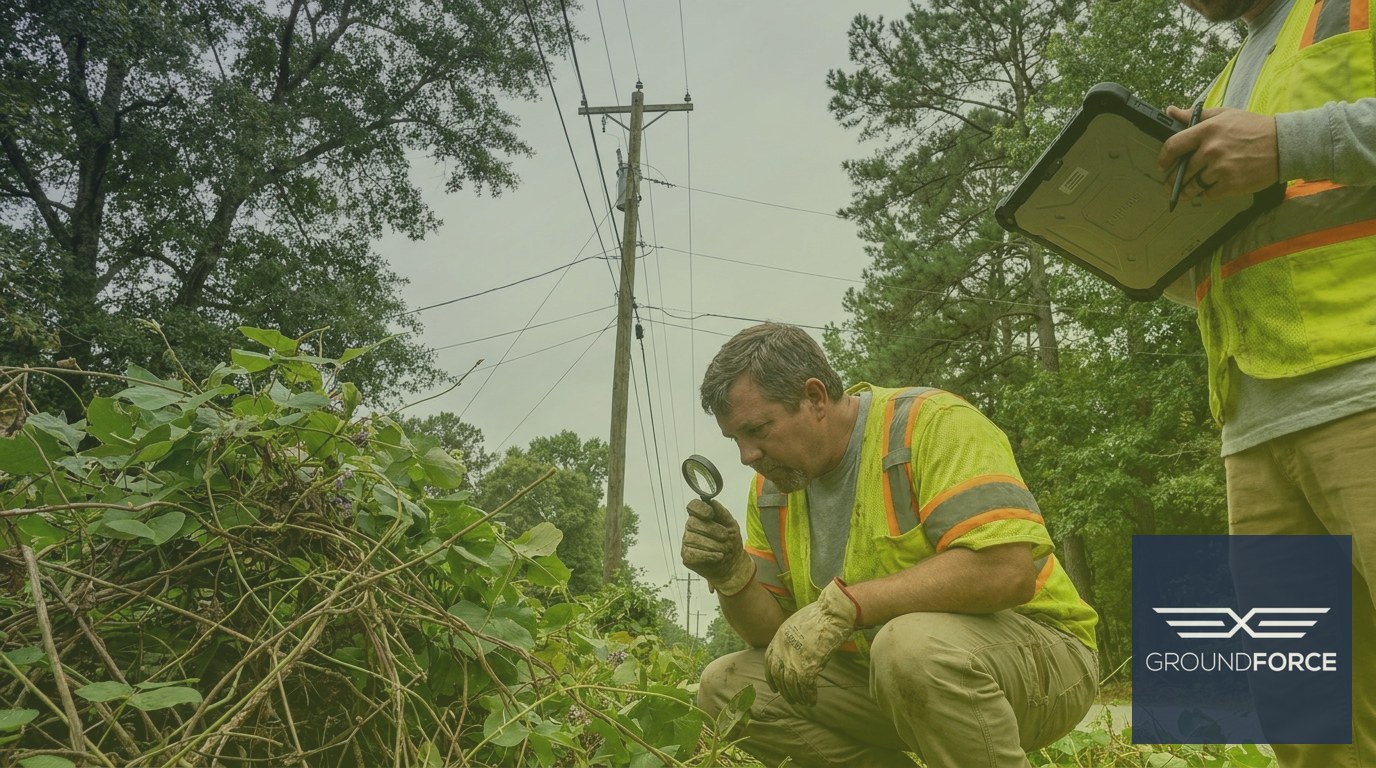
Site-type experience outweighs tenure. Utility corridors, municipal rights-of-way, commercial retention ponds, and industrial sites each demand different application equipment, chemical registrations, and treatment protocols, so a contractor with decades of general work may still be unqualified for a municipal right-of-way. Years in business measures survival, not site competence.
Documented treatment protocols and site records are a marker of contractor experience and professional accountability. Qualified contractors produce prior treatment logs showing dates, products, rates, and site conditions; references alone cannot confirm that a program was executed as specified.
Eco-friendly vegetation management contractors demonstrate qualification through IPM training, reduced-chemical protocols, and documented environmental outcome tracking. IPM-trained contractors practice Integrated Vegetation Management, which requires an initial inventory of existing vegetation before any treatment strategy is developed, according to The Utility Expo (2025). Arboriculture & Urban Forestry, the journal of the International Society of Arboriculture, reports that IVM programs group treatments into mechanical, chemical, cultural, physical, biological, and ecological categories, with two or more categories typically used on one site. A chemical-first operator skips the inventory and defaults to broadcast spraying; the same journal reports that a selective vegetation management approach can halve herbicide use compared with broadcast spraying.
References must come from similar commercial or municipal accounts in Georgia, not residential clients, because Georgia climates and site conditions make regional histories more predictive. The choosing regional over national firms comparison favors contractors with documented local site histories, and contractors who track environmental outcomes across seasons can evidence the long-term benefits of sustainable vegetation practices instead of merely claiming them.
What are the red flags that signal an unqualified vegetation management contractor?
A vegetation management contractor is unqualified when the contractor deflects license verification, gives verbal-only pricing, cannot name the property owner as additional insured, or quotes without a site visit. Vague contract scope and verbal-only pricing are a primary red flag distinguishing unqualified from qualified vegetation management contractors.

- License evasion. The contractor cannot produce a current Georgia Department of Agriculture license number on request, or deflects the question. The Georgia Department of Agriculture asks the public to report unlicensed pesticide applicators through an official reporting form; red flags in contractor licensing verification covers that confirmation process.
- Unenforceable pricing. The contractor provides verbal-only pricing or a scope of work so vague it cannot be enforced, such as ‘we’ll treat the vegetation on your property.’ The pricing patterns in decoding lowball contractor quotes show how vague scope language hides change orders and skipped treatments.
- Insurance resistance. The contractor refuses to name the property owner or municipality as additional insured, or cannot produce an insurance certificate within 24 hours of the request.
- No site assessment. The contractor has no documented treatment protocols, skips the site visit before quoting, or proposes a single chemical for every site. The checklist in identifying underqualified vegetation contractors treats the missing site visit as the clearest operational warning sign.