
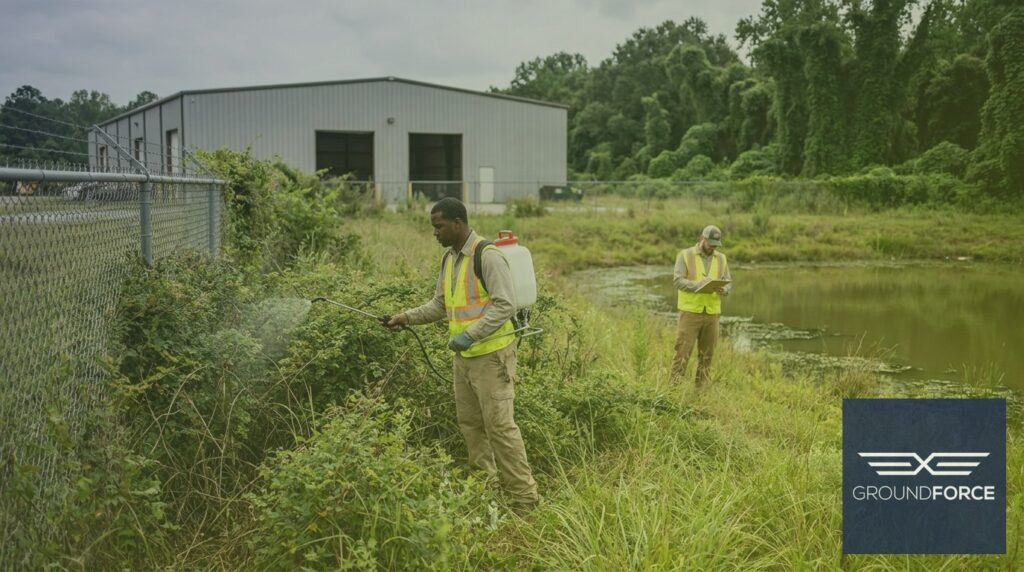
Develop a long-term vegetation management plan for commercial properties by building a multi-year documented program that integrates site assessment, goal-setting, treatment scheduling, ecological monitoring, and regulatory documentation across Georgia commercial and industrial land. Georgia commercial properties face compounding vegetation pressures: aggressive invasive species, stormwater compliance requirements, utility corridor encroachment, and shifting seasonal conditions. A single-season treatment cycle cannot resolve these pressures. A structured multi-year vegetation management plan separates reactive maintenance from proactive land stewardship.
What Is a Long-Term Vegetation Management Plan for Commercial Properties?
A long-term vegetation management plan is a multi-year documented program that integrates site assessment, goal-setting by zone, treatment scheduling, ecological monitoring, and regulatory documentation to maintain and improve vegetation conditions across Georgia commercial and industrial properties over multiple growing seasons.
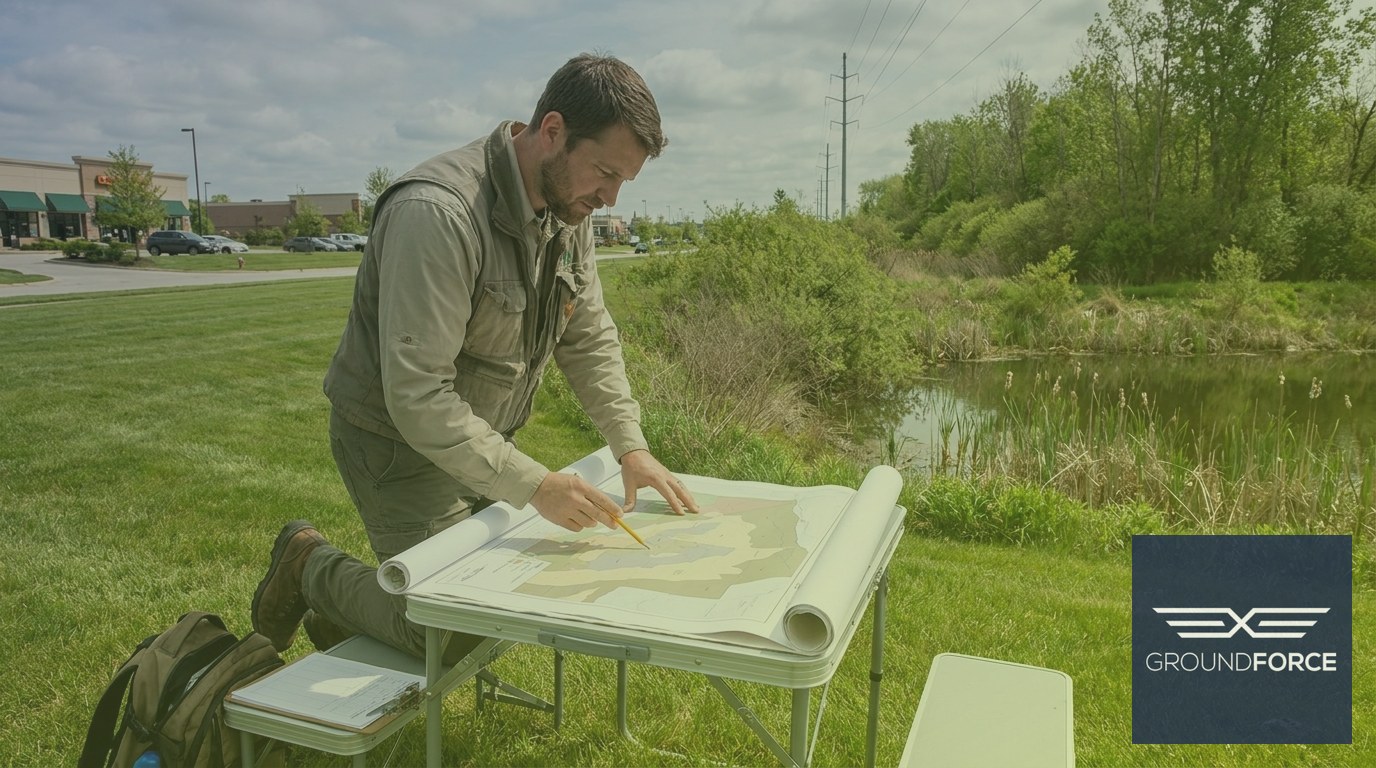
A plan is not a recurring service schedule. A service schedule repeats identical tasks on fixed dates; the long-term vegetation management plan commercial properties adopt records a baseline species inventory, maps problem zones, sequences treatments by priority, sets measurable success thresholds for each zone, and schedules review triggers that force revision when conditions change. Properties that lack measurable success thresholds and scheduled review triggers underperform on invasive suppression and compliance outcomes, because no one measures whether vegetation conditions improve and no mechanism forces the program to change.
A long-term vegetation management plan contains five core components:
- Site assessment. A baseline species inventory, mapped management zones, and soil and drainage conditions.
- Goal-setting by zone. Measurable success thresholds per zone, such as target native cover or invasive density limits.
- Treatment calendar. Sequenced treatments timed to species growth cycles, with Integrated Pest Management guiding method selection.
- Monitoring protocol. Scheduled inspections that score each zone against the zone’s thresholds.
- Documentation system. Treatment logs and monitoring records that support stormwater permits and regulatory audits.
Annual maintenance contracts differ from a plan in scope, documentation depth, and ecological continuity. A contract covers one season of tasks and ends; a plan carries ecological continuity across years, because each season’s monitoring data shapes the next season’s treatments. Plan documentation also runs deeper than invoices, since baseline maps and trend measurements accumulate into evidence of compliance.
Georgia conditions make multi-year planning necessary. The University of Florida IFAS Extension identifies cogongrass as one of the worst weeds in the world, and Woodland Works reports that cogongrass burns hot enough to kill mature pine trees that survive ordinary fires. Invasive pressure of that severity, combined with stormwater compliance duties and the seasonal complexity of a long growing season, defines the long-term Georgia land management context that commercial plans must address.
Integrated Pest Management gives the plan a disciplined treatment methodology. Integrated Pest Management applies an assess, intervene, monitor, adjust cycle to vegetation control, favoring mechanical removal and biological controls and reserving herbicide for targeted spot treatments. The assess, intervene, monitor, adjust cycle matches the plan’s scheduled review triggers, so every review becomes an Integrated Pest Management adjustment point rather than a paperwork exercise. Integrated Pest Management also supports Georgia regulatory alignment: the preference for minimal, precisely timed herbicide use produces the treatment logs and justification records that Georgia stormwater permits and audits demand.
The plan functions as a living document. Property managers and the vegetation management provider revise the plan at defined intervals, with annual reviews and post-storm reassessments updating zone goals as monitoring data accumulates. Monitoring drives every revision.
Ground Force, a commercial vegetation management provider in Georgia, builds multi-year service agreements around the plan’s review cycle, so each service visit feeds the monitoring protocol rather than repeating a static task list.
How does a professional site assessment form the foundation of the plan?
Site assessment for vegetation management precedes all other components of a vegetation management plan, and professional assessors record species, problem areas, soils, hydrology, and vegetation condition as the fixed, documented baseline that guides every later treatment, schedule, and monitoring decision.
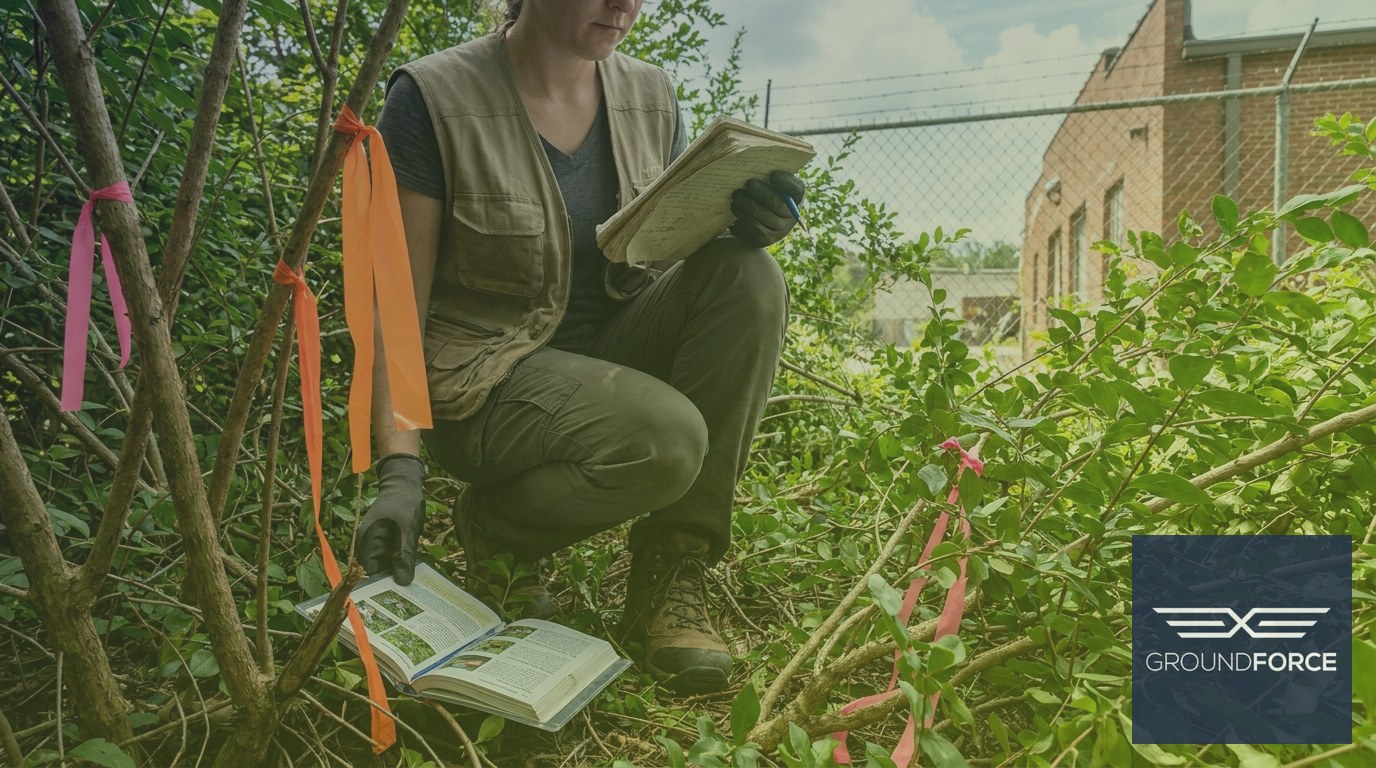
A professional assessment on Georgia commercial land follows four steps:
1. Species inventory. Assessors catalog every plant species on the property, flagging invasives such as Chinese privet and kudzu alongside desirable native cover. 2. Problem area mapping. Assessors plot infestations, erosion-prone slopes, and access constraints onto scaled site maps. 3. Soil and hydrology observations. Assessors record drainage patterns, standing water, compaction, and moisture gradients that drive vegetation behavior. 4. Condition scoring. Assessors grade existing vegetation so the plan can track improvement across years.
These four outputs define what a professional site evaluation covers, and each output feeds a later plan component: species lists determine control methods, priority-zone maps sequence multi-year treatments, and condition scores set the monitoring baseline.
Self-assessed plans consistently miss cryptic invasives and drainage-related problems. Kudzu shows why: the Georgia Forestry Commission and Georgia Tree Council report that kudzu stems reach 4 inches in diameter while semi-woody roots extend 3 to 16 feet deep, so a surface walkthrough misses the root mass that determines control effort. According to the University of Georgia College of Agricultural and Environmental Sciences, Chinese privet covers approximately 3.2 million acres in Southern forests while kudzu covers an estimated 227,000 acres, so both species are common enough on Georgia commercial land that untrained reviewers routinely overlook them. Property staff also tend to read dying vegetation as a plant problem, while trained assessors trace the decline back to the compaction and drainage failures documented during hydrology observations.
How should vegetation management goals be set across different areas of a commercial property?
Managers set vegetation management goals by zone type, not by property as a whole. Georgia commercial properties contain distinct vegetation zone types, including turf areas, buffer zones, pond banks, perimeters, and utility corridors, and each zone requires differentiated management goals, its own success metric, and a documented target.
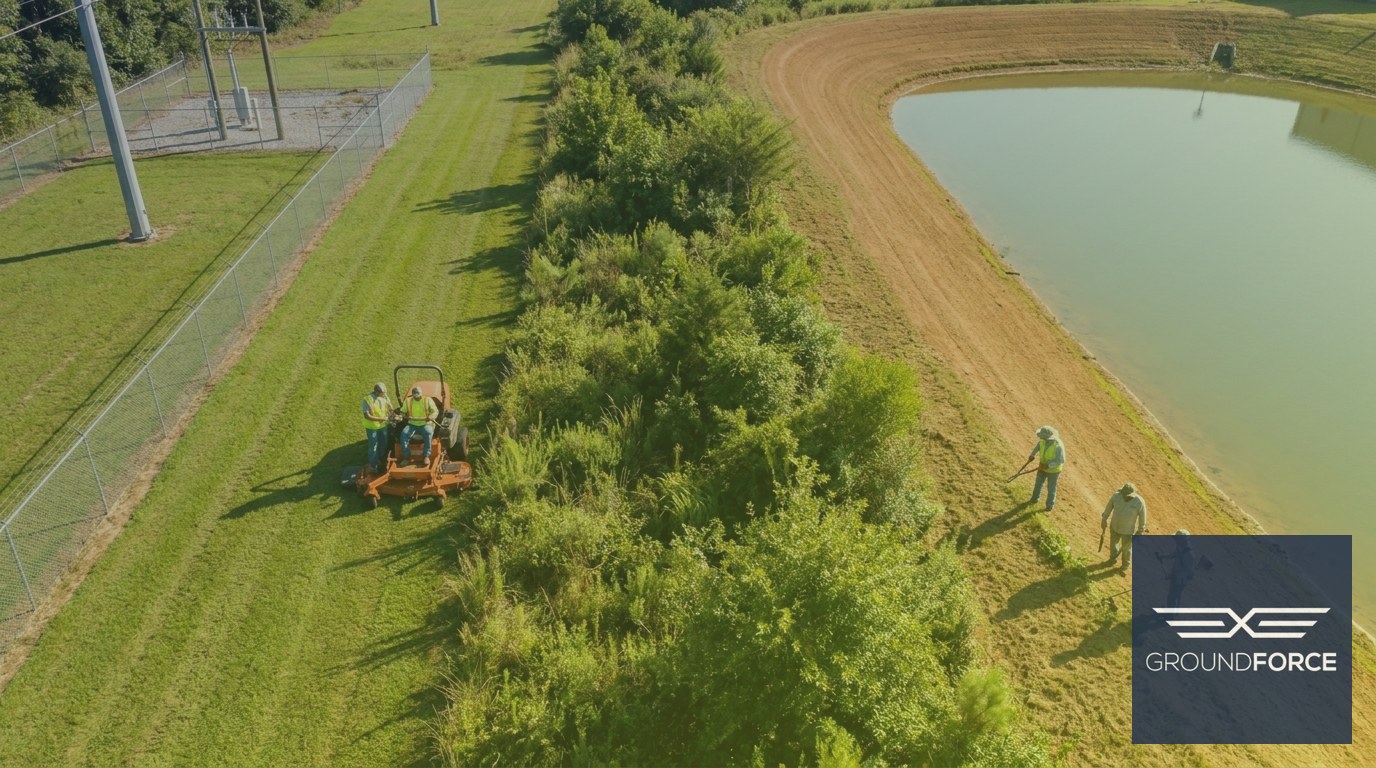
1. Map zones during the site assessment. The assessment divides the property into turf corridors, pond banks, stormwater buffers, perimeter buffers, and utility corridors. Vegetation safety management near structures, fencing, and signage is a distinct planning objective, and the assessment identifies root-damage and liability exposure in those areas and assigns those areas their own zone goals.
2. Assign each zone its own success metric. Turf corridor goals target uniformity and sight-line safety. Pond bank goals target erosion control and stormwater compliance: Georgia’s Erosion and Sedimentation Act requires a 25-foot undisturbed vegetated buffer along most state waters, according to Exact Stormwater Management, and Georgia Environmental Protection Division permit conditions prohibit thinning or trimming vegetation within protected buffers. Perimeter buffer goals target invasive suppression, which the Georgia Forestry Commission quantified in 2023: cogongrass detections have reached 77 Georgia counties since 2007, with 88% of known spots now inactive under the state treatment program. Utility corridor goals target clearance reliability.
3. Document targets zone by zone. The practice of setting vegetation management goals by property area produces the zone-level records that site-specific industrial vegetation management planning uses during compliance audits and budget reviews.
4. Reject blanket objectives. A single objective across all zones fails outcomes at both ends, because a turf standard leaves pond banks exposed to erosion while a buffer standard over-maintains turf. A blanket objective also wastes measurable budget on low-priority zones while high-compliance zones receive insufficient funding.
What does a multi-year treatment schedule look like for Georgia commercial properties?
A multi-year treatment schedule for Georgia commercial properties sequences herbicide applications and monitoring across consecutive growing seasons, because invasive species suppression requires multi-year sequential treatment cycles rather than single-season intervention. Each year carries a target species, a treatment method, and a measurable benchmark.
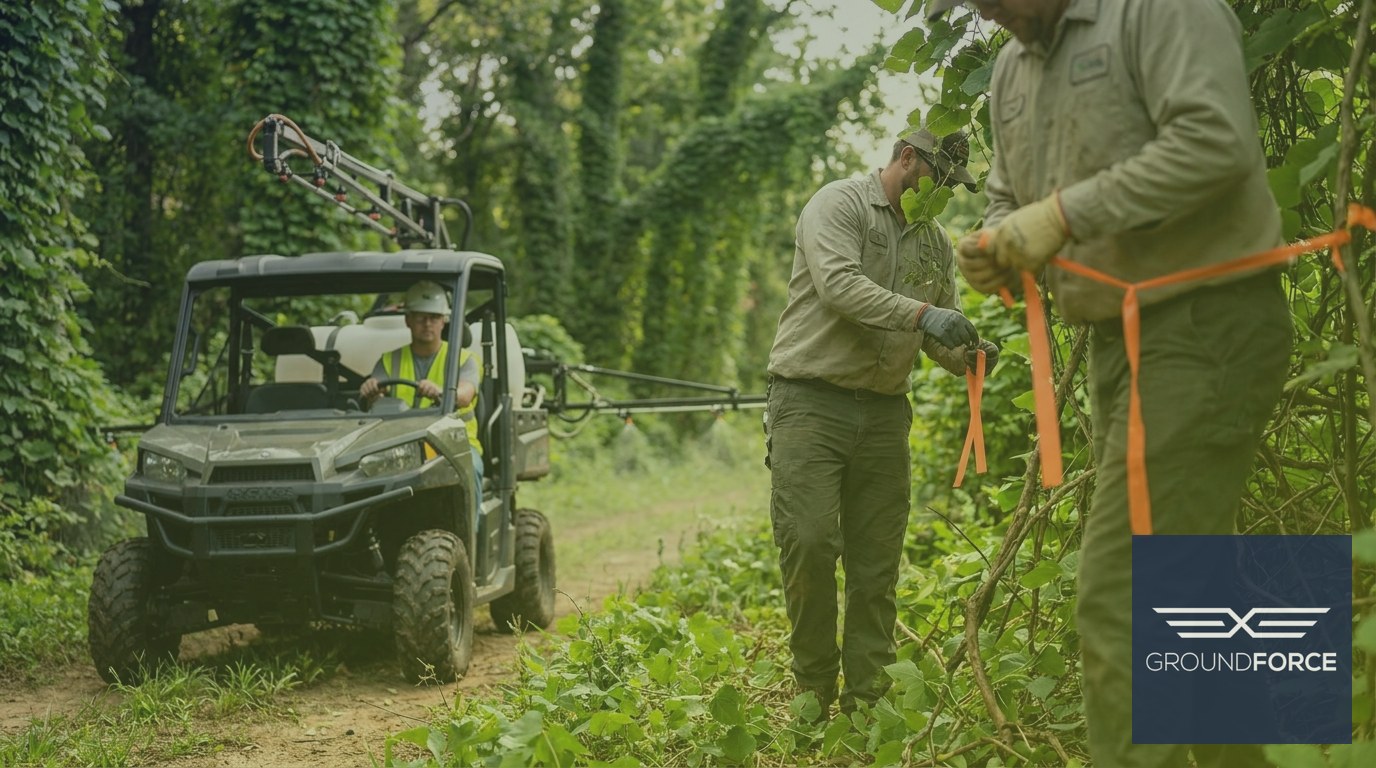
Year one delivers baseline suppression of high-priority invasives and establishes treatment benchmarks for stem density, percent canopy cover, and resprout rate. Georgia’s kudzu, Chinese privet, and cogongrass survive single applications through deep root reserves and dormant seed banks. Kudzu, Chinese privet, and cogongrass each require a minimum of three consecutive growing-season treatment cycles, so a one-year contract cannot produce a meaningful outcome. A 2026 Alabama Cooperative Extension System publication reports that kudzu control often takes several years of aggressive treatment, especially for patches that have persisted for decades.
Year-one results often look worse before conditions improve. Initial treatment opens the canopy, sunlight reaches the soil, and the dormant seed bank germinates, so new invasive seedlings appear even as mature plants die. According to a 2015 Scientific Research Publishing study, eradication of kudzu should not be expected from any herbicide with a single application.
Years two and three target resprouting stems and seed-bank germination with follow-up spot treatments, while crews reinforce native or desired vegetation through seeding and selective release. Woodland Works reports that a severe kudzu or cogongrass infestation typically requires an initial heavy treatment followed by two to three years of follow-up spot treatments to exhaust the seed bank and root reserves.
Georgia’s seasonal calendar sets treatment timing and cost efficiency. Dormant-season applications from November through February frequently deliver higher cost efficiency per acre for woody invasive suppression, because herbicide translocation in dormant stems is more predictable and competing vegetation interference is reduced, an approach known as dormant-season vegetation management. Growing-season foliar treatments then catch resprouts at full leaf. The phased steps in a vegetation management plan document each cycle’s timing and target so commercial property managers can budget across the full multi-year horizon.
How do you monitor and measure whether your vegetation management program is working?
Property managers and contractors use vegetation management monitoring to evaluate program effectiveness and trigger plan adjustments. Monitoring tracks invasive cover, species establishment, erosion, and compliance outcomes through annual audits and seasonal spot checks, and the resulting data drives revisions when site conditions change.
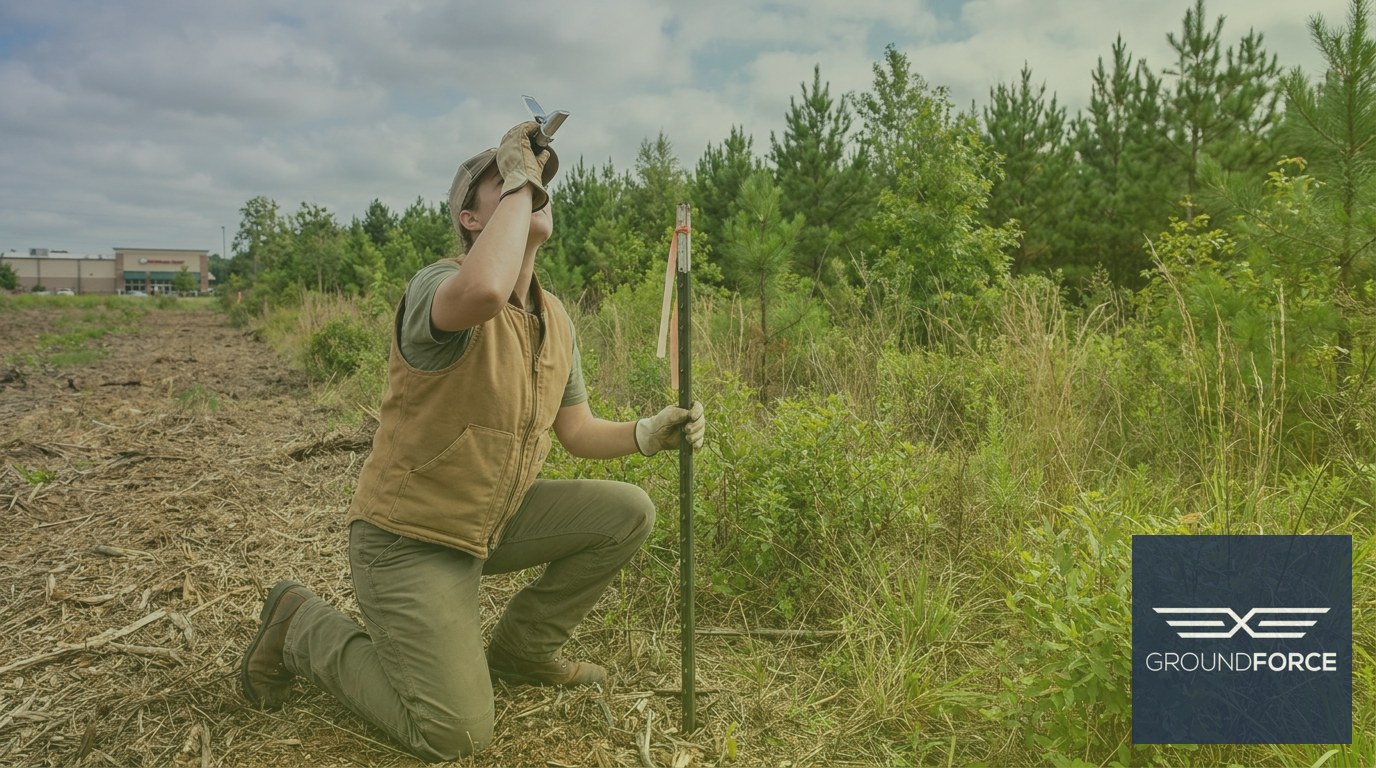
1. Establish a measurable baseline. The first audit maps existing invasive cover, desired species, and erosion points across the Georgia property, giving every later measurement a fixed reference. Treatment benchmarks keep targets realistic: according to a 2016 USDA Agricultural Research Service study, optimized herbicide programs killed 99 to 100 percent of kudzu during the second treatment year, while an organic program killed 91 percent after year one and 95 percent after year two.
2. Track four core metrics. Crews monitoring vegetation program effectiveness record percent invasive cover reduction, desired species establishment rate, erosion incidence, and compliance inspection outcomes at every visit.
3. Schedule audits and spot checks. An annual site audit documents full-site conditions, while seasonal spot checks at defined trigger points, such as after major storms, at the start of the growing season, and following treatment windows, catch problems between audits. Spot checks stay brief. The end-of-year site audit is the most practical trigger point for annual plan revision because it closes the treatment year’s documentation loop and produces the updated species map and priority list that drives next-year scheduling.
4. Act on what the data shows. Monitoring data signals when vegetation programs need strategic revision through three conditions: a new invasive species appears on the property, a Georgia or federal regulation changes treatment rules, or the property’s use shifts.
What documentation should commercial property owners maintain for their vegetation management program?
Commercial property owners should maintain four record types: treatment logs documenting dates, methods, products, and acreage; site maps dividing the property into treatment zones; monitoring reports recording vegetation response; and contractor certifications verifying current Georgia pesticide applicator licenses and required insurance coverage.
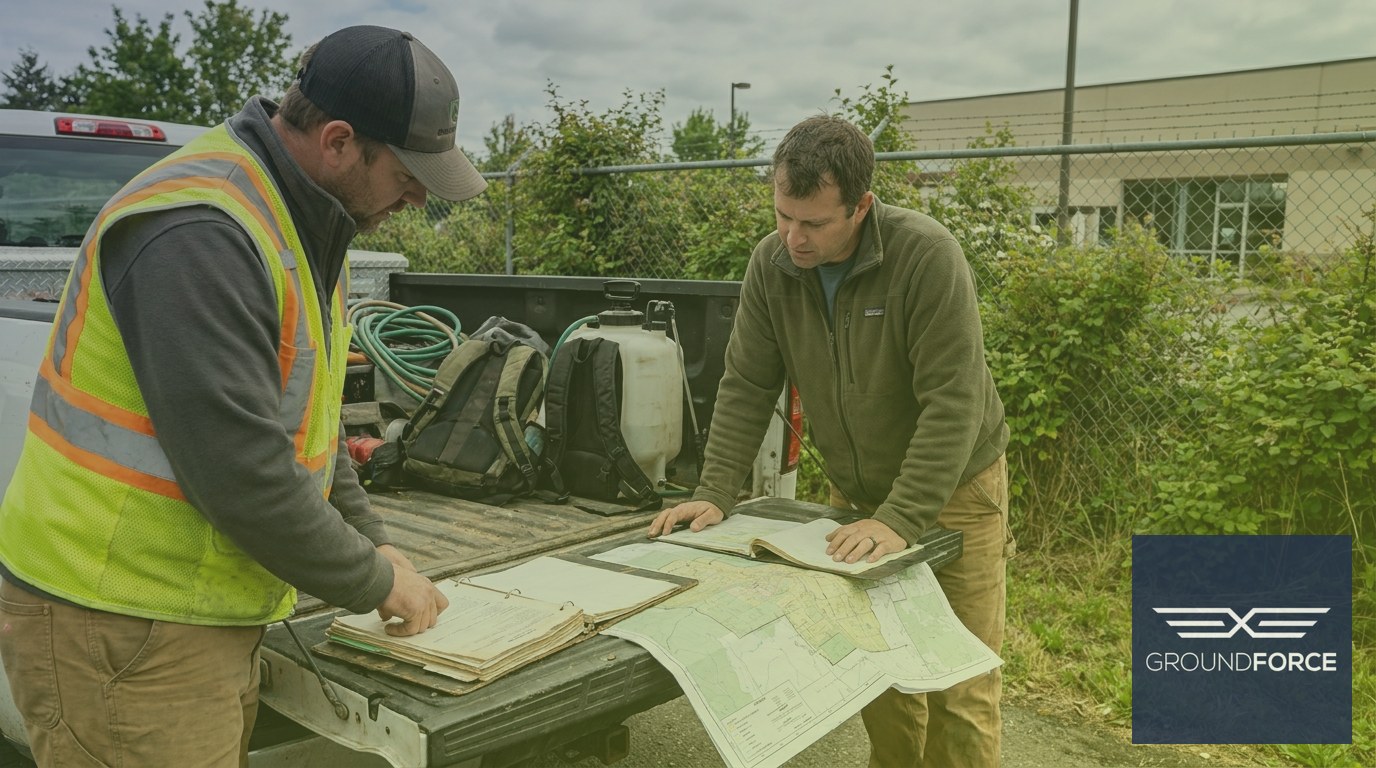
Treatment logs document each herbicide application, mechanical clearing, or prescribed treatment with dates, methods, products, and acreage. Site maps divide the property into treatment zones and track the condition of each zone over time. Monitoring reports record vegetation response, erosion indicators, and invasive species pressure after each treatment cycle. Contractor certifications verify that applicators hold current Georgia pesticide licenses and carry required insurance. Vegetation management documentation applies to regulatory compliance, insurance claims, and contract accountability for commercial and industrial properties.
Georgia EPD compliance drives much of the recordkeeping burden for commercial vegetation programs. According to Addison Excavations, any Georgia land-disturbing activity affecting one acre or more must hold NPDES permit coverage, maintain an active Stormwater Pollution Prevention Plan, and inspect controls within 24 hours of a qualifying rain event. Exact Stormwater Management reports that projects disturbing one or more acres must also develop an Erosion, Sedimentation, and Pollution Control Plan, and that stormwater BMP inspections must assess vegetation health, sediment accumulation, and erosion damage in a written report meeting EPD recordkeeping standards. Property owners who structure treatment and inspection records according to compliance reporting requirements for vegetation programs give EPD reviewers a consistent format for audit review.
Utility corridor owners face a distinct documentation duty: the federal reliability standard NERC FAC-003 and easement agreements require transmission owners to retain records showing vegetation clearance cycles, hazard tree removals, and contractor qualifications for work near transmission lines. Insurance carriers request similar records when vegetation-caused infrastructure damage triggers liability claims, since documented treatment history demonstrates reasonable care. Commercial real estate transactions increasingly treat multi-year vegetation records as due-diligence evidence, and properties with documented programs carry demonstrably lower risk profiles during acquisition review.
What are the advantages of a multi-year vegetation management contract over annual agreements?
A multi-year vegetation management contract covers more than one growing season on a Georgia commercial property. Multi-year vegetation management contracts lock in pricing, preserve contractor site knowledge, and reduce per-acre treatment intensity across each successive season on Georgia commercial properties. structuring extended vegetation management contracts around the plan’s review cycle ensures that pricing, site knowledge, and treatment intensity all align with documented ecological outcomes rather than a fixed task list.

- Compounding treatment efficacy. Year-one treatments establish baseline suppression of target species across the property. Year-two treatments are more targeted and less expensive than year-one treatments because baseline suppression is already established, so crews apply less herbicide and spend fewer labor hours per acre. Each successive season deepens baseline suppression, so year-three and later treatments target residual growth with still lower herbicide volumes and fewer labor hours than the season before.
- Cost predictability. A multi-year vegetation management contract locks in per-acre pricing and shields the property budget from herbicide and labor cost inflation. Locked-in pricing supports long-term vegetation management financial planning by converting variable treatment expenses into fixed budget lines across the full contract term.
- Contractor continuity. A contractor with multi-year site history knows the property’s species inventory and pressure zones, so crews detect new invasive introductions earlier and adjust treatment plans proactively. Early detection carries real financial weight: a 2021 peer-reviewed study in Science of the Total Environment found that biological invasions cost the Southeast United States $17.31 billion.
Sources
- Woodland Works, “Invasive Species Eradication | Kudzu & Cogongrass Control”
- USDA Agricultural Research Service, “A Faster Way to Get Rid of Kudzu” (2016)
- Exact Stormwater Management, “Stormwater BMP Services in Georgia”
- Addison Excavations, “Georgia EPD Stormwater Regulations: Complete Business Compliance Guide” (2026)