
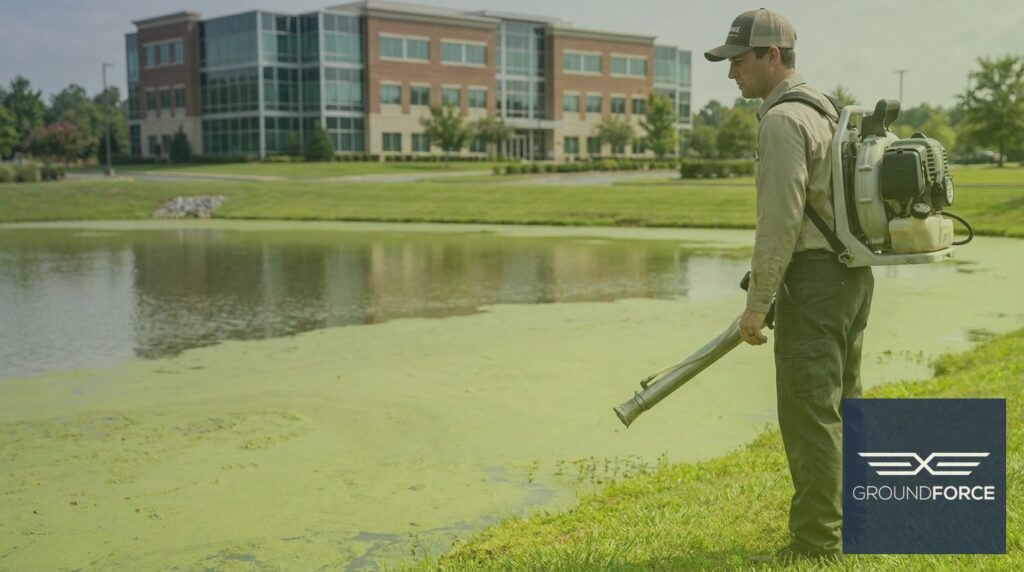
Algae blooms and excess nutrient loading convert Georgia stormwater retention ponds into compliance liabilities and aesthetic failures for HOAs and commercial property managers. Ground Force delivers licensed, integrated algae and nutrient management programs that restore pond health, satisfy Georgia stormwater permit requirements, and break repeat bloom cycles. Ground Force pairs algaecide application with nutrient source control, so treated ponds stay clear between service visits instead of rebounding weeks after a single treatment.
What causes algae blooms in Georgia stormwater retention ponds?
Nutrient loading causes algae blooms in Georgia stormwater retention ponds: excess nitrogen and phosphorus from fertilizer runoff and organic matter accumulation feed rapid algae growth, and Georgia’s warm, shallow, still pond water from April through October accelerates every bloom cycle.
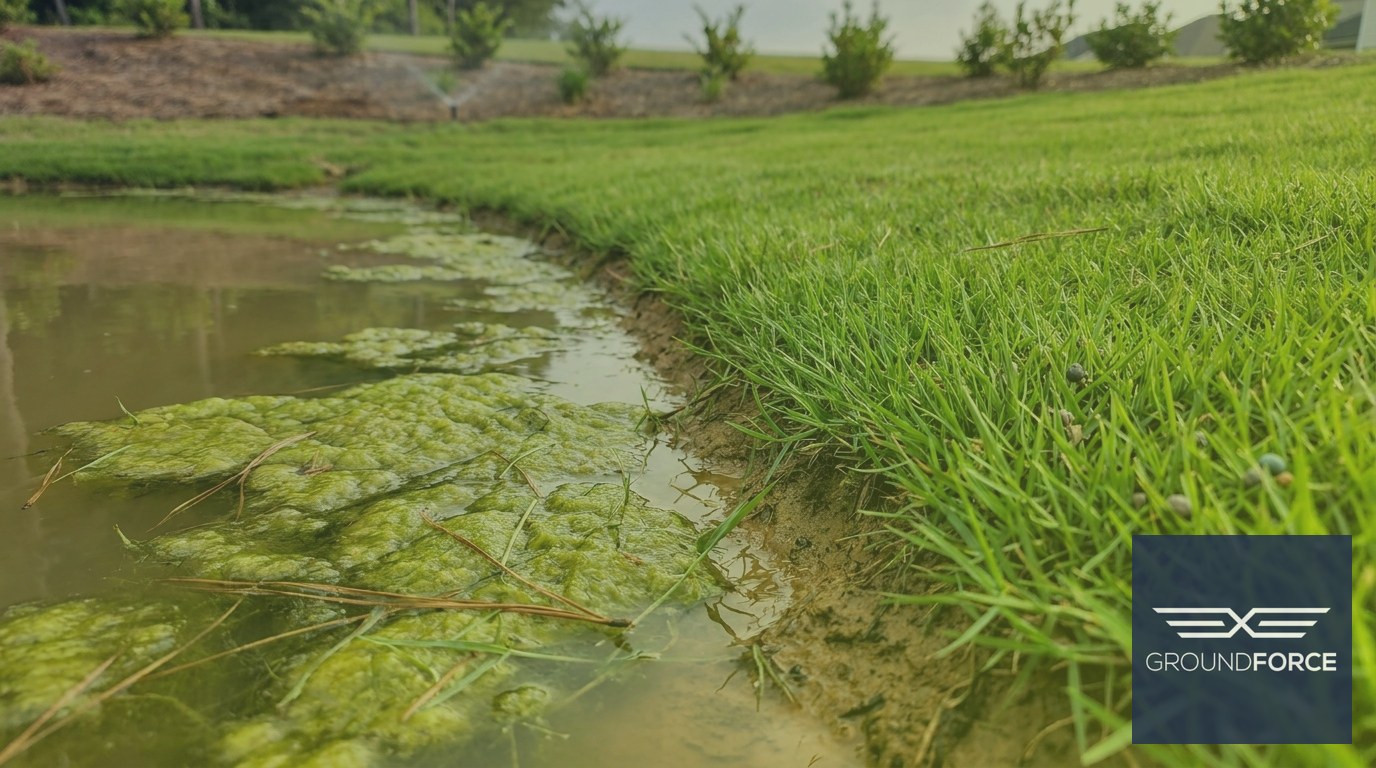
Algae bloom mechanics start with eutrophication, the over-enrichment of water by nutrients. The Washington State Department of Health confirms that nitrogen and phosphorus from fertilizers travel into lakes and streams and contribute to algal blooms, with phosphorus specifically promoting algae growth. A 2023 review in MDPI Water identifies stormwater runoff as one of the largest nutrient sources for freshwater bodies, making urban and suburban retention ponds prime environments for cyanobacteria. On Georgia commercial properties, the primary nutrient sources driving algae blooms are fertilizer runoff from manicured lawns and organic debris such as grass clippings and leaves washing into the pond. A 2024 Golfdom report documents that turfgrass management around ponds exacerbates eutrophication through exactly that combination of fertilizer nutrients and clippings. Ponds adjacent to golf courses or intensively fertilized commercial turf carry a higher baseline nutrient load than a typical HOA pond, so those ponds generally require more frequent monitoring and treatment scheduling.
Temperature is the second driver. The 2023 MDPI Water review recognizes eutrophication and temperature as the key factors controlling both bloom formation and toxin production. The American Animal Hospital Association reports that cyanobacteria thrives in warm, nutrient-rich water and grows quickly when fertilizer runoff is abundant, forming dense blooms most often during warmer months. Georgia’s climate stretches that warm window considerably. High summer humidity and elevated water temperatures combine with nutrient-rich runoff from heavily fertilized commercial and HOA landscapes to create a bloom window from April through October, far longer than most northern stormwater management guidance assumes.
Pond design compounds the problem. Retention ponds are shallow, still, and broad, so sunlight and heat penetrate the entire water column and no current disrupts algae colonies, while natural lakes are typically deeper with stronger thermal stratification and mixing. NOAA has characterized stormwater ponds as “incubators” for harmful algal blooms, and Cornell University College of Veterinary Medicine notes that harmful algal blooms occur most commonly in stagnant water such as ponds. The MDPI Water review adds that bloom events occur most frequently in developed landscapes where nutrient-rich runoff is prevalent.
Algae blooms recur seasonally because treatment that ignores nutrient loading leaves the fuel supply intact. Barr Engineering reports that engineers designed many stormwater ponds as phosphorus sinks, but accumulated sediment now releases phosphorus back into the water column and turns those ponds into phosphorus sources that export nutrients. Lasting algae control in Georgia ponds therefore requires reducing nutrient inflows at the source, not only treating visible blooms.
Is the Algae in My Georgia Retention Pond Dangerous?
Most algae in Georgia retention ponds is filamentous algae, an aesthetic nuisance. Cyanobacteria, commonly called blue-green algae, is a public health hazard distinct from common filamentous algae, and cyanobacteria produces toxins harmful to humans and animals. Blue-green surface scum warrants professional identification.
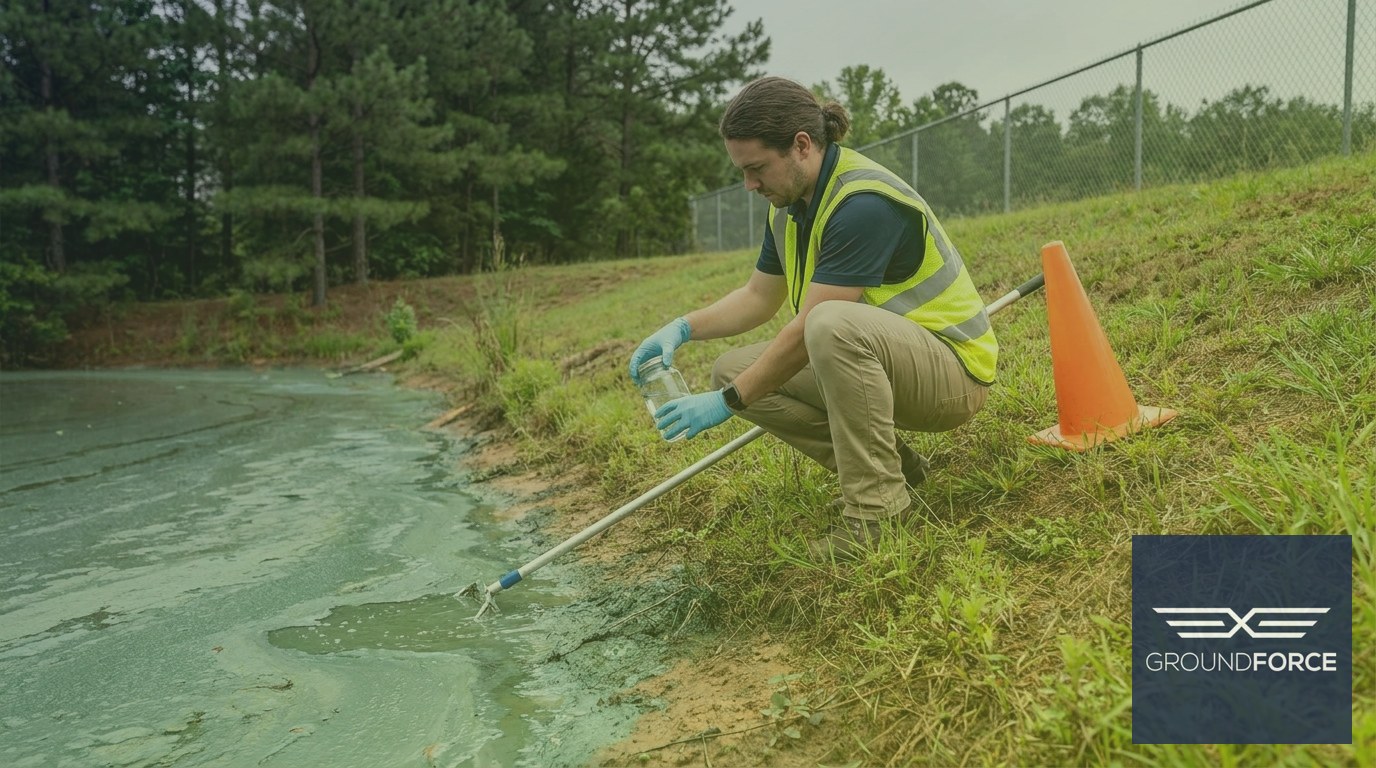
MSPCA-Angell identifies three cyanobacterial toxin types: neurotoxins that attack the nervous system, hepatotoxins that attack the liver, and dermatotoxins that attack the skin. The American Animal Hospital Association names microcystin, a cause of severe liver damage, and anatoxin, a cause of seizures, excessive salivation, and rapid death. The New York State Department of Health lists diarrhea, nausea, skin and eye irritation, and breathing difficulties among human symptoms at high exposure. MSPCA-Angell identifies dogs as the most susceptible domestic species, which matters for ponds ringed by walking trails.
Cyanobacteria looks and smells different from filamentous algae. A cyanobacteria bloom forms a blue-green or teal surface scum, often with a paint-like sheen on calm water, and concentrated cyanobacteria blooms emit a foul, musty odor. Filamentous algae forms green, stringy mats that a rake lifts from the surface.
Misidentification carries a legal cost for associations. An HOA board’s fiduciary duty under the declaration of covenants includes a common-area maintenance provision covering retention ponds, and Georgia premises-liability law recognizes a duty of reasonable care owed to residents and guests. A known cyanobacteria bloom left untreated that sickens a child or kills a dog breaches that common-area maintenance provision, converts a maintenance decision into a negligence claim against the association, and exposes board members to breach-of-fiduciary-duty claims from residents. Property managers frequently read a cyanobacteria bloom as a cosmetic problem and defer treatment to the next quarter. Treating a cyanobacteria bloom is a risk-management decision rather than an aesthetic one, and Ground Force’s guidance on cyanobacteria risks and control in Georgia explains how licensed applicators confirm and treat blooms on an accelerated timeline.
How does algaecide treatment work for Georgia retention ponds?
Algaecide treatment suppresses active algae blooms in Georgia retention ponds through EPA-registered copper-based or peroxide-based compounds applied by a licensed pesticide applicator. Algaecide kills existing algae but leaves the underlying nutrient load intact, so treatment works best inside an integrated management program.
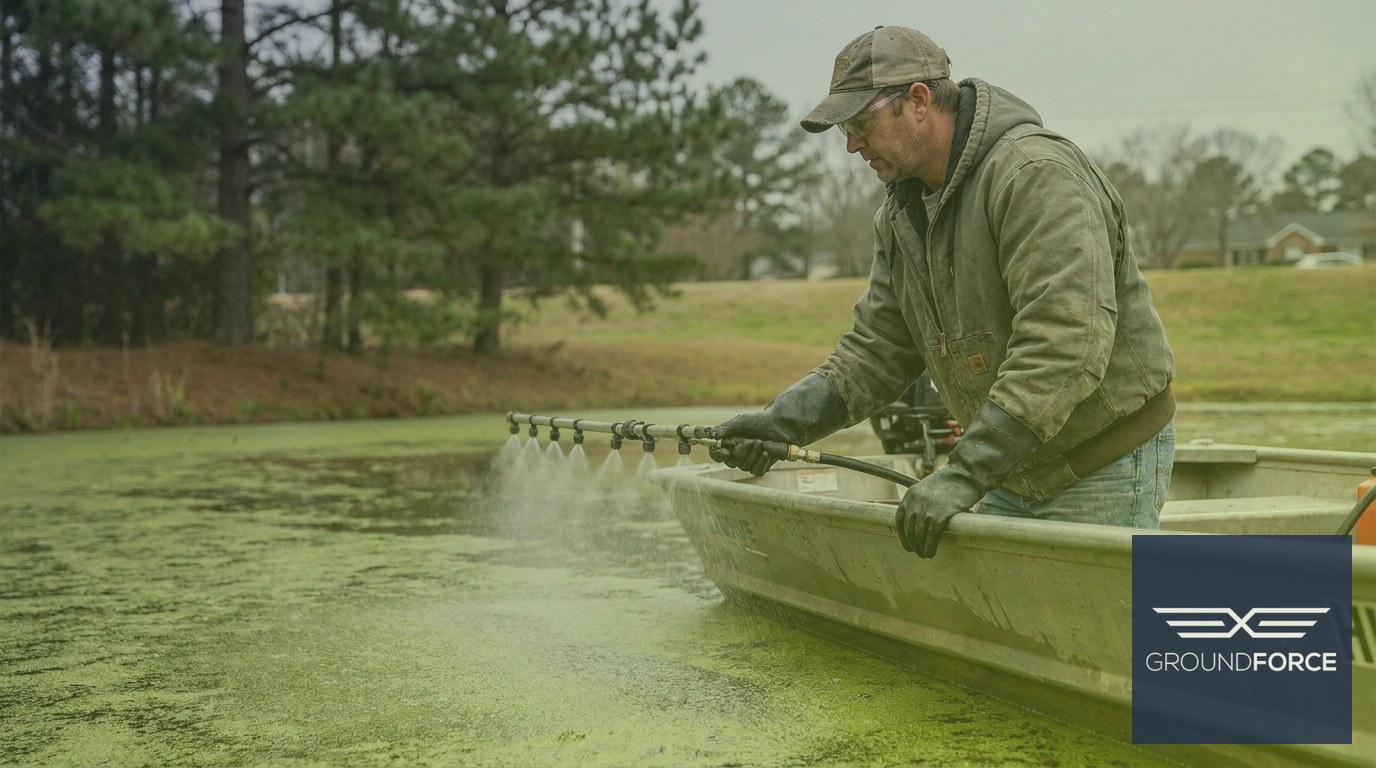
A professional application follows a fixed sequence:
1. Species identification. The applicator identifies the algae species and bloom extent, because copper-based products and peroxide-based products act on different algal groups. 2. Dose calculation. The applicator measures pond volume and applies the product at the EPA label rate, often treating a portion of the pond at a time to protect dissolved oxygen. 3. Contact and kill. Copper ions disrupt photosynthesis and enzyme activity inside algal cells, while peroxide-based products oxidize cell membranes on contact. 4. Die-off monitoring. Dead algae sink and decompose over several days, and the applicator tracks dissolved oxygen because decomposition consumes it.
Georgia law requires a licensed pesticide applicator to treat any water body with algaecide, so application is not a DIY option for HOA boards or facility managers. The license requirement exists because label rates, buffer zones, and water-use restrictions carry legal weight.
Algaecide treatment applies to active bloom suppression but does not eliminate the nutrient conditions that cause recurrence. Dead algae cells decompose and release their stored phosphorus back into the water column, which can accelerate the next bloom cycle when the underlying nutrient load goes unaddressed. Algaecide alone does not solve algae blooms.
For that reason, algaecide performs best as one component of an integrated program alongside nutrient reduction and aeration. Timing drives results: treatments applied in early spring before peak bloom, typically April through May, are more effective and more cost-efficient than reactive treatments during a full midsummer bloom event. The algaecide treatments for stormwater ponds cover product selection, dosing, and seasonal scheduling across the full bloom cycle.
How does Ground Force manage algae and nutrient loading as an integrated service?
The Ground Force algae and nutrient management program contains algaecide application, buffer vegetation management, nutrient runoff reduction, and aeration coordination as one integrated service for HOA communities, commercial campuses, and municipal stormwater features across Georgia.
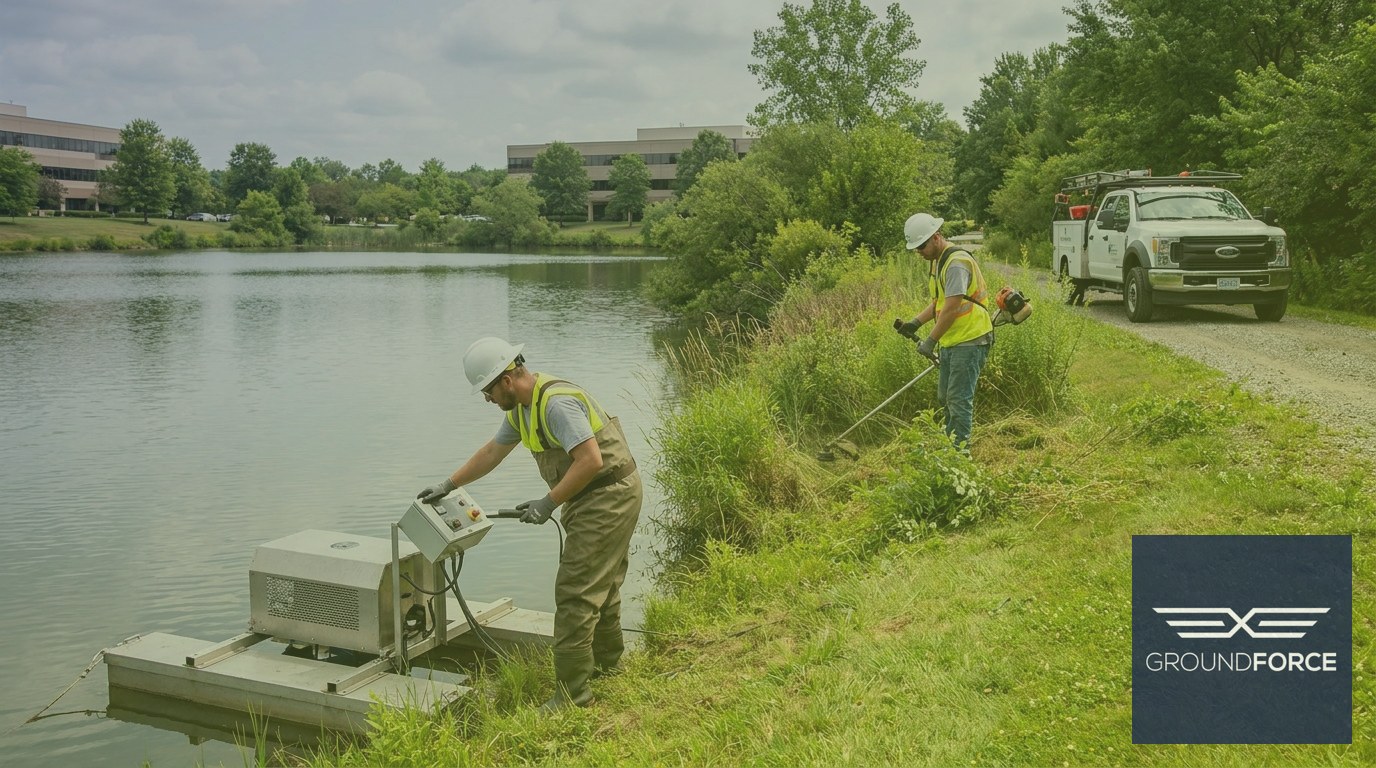
1. Licensed algaecide application. Ground Force technicians treat active blooms with registered algaecide products under a Georgia pesticide applicator license. Crews time applications to bloom stage so treatments suppress algae before mats or surface scums form.
2. Buffer vegetation management. Crews establish and maintain native grasses and sedges around each pond perimeter. Stormwater pond managers use buffer vegetation as a biological nutrient filter that reduces phosphorus and nitrogen reaching open water. NOAA identifies vegetative buffers as an effective tool for reducing nutrient runoff, and University of Nebraska-Lincoln Extension (2026) lists buffer strips of tall grasses as a best management practice for HOAs. These managed buffers operate as part of the stormwater nutrient load reduction strategies applied across each property.
3. Shoreline and upland cleanup. Crews remove leaf litter, grass clippings, and accumulated organic debris from banks and inflow swales before decomposition releases nutrients into the water column. Regular debris removal also supports stopping weed overgrowth before it starts along the shoreline.
4. Aeration coordination. Ground Force coordinates aeration systems combined with vegetation control because surface aerators or diffused air increase dissolved oxygen and disrupt the thermal stratification that blue-green algae exploit. Aeration alone cannot overcome heavy nutrient loading without concurrent vegetation and runoff management; University of Nebraska-Lincoln Extension (2026) reports that reducing external nutrient loads alone rarely produces quick improvements because internal nutrient cycling continues to sustain eutrophication.
Monitoring ties the four components together. Technicians inspect each pond on a recurring schedule through Georgia’s warm-season bloom window, roughly April through October, testing water for phosphorus and nitrogen, assessing bloom presence and density, and recording dissolved oxygen levels. Visit frequency increases during peak summer heat, and each inspection adjusts algaecide timing, buffer maintenance, and aeration scheduling for the weeks ahead.
Do algae blooms in retention ponds create stormwater compliance problems for Georgia property owners?
Yes. Algae blooms in Georgia retention ponds create compliance problems because permit conditions, inspection protocols, and HOA covenants all treat a bloom-choked pond as evidence of impaired stormwater function and neglected maintenance, which exposes owners to citations, enforcement action, and liability.
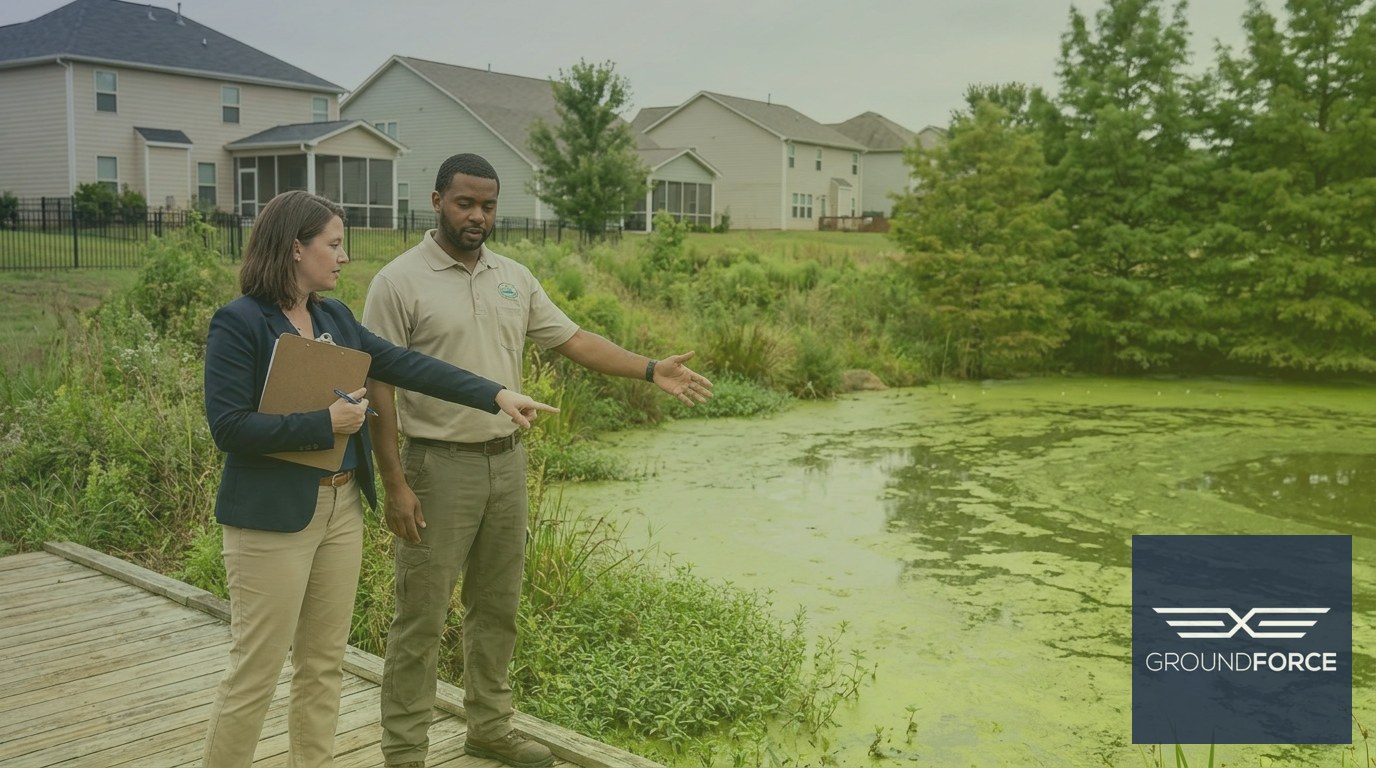
Georgia stormwater permit compliance applies to retention pond condition, including visible algae blooms as a potential indicator of pond function failure. The Georgia Erosion and Sedimentation Act and local MS4 permits require every stormwater retention pond to operate as designed, and a pond choked with algae can no longer settle sediment or treat runoff at the designed capacity. The nutrient runoff rules under Georgia MS4 set the nitrogen and phosphorus loading limits that shape the retention pond vegetation management industrial properties must document to stay in permit compliance.
HOA governing documents and many Georgia municipal ordinances obligate the association to keep the ponds in good condition. A visible, persistent algae bloom gives homeowners grounds to argue the board has breached that maintenance duty. The guidance on responding to HOA pond algae complaints outlines how boards should document complaints, vendor responses, and corrective action.
Inspectors and MS4 compliance reviewers flag chronic algae blooms in written inspection reports as documented evidence of poor pond maintenance. A single storm-driven bloom rarely triggers enforcement; a bloom recorded across consecutive site visits builds a documented maintenance-failure record, and that paper trail is what triggers enforcement letters and mandated repairs. A licensed, documented treatment program answers that record directly, since dated applications, applicator credentials, and follow-up water readings demonstrate due diligence to regulators.
Sources
- MDPI Water, “Harmful Algal Blooms: A Prolific Issue in Urban Stormwater Ponds” (2023)
- Golfdom, “Key factors affecting nutrient levels and algae growth in stormwater ponds” (2024)
- Washington State Department of Health, “Cyanobacteria”
- Barr Engineering, “Drowning in Nutrients: Navigating Stormwater Pond Remediation” (2025)
- Cornell University College of Veterinary Medicine, “Blue-green algae poisoning (Harmful Algal Blooms)”
- NOAA, “Water Quality and Harmful Algae in Southeastern Coastal Stormwater Ponds”
- University of Nebraska-Lincoln Extension, “Pond Management Extension Circular EC3082, 2026” (2026)
- MSPCA-Angell, “The Silent Threat of Blue-Green Algae: What Pet Owners Need to Know” (2026)
- New York State Department of Health, “Harmful Blue-Green Algae: Frequently Asked Questions”