
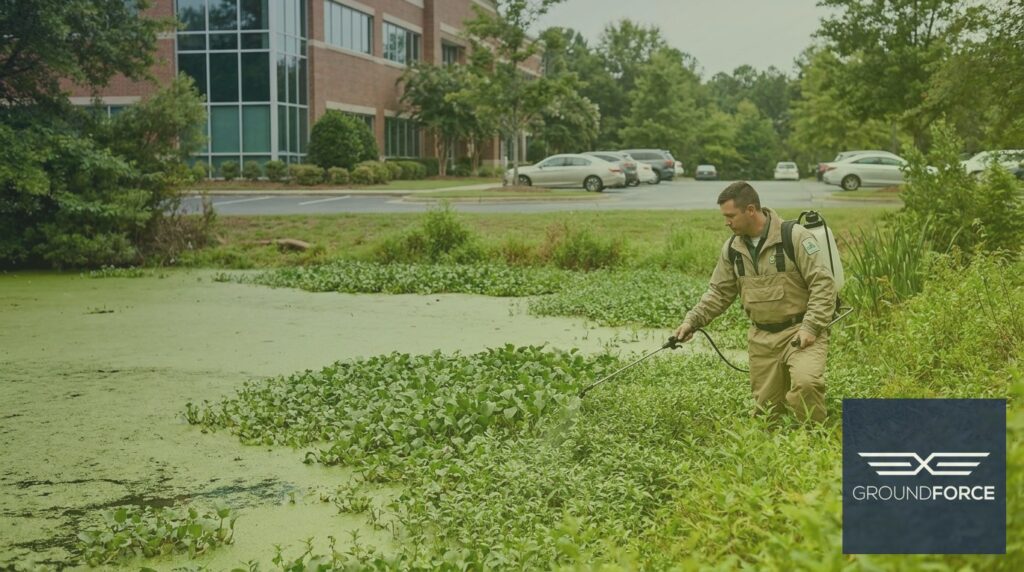
Invasive aquatic weeds colonize Georgia retention ponds rapidly under the state’s warm temperatures and nutrient-rich stormwater conditions. Uncontrolled aquatic vegetation chokes stormwater storage capacity, degrades pond infrastructure, and triggers HOA complaints and Georgia EPD permit violations. Ground Force delivers licensed aquatic weed control programs that restore pond function and keep commercial properties compliant with Georgia EPD requirements.
What do aquatic weeds do to a Georgia retention pond?
Invasive aquatic weeds degrade retention pond stormwater capacity and water quality. Cattails, water hyacinth, duckweed, and hydrilla displace flood storage, deplete dissolved oxygen, erode banks and outfall structures, and expose HOAs to liability when a choked pond fails to drain during storm events.
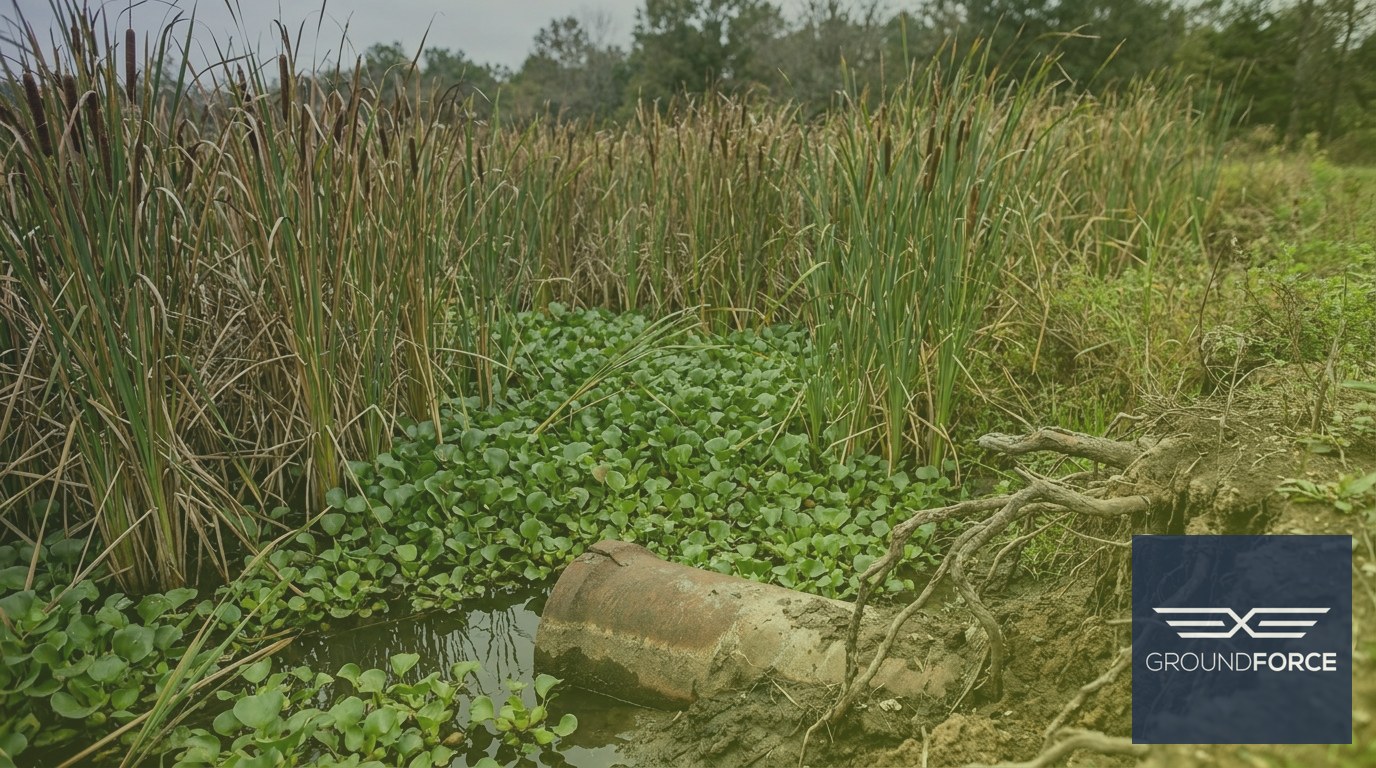
A retention pond is sized to hold a calculated runoff volume, and vegetation consumes that volume directly. Cattails colonize shallow margins and trap sediment. Water hyacinth doubles its population in as few as 5 to 15 days under warm, nutrient-rich conditions, according to ScienceDirect Topics (2019). Hydrilla outcompetes native aquatic plants until hydrilla becomes the dominant vegetative species, per Earthzine (2019), and the Georgia Department of Natural Resources reports hydrilla in several Georgia waterbodies, where hydrilla has been linked to bald eagle deaths from avian vacuolar myelinopathy. Every cubic foot counts. Plant mass and trapped sediment are flood storage the pond can no longer deliver. These species rank among the common aquatic weeds in Georgia ponds.
Weed mats then degrade water quality in a compounding cycle. Water hyacinth mats decrease dissolved oxygen by blocking air-to-water oxygen transfer and sunlight, according to Lake Forest College’s Eukaryon journal, and UGA Extension (2025) reports duckweed can blanket pond surfaces within days, driving oxygen depletion and fish kills. Decomposing vegetation releases nitrogen and phosphorus back into the water column, which fuels algae. Property managers frequently mistake duckweed and water meal for algae; both are floating vascular plants that require different treatment products, so misidentification leads to failed treatments. Nutrient-driven blooms follow the separate management approach detailed under algae bloom control in Georgia ponds.
Georgia’s climate accelerates aquatic weed growth in retention ponds year-round, and nutrient-rich inflow compounds the pressure. A 2017 PLOS ONE study found the first flush of urban stormwater runoff is highly enriched in nitrogen and phosphorus, with lawn irrigation runoff averaging 10.9 mg/L total nitrogen and 1.3 mg/L total phosphorus. A 2022 Journal of Environmental Management review confirms accumulated nitrogen and phosphorus accelerate eutrophication and fuel weed growth; under eutrophic conditions, water hyacinth biomass density rises from 0.1 kg/m² to 10 kg/m², a 100-fold increase, according to a 2021 Plants journal study. A retention pond is an engineered basin, not a natural water body: shallow depth, hard edges, and constant runoff from parking lots and turf produce explosive growth beyond anything a natural pond sustains, so standard lake management advice underestimates the treatment frequency these basins require.
Untreated aquatic weed overgrowth causes structural risks including reduced flood storage, erosion, and potential HOA liability. Cattail root masses undermine berm soils, and floating mats clog risers and outfall structures. When a blocked outlet prevents drainage during a storm event, water overtops the banks, floods adjacent pavement and buildings, and the HOA or commercial owner answers for a stormwater asset the property is legally required to maintain. A professional aquatic weed and pond vegetation program matches treatment timing to these growth rates before storage and structure are compromised.
How does Ground Force treat aquatic weeds in Georgia retention ponds?
Ground Force delivers licensed aquatic herbicide applications and integrated weed control programs for Georgia retention ponds. Treatment pairs EPA-registered herbicides matched to the target species with biological controls and nutrient management, structured as recurring service rather than one-time applications.
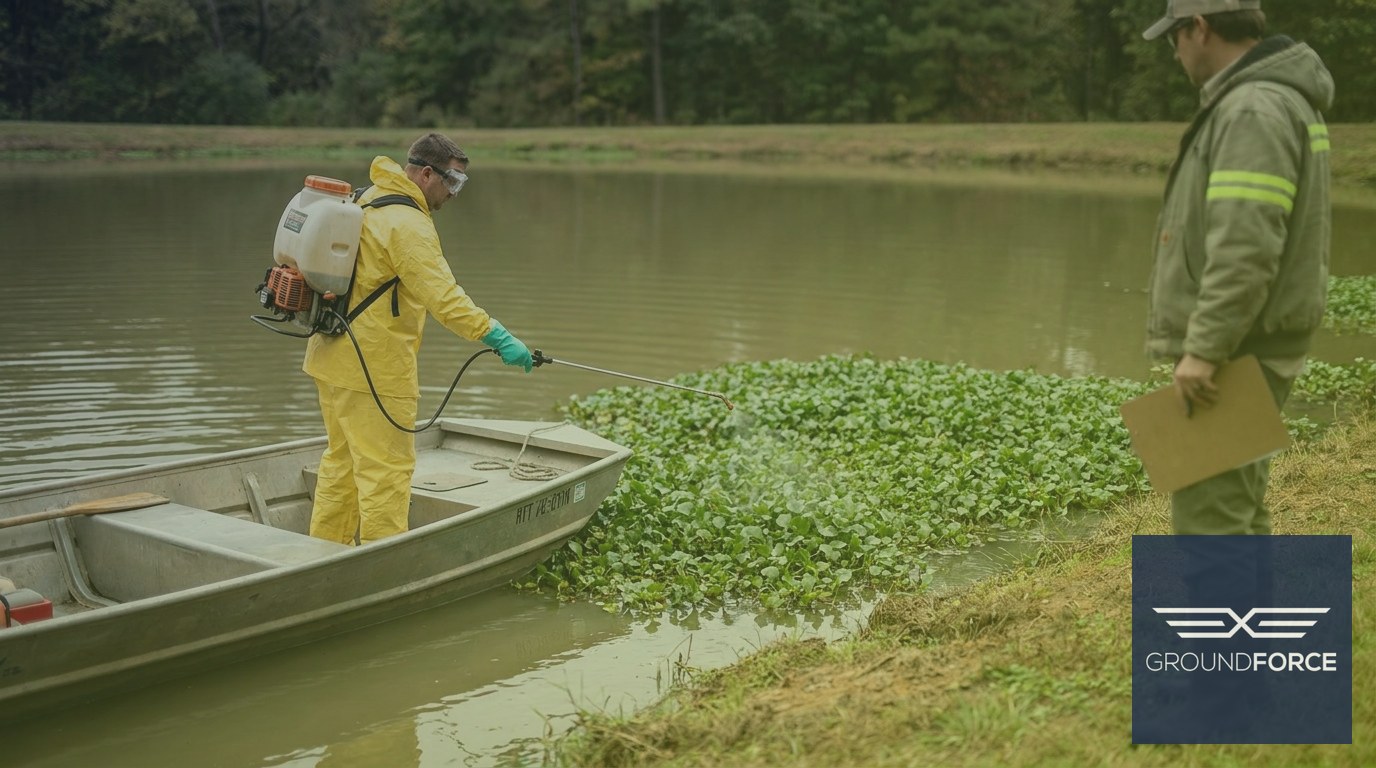
1. Site assessment. Technicians measure pond size, identify the weed species present, and note water use restrictions that limit product choice. Species identification drives everything: UGA Extension Madison County (University of Georgia, 2025) reports that misidentification of duckweed as algae results in ineffective treatment. 2. Product selection. Ground Force matches EPA-registered aquatic herbicides to the confirmed species and pond conditions. Aquatic Herbicide Applications covers product matching and label requirements. 3. Licensed application. Applicators treat at label rates and follow the herbicide safety rules for ponds, which include water use restrictions after treatment. Restrictions vary by product, and some labels require a hold period before the water can be used for irrigation, which matters for commercial properties that draw on retention ponds for landscape irrigation. 4. Biological and nutrient controls. Integrated aquatic weed management combines herbicide treatment, biological controls, and proactive nutrient management. Ground Force introduces the biological controls for pond vegetation, including grass carp and beneficial bacteria, where site conditions suit them. Biological Controls for Retention Pond Vegetation explains how each option works. 5. Recurring service. Treatments run on a scheduled program with follow-up visits, because regrowth from seeds, fragments, and nutrient loading is the norm in stormwater ponds. How to Prevent Aquatic Weed Overgrowth covers the nutrient-management habits that extend the interval between treatments.
Do you need a permit to treat aquatic weeds in a Georgia retention pond?
Yes. Aquatic herbicide application requires a Georgia EPD permit and licensed applicator for legal treatment of retention ponds. The Georgia Environmental Protection Division regulates chemical treatment of state waters, and the Georgia Department of Agriculture licenses the applicators who may legally perform the work.
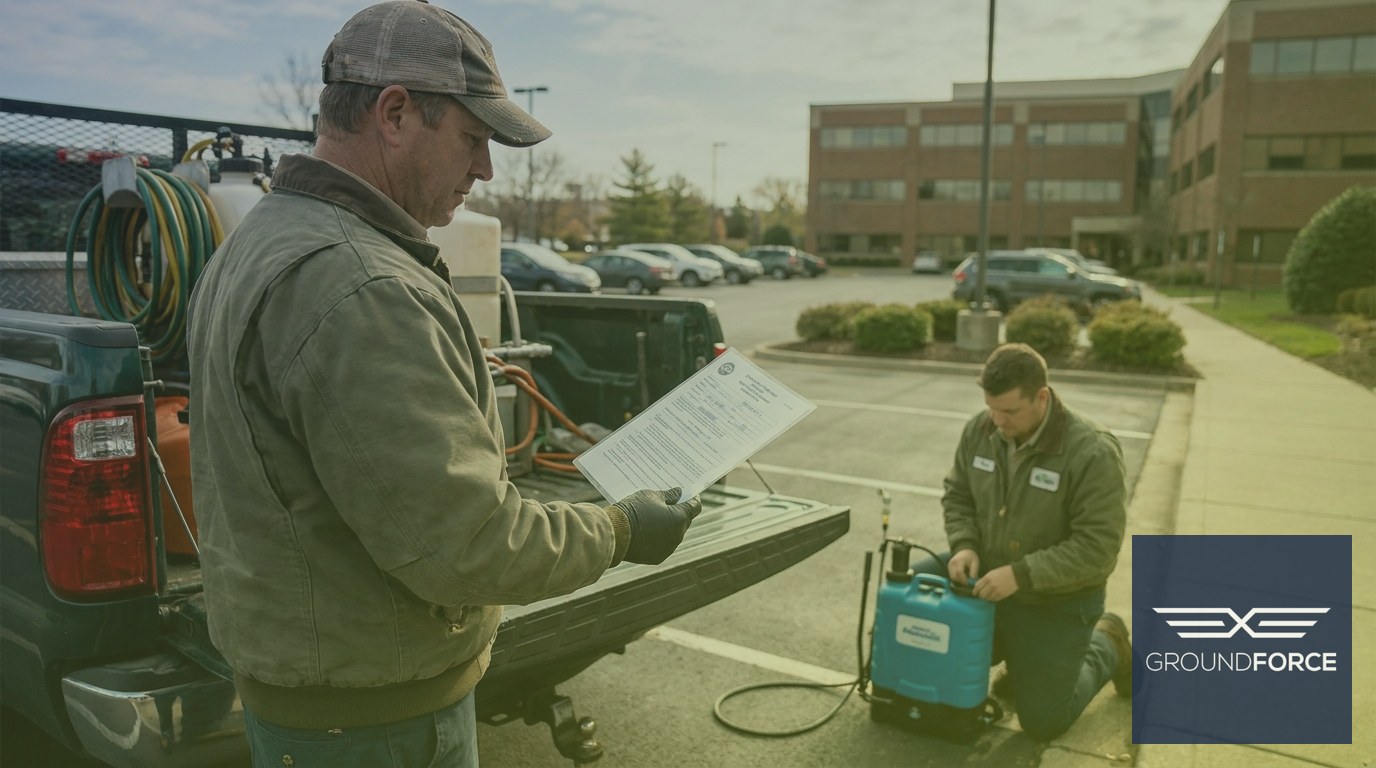
According to the Georgia Environmental Protection Division, the NPDES General Permit GAG820000 (2021) covers all new and existing point source discharges from biological and chemical aquatic pesticides that leave a residue into, over, or near waters of the state. A stormwater retention pond falls within that coverage. The Georgia Environmental Protection Division issued a revised public notice for GAG820000 on May 6, 2026, confirming the permit remains an active regulatory requirement. The EPD permit process for weed control documents which products, application rates, and discharge conditions apply to a given water body.
The licensing requirement sits with the Georgia Department of Agriculture. Under Georgia law, any company that applies pesticides to another person’s property for a fee must hold both a Commercial Applicator License and a Pesticide Contractor License, according to Gwinnett County, Georgia guidance.
The product itself carries separate legal weight. Aquatic herbicides registered for retention pond use differ from terrestrial herbicides by EPA registration number and aquatic use pattern, not just by label. Applying a terrestrial product in or near a Georgia retention pond constitutes illegal pesticide misuse. The herbicide laws affecting Georgia waterways place liability for that misuse on the property owner, not only on the applicator. A cheaper unlicensed treatment transfers legal risk directly to the HOA board or property manager who authorizes the work.
Ground Force manages EPD permit filings, compliant product selection, and applicator licensing on each client’s behalf as part of every aquatic program. The assessment process also reviews HOA governing documents and community pond easements, which sometimes restrict or require specific treatment methods, before recommending a program. EPD permit conditions and state licensing rules sit within the broader framework of Aquatic Weed Control Regulations in Georgia.
How often should Georgia retention ponds be treated for aquatic weeds?
Georgia retention ponds need recurring aquatic weed treatment across the growing season rather than a single annual application. Recurring aquatic weed treatment prevents explosive reinfestation driven by Georgia’s extended warm growing season, and the correct interval for a given pond depends on its size, nutrient load, and dominant weed species.
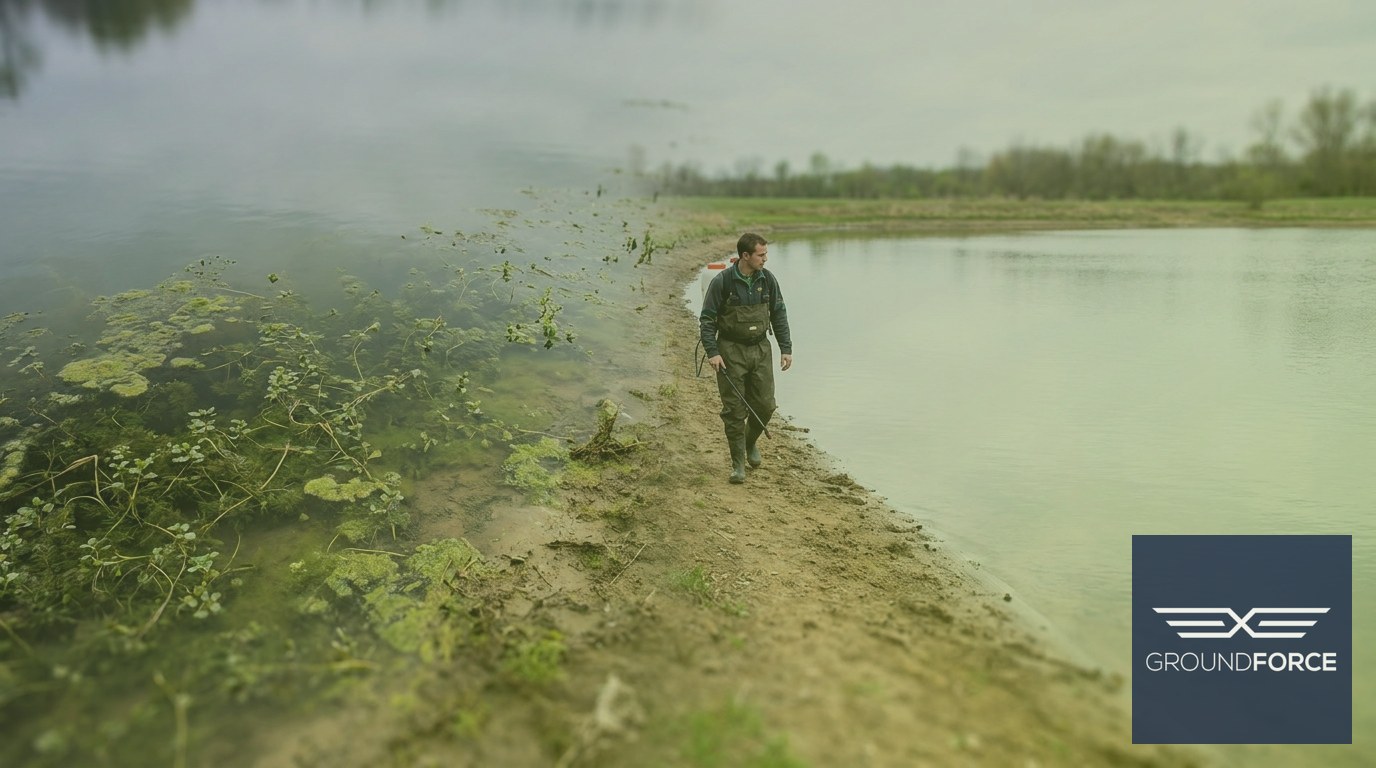
A compliant recurring program follows a consistent structure:
1. Early-season treatment targets new growth before stems reach the surface, when a smaller herbicide application achieves full control. 2. Recurring follow-up treatments through the warm months address regrowth, because Georgia’s growing season runs most of the year and one annual application rarely holds. 3. Interval adjustment matches timing to the pond: small ponds with heavy nutrient inflow and fast colonizers such as duckweed need tighter intervals than large ponds with low nutrient loading. 4. Nutrient reduction limits the runoff and sediment inputs that feed regrowth, which lowers how often reactive treatment is needed and what each visit costs.
Property managers sometimes assume grass carp offer a permit-free alternative to herbicide. Triploid grass carp require a Georgia Department of Natural Resources permit, and stocking them without state authorization is illegal. The long-term weed prevention strategies cover how biological controls for retention pond vegetation fit inside a permitted program, and the retention pond treatment frequency details how intervals shift once nutrient inputs come under control.