
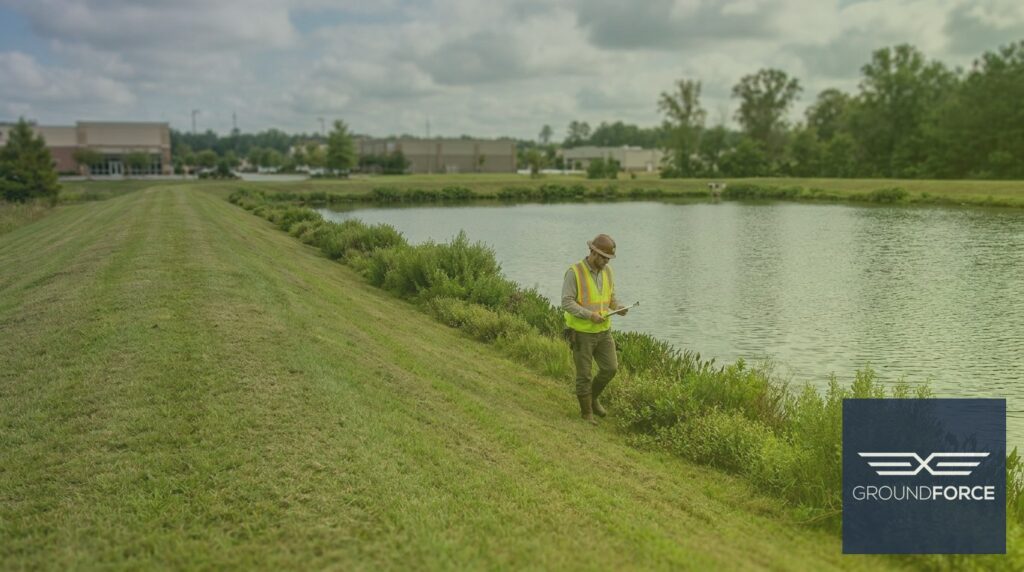
Bank and shoreline vegetation management controls the terrestrial and transitional plant zones on retention pond berms, slopes, and wet margins. Retention pond banks carry the most structurally and visually consequential vegetation on a commercial stormwater system, and unmanaged growth on berms and wet margins triggers slope failure, invasive encroachment, and HOA compliance violations faster than open-water problems do. Ground Force delivers Georgia-specific bank and shoreline programs that stabilize slopes, filter runoff, and keep stormwater infrastructure inspection-ready year-round.
What is bank and shoreline vegetation management for retention ponds?
Bank and shoreline vegetation management for retention ponds is the planned establishment, maintenance, and removal of plant communities across three zones: the upland berm and slope, the shoreline transition zone, and the immediate water’s edge. The service protects berm structure, runoff quality, and site appearance for Georgia HOAs and commercial properties.
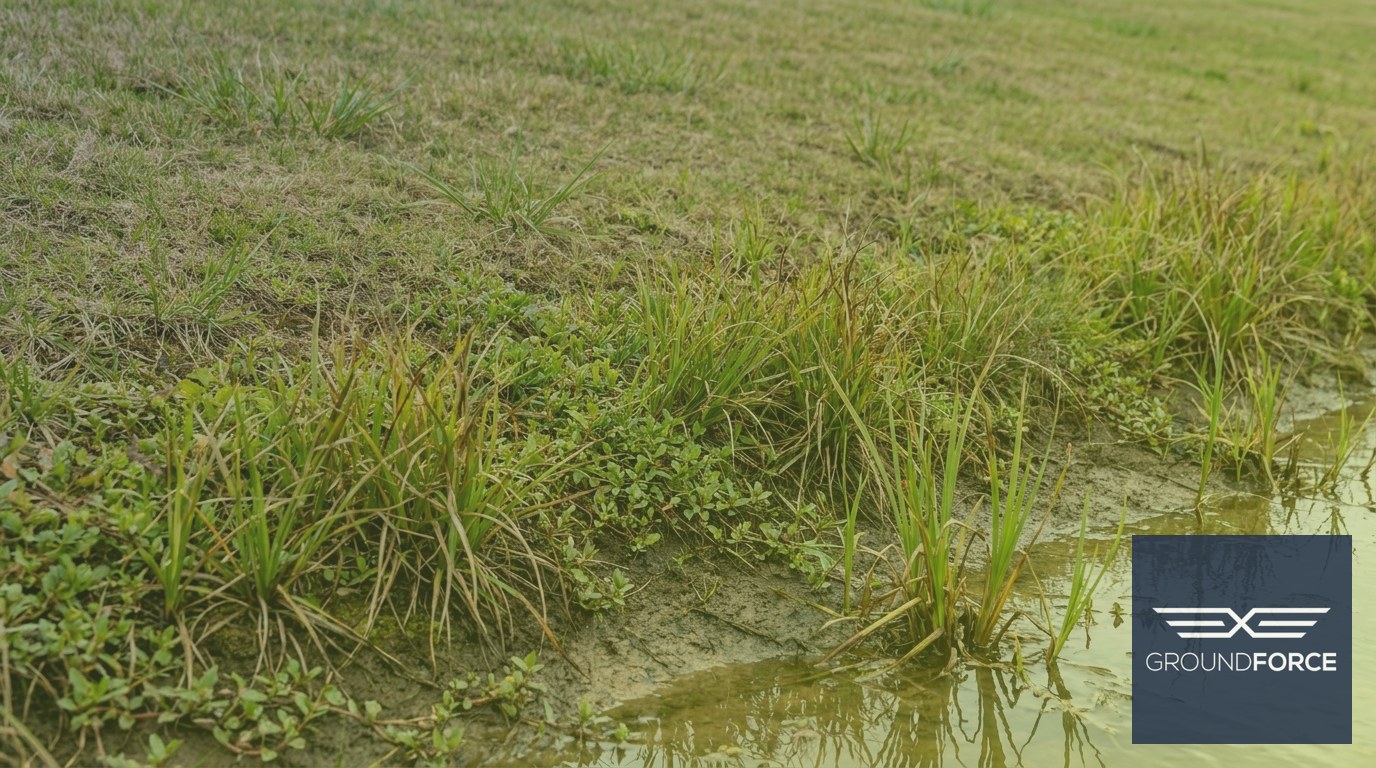
Each zone supports a different plant community and demands a different management approach:
- Upland berm and slope. Deep-rooted grasses and groundcovers armor the engineered embankment against rain impact and foot traffic. Management centers on species selection, mowing height, and woody invasion control.
- Shoreline transition zone (wet margin). The shoreline transition zone is a distinct vegetation management zone requiring different species selection and treatment than open water or upland turf. Plants in the wet margin tolerate fluctuating water levels and saturated soils.
- Immediate water’s edge. Emergent and marginal species grow in standing or near-standing water. Management of the water’s edge coordinates with aquatic work but stays on the terrestrial side of the waterline.
Property managers sometimes conflate bank and shoreline vegetation management with two adjacent services. Aquatic weed control targets submerged and floating vegetation in open water. Standard turf mowing treats the berm as flat lawn and ignores slope stability and buffer function. The pond bank vegetation management covers the full berm-to-water scope that both adjacent services miss.
Bank vegetation performs structural work that mowing cannot replace. Root systems bind berm soil and resist slumping under saturated conditions. Buffer strips intercept runoff and trap sediment and nutrients before the runoff reaches the water. Transitional plants stabilize the water-soil interface where wave action and fluctuating levels erode unprotected banks. Neglect reverses every one of those functions: retention pond bank vegetation causes berm slope failure and structural damage when invasive woody species dominate the slope or when the bank goes unmanaged, because woody roots loosen compacted embankment soil and falling stems open the slope to erosion.
Georgia’s humid subtropical climate drives aggressive growth of both desirable and invasive species on pond perimeters year-round. Unmanaged banks rarely stay stable. Stormwater pond banks in Georgia’s Piedmont region face additional pressure from clay-heavy soils that crack when dry and slump when saturated, which makes vegetation selection for Piedmont sites different from Coastal Plain sandy-soil ponds. The shoreline and bank plant management details how Ground Force matches species and treatment timing to each zone and each soil region.
Why do HOAs and commercial properties need professional pond bank vegetation management?
HOA retention pond bank management applies to liability exposure from erosion, sinkholes, and regulatory non-compliance when bank vegetation is neglected. Professional management keeps berms structurally sound, satisfies Georgia stormwater rules, and protects the property values around the pond.
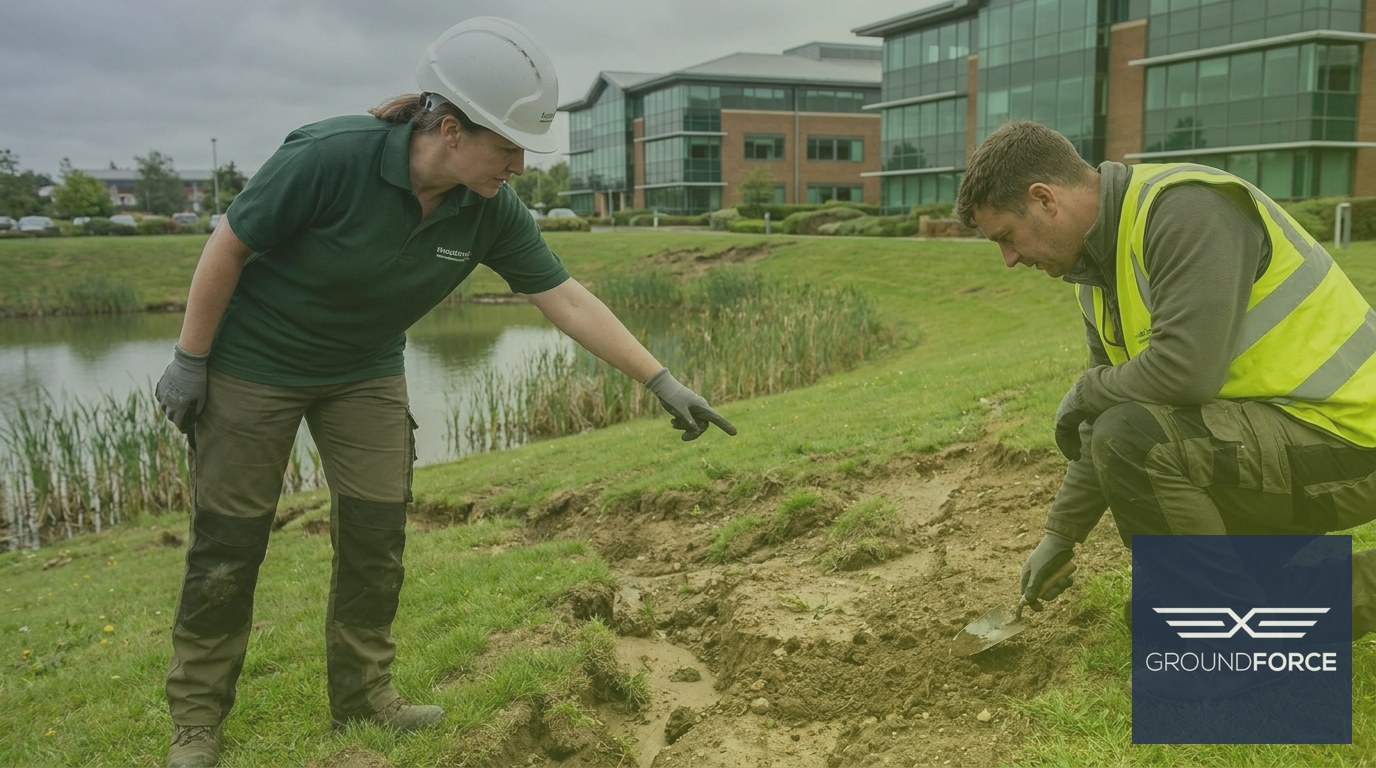
Liability exposure. Eroding berms, sinkholes along pond edges, and unstable slopes create safety hazards on common property, and an injured visitor converts those hazards into legal claims against the HOA board and the property manager. The plant-based bank erosion solutions a contractor installs, such as deep-rooted native grasses on the slope face, remove the hazard before it becomes a claim.
Regulatory compliance. Georgia EPD stormwater permits and local ordinances require vegetated buffers and structurally sound berms on retention facilities, so neglected banks can trigger inspection failures. The commercial property riparian buffer strategies documented for a site determine whether its buffer passes that inspection.
Aesthetics and property value. Overgrown, weedy, or eroded pond edges rank among the most frequent resident complaints an HOA receives, and visible bank deterioration reduces the curb appeal of adjacent lots.
Insurance and reserves. Structural berm damage from erosion is expensive to remediate, and standard HOA property policies routinely exclude gradual earth movement, so emergency berm reconstruction draws directly on reserve funds.
One distinction matters for budgeting: bank and shoreline vegetation problems are structurally more dangerous than open-water problems. An algae bloom is an aesthetics and water-quality issue, while invasive shrub roots and unchecked erosion on a berm can compromise the entire pond embankment. Most HOA boards do not separate these two categories when they budget pond maintenance, so embankment risk goes unfunded while open-water treatments get approved.
Some HOA covenants require “maintained” pond edges without defining the term. A service contract with Ground Force establishes the documented maintenance standard, and maintenance schedules for HOA retention pond vegetation programs give the board defensible records if the obligation is ever legally challenged.
How does shoreline buffer vegetation improve retention pond water quality?
Stormwater systems use a vegetated buffer strip on pond banks to filter sediment, nutrients, and pollutants before runoff enters the pond. The strip slows sheet flow, traps suspended sediment, and absorbs nitrogen and phosphorus that would otherwise fuel algae blooms.
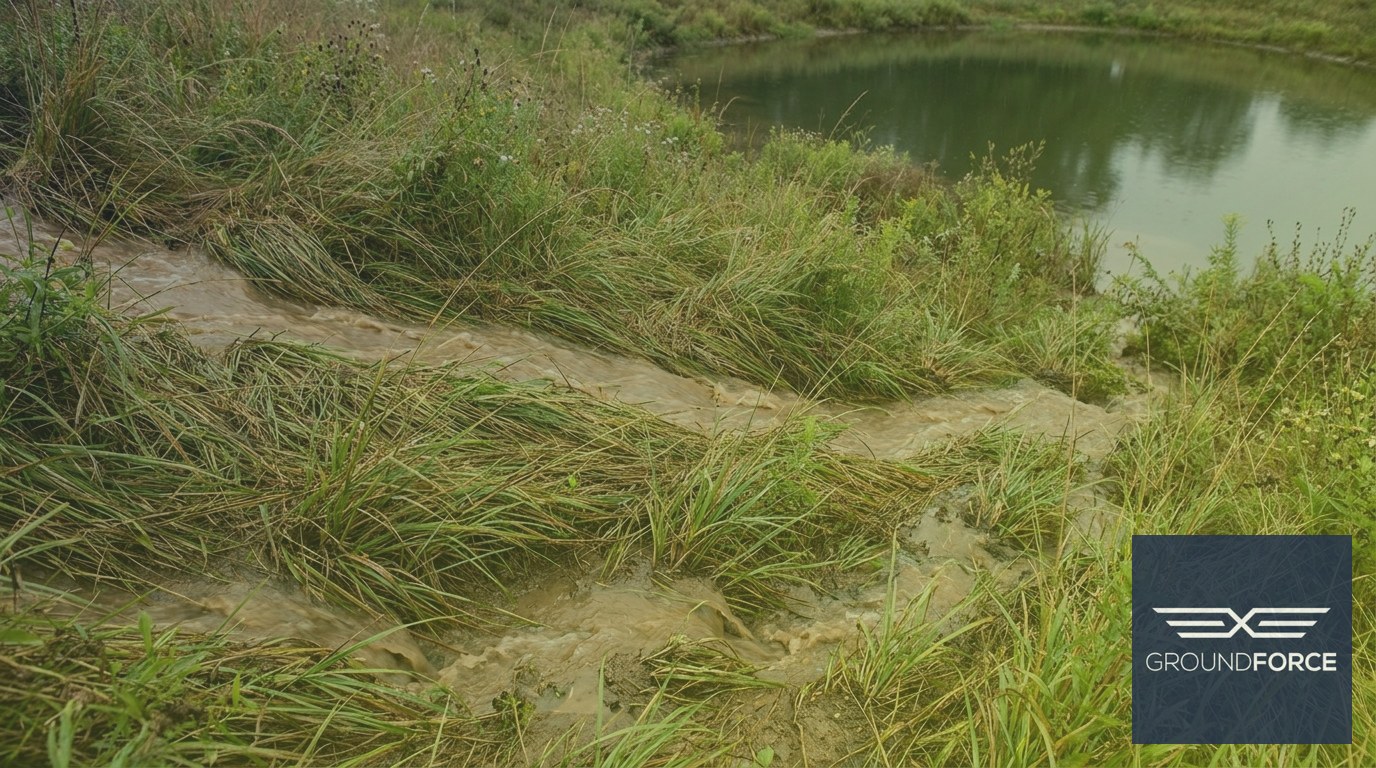
How buffer vegetation affects retention pond water quality comes down to three mechanisms.
1. Runoff interception. Buffer vegetation slows sheet-flow runoff velocity across the bank, so suspended sediment drops out before reaching the pond and sedimentation rates in the basin fall. A 2017 review published on ResearchGate reports runoff volume reductions of 35 to 90 percent and sediment concentration reductions of 42 to 94 percent. 2. Nutrient uptake. Dense-rooted bank plants absorb excess nitrogen and phosphorus from fertilizer runoff, cutting the nutrient loading that drives algae blooms. The same review reports nitrate reductions of 35 to 88 percent and phosphate reductions of 28 to 95 percent. A 2020 ScienceDirect review attributes the riparian vegetation and nutrient filtration effect to root-zone porosity, where nutrients sorb onto soil particles, transform through microbial activity, or sequester into plant tissue. 3. Species composition. Width and plant mix set performance. Sparse turf grass alone delivers minimal filtration compared with a mixed native buffer of sedges, rushes, and emergent species at the toe. A 2024 ScienceDirect field investigation found grass-only buffers showed limited nutrient reduction while mixed woody riparian buffers outperformed non-woody vegetation, and a 2025 ScienceDirect meta-analysis found suspended solids retention peaked at 80 ± 6 percent in two-species buffers.
Native shoreline buffers are not zero maintenance. They require the right maintenance: selective removal of invasives within the buffer, periodic cutting to prevent woody encroachment, and sediment management at the toe of slope. In Georgia’s climate, a buffer treated as a no-mow zone without active management shifts to invasive dominance within two to three growing seasons.
Grass carp, sometimes stocked for aquatic weed control inside the pond, do not address bank vegetation and can actually graze desirable shoreline emergents. Bank management is always a separate scope from biological aquatic control.
Which invasive plants most commonly threaten Georgia retention pond banks?
Chinese privet, kudzu, and the Chinese tallow tree are the dominant invasive shrub and vine threats on Georgia retention pond perimeters, and each requires targeted removal. Privet colonizes berms, kudzu blankets slopes, and tallow trees root at the water’s edge.
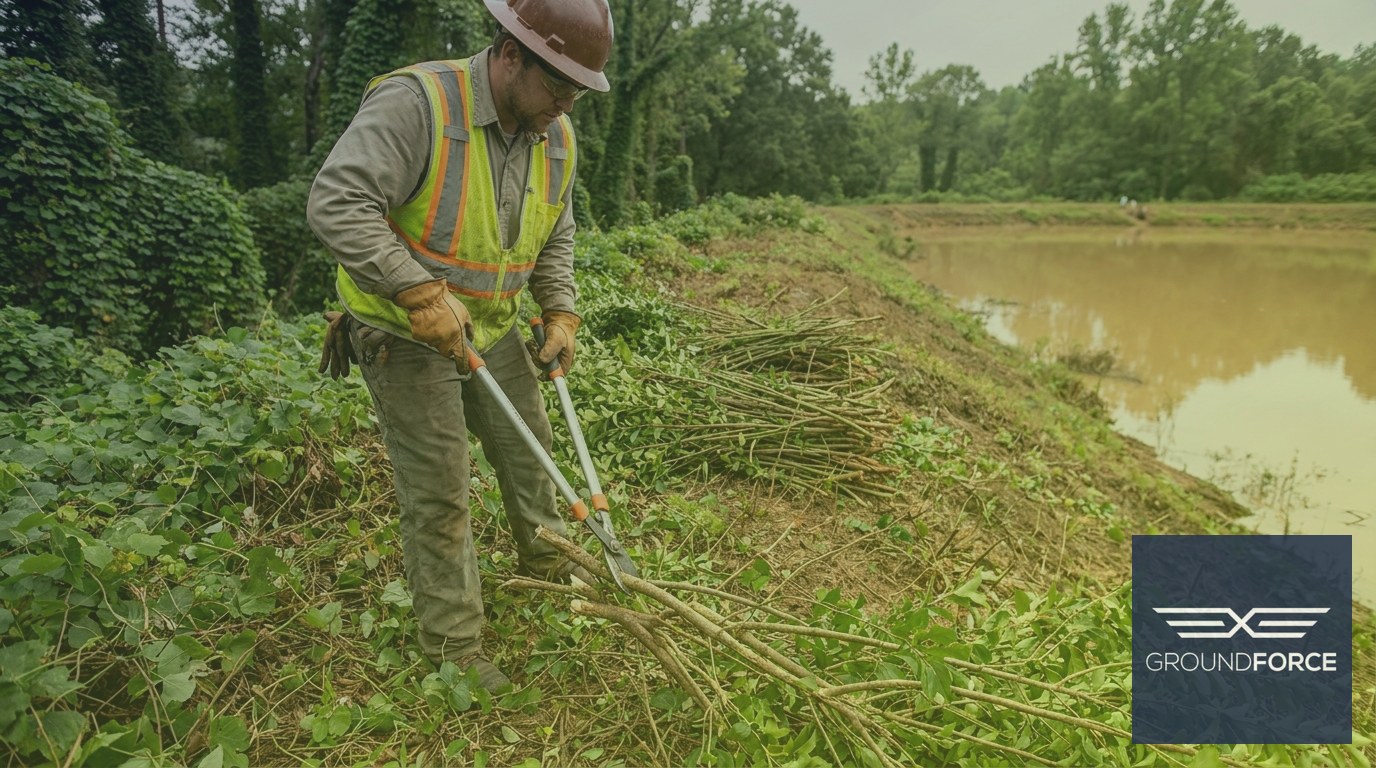
Chinese privet (Ligustrum sinense) has held the top ranking on the Georgia Forestry Commission’s Dirty Dozen list since 2009, according to UGA Extension Forsyth County (2017). The shrub forms dense monoculture thickets that shade out native buffer plants, and birds disperse privet berries while root suckers expand each stand. Privet’s shallow root system stabilizes slopes poorly compared to the native shrubs privet replaces.
Kudzu (Pueraria montana) grows 60 to 100 feet per season, according to the New Georgia Encyclopedia (2022), and the Atlanta Journal-Constitution (2024) reports kudzu occurs in every Georgia county. On berms the vine smothers all competing vegetation, adds weight to slopes, and blocks inspection access. Kudzu roots can weigh up to 400 pounds.
The Chinese tallow tree (Triadica sebifera) roots near the water’s edge and destabilizes shorelines with aggressive root growth. The tree grows quickly in Georgia’s warm climate and spreads through abundant bird- and water-dispersed seed.
Cutting alone fails against all three species. Privet resprouts aggressively from stumps and roots, a 2025 Alabama Cooperative Extension System bulletin notes, so a season of mowing worsens the infestation. Effective control pairs cutting with immediate cut-stump herbicide treatment or basal bark application. UGA Extension Forsyth County recommends a 3 to 5 percent glyphosate solution on foliage for small plants and prompt stump treatment for larger shrubs.
Torpedo grass (Panicum repens), a semi-aquatic invasive, colonizes wet shoreline margins and is frequently misidentified as desirable groundcover. Torpedo grass aggressively displaces native emergents and requires targeted treatment, not routine cutting.
Replacing cleared banks with Georgia-native shoreline planting options restores the deep-rooted stabilization these invaders never provide.
What are best practices for mowing retention pond banks safely and effectively?
Retention pond bank mowing best practices set a cutting height of 4 to 6 inches on berm faces, match equipment to slope steepness, and follow a growth-based schedule of four to eight cycles per year. Each practice preserves root mass, protects berm integrity, and keeps Georgia banks compliant.
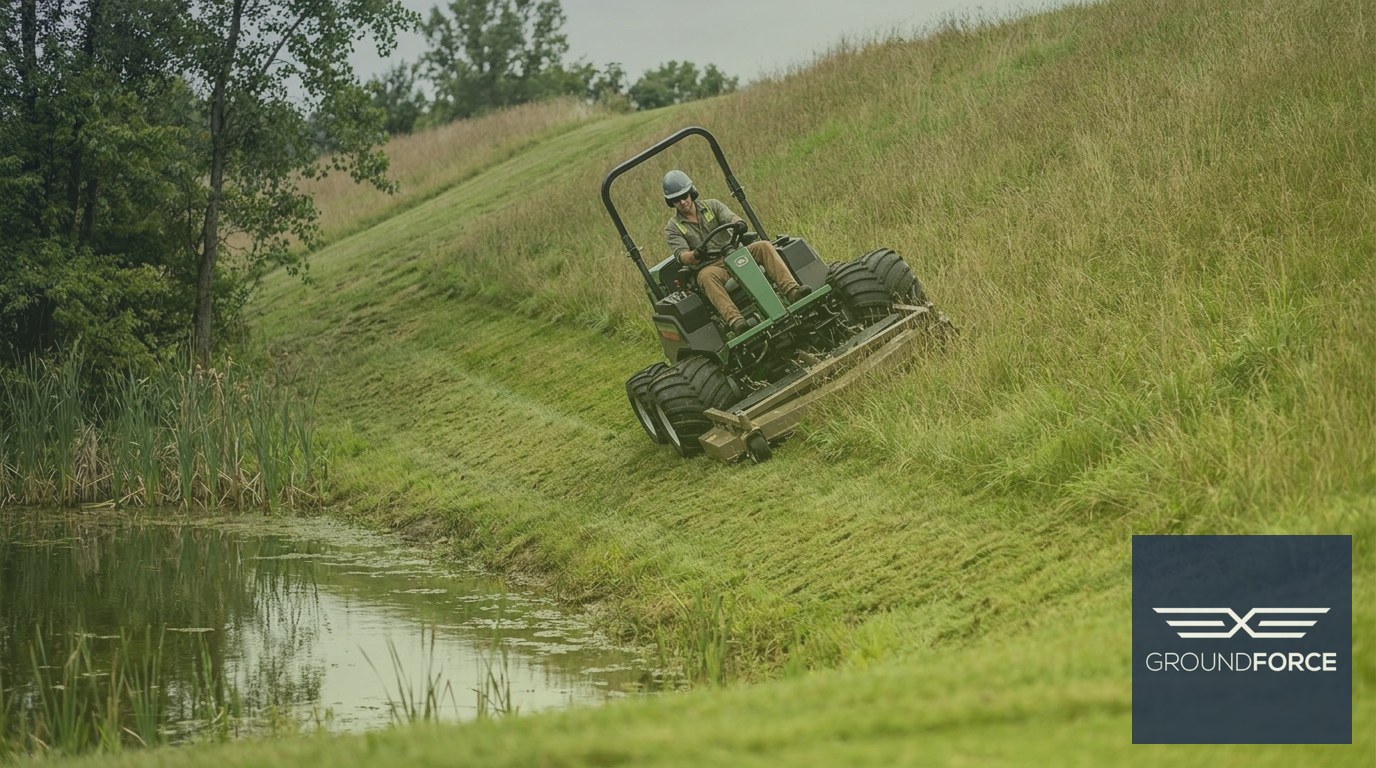
- Mowing height: Hold turf at 4 to 6 inches minimum on every berm face to preserve root mass and soil-binding capacity. Cutting shorter is a leading cause of pond bank erosion, not a neatness upgrade: scalped slopes develop the bare-soil conditions that produce rilling and undercutting, the exact failure pattern behind the common HOA instinct to keep banks trimmed close.
- Equipment selection: Standard riding mowers are unsafe on slopes steeper than 3:1 and cause rutting that channels runoff. Properly equipped operators use slope-rated mowers or remote-controlled slope mowers for steep berms.
- Mowing frequency: Georgia banks typically need four to eight cycles per year depending on the growth season, not a fixed calendar. Over-mowing of pond bank slopes causes bare soil exposure, root loss, and accelerated erosion that undermines berm integrity, so over-mowing damages a slope as much as under-mowing.
- Clipping management: Clippings left on a bank wash into the water, so professional crews collect or redirect clippings on every visit. Clipping control is a routine part of mowing around retention ponds safely and prevents additional nutrient loading from decomposing organic matter.
The bank stabilization through shrub removal addresses woody stem colonization that a mower cannot reach.
What does Ground Force’s bank and shoreline vegetation management service include?
The Ground Force bank and shoreline vegetation program contains slope mowing, invasive shrub and vine removal, native buffer establishment, and scheduled maintenance under a single HOA or commercial service agreement. One agreement covers the full bank zone, from berm crest down to the wet margin.
Every engagement begins with a site assessment. Ground Force evaluates each pond’s bank zones, slope gradients, existing vegetation, invasive pressure, and compliance requirements before prescribing a management plan. Gradient matters in practice: steeper slopes restrict mowing equipment and push the plan toward hand crews and deeper-rooted buffer plantings that hold soil where machines cannot safely operate.
Service plans are structured for recurring contractual delivery rather than one-time cleanup. Visit cadence follows the maintenance schedules for HOA retention pond vegetation programs, and every visit generates documentation formatted for HOA boards, property managers, and regulatory inspections. The annual shoreline treatment timing coordinates herbicide applications and buffer planting with the Georgia growing season. Vegetation rooted below the waterline belongs to a separate scope, and the submerged and floating weed management addresses those aquatic species directly.