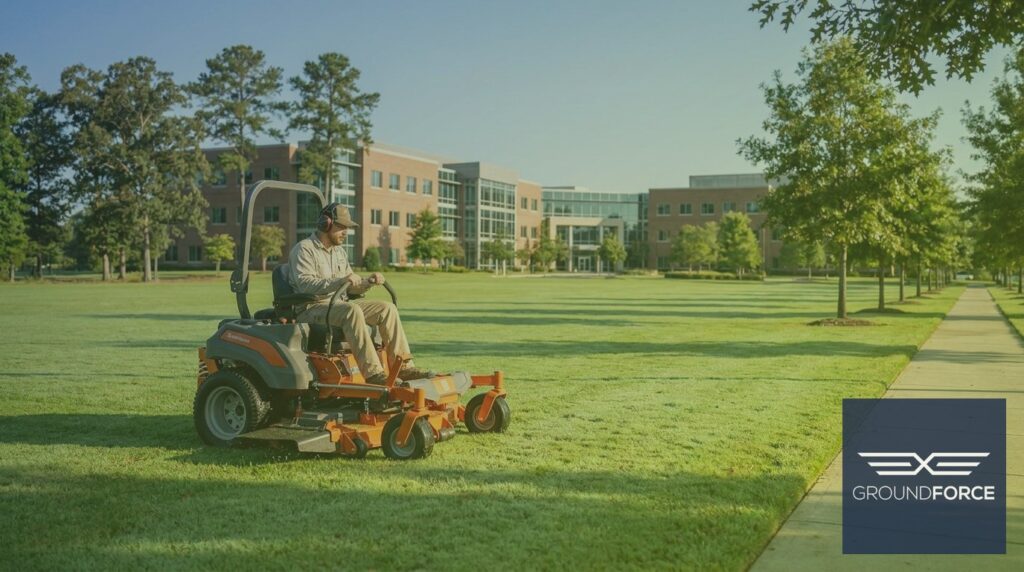
Commercial turf care for business parks and office campuses in Georgia demands a program built for pressures retail and residential properties never face. High-frequency foot traffic compacts campus turf across shared common areas, tenant leases tie exterior appearance to occupancy expectations, and large contiguous acreage punishes inconsistent scheduling with visible decline. Ground Force meets these demands with structured, eco-conscious turf programs that protect curb appeal, tenant satisfaction, and property value.
Why do business parks and office campuses need a different turf care approach than other commercial properties?
Business parks and office campuses carry distinct turf management requirements driven by contiguous acreage, high foot-traffic corridors, and multi-tenant curb-appeal obligations. Uniform appearance across large connected frontages, lease-tied appearance standards, and corporate tenant site evaluations turn turf quality into a financial variable with occupancy consequences.

Contiguous acreage creates the first requirement: uniformity pressure. A single thin or weedy zone reads across the entire property frontage because nothing interrupts the sightline. Retail turf sits in isolated islands broken up by pavement, so a weak patch stays visually contained; business park turf fails in full view of every tenant and visitor on the drive in.
High foot-traffic corridors create the second requirement. Entry walks, parking medians, and common area lawns concentrate pedestrian load, and according to the LSU AgCenter, heavily trafficked turf develops a compacted root zone with little air and poor water percolation, producing thin, shallow root systems that recover poorly from wear. UMass Extension describes the same mechanism at the soil level: compaction from foot and vehicle traffic reduces total pore space, particularly the macropores responsible for drainage, root growth channels, and air exchange. A generic mowing schedule does not address compaction. Aeration timing and traffic-pattern planning do.
Multi-tenant structure creates the third requirement, and it is the one most generic turf vendors miss. Office campus leases frequently contain exterior appearance standards clauses, a detail most generic turf care vendors do not account for in service agreements, so turf decline becomes a potential lease compliance trigger with consequences well beyond aesthetics. Corporate tenants also evaluate campus properties during site visits and lease renewals, and first-impression turf quality directly influences occupancy decisions. Tenant retention and lease renewal follow from consistently maintained exterior turf that signals property owner investment and professionalism.
Two operational details follow from these requirements. Parking island turf is especially vulnerable to heat stress because asphalt radiant heat raises soil temperature beyond what even Bermuda tolerates without supplemental irrigation scheduling, so program designers must account for island heat load in summer visit frequency. The Georgia turf maintenance by season covers how irrigation windows shift as Bermuda moves from spring green-up into peak summer stress.
Small business tenants inside a campus rarely hold any direct voice in exterior turf decisions, yet they complain first to property managers when appearance slips. Consistent program execution functions as a tenant-relations tool rather than a simple landscaping choice. Gwinnett County commercial vegetation services apply this corridor, island, and frontage logic to office properties across that submarket.
What does Ground Force’s turf care program for business parks and office campuses include?
Ground Force’s turf care program includes growth-calibrated mowing, soil-temperature-timed fertilization, proactive weed scouting with targeted spot treatment, and precision edging along curbs, sidewalks, and parking islands. Commercial property managers and business park owners in Georgia use Ground Force for scheduled, accountable turf programs.
Ground Force schedules mowing around warm-season growth peaks rather than fixed weekly intervals. Growth rate sets the schedule. Bermuda and Zoysia turf flush aggressively through Georgia’s humid subtropical summers, then slow during dry stretches and cool snaps, so a rigid weekly route either scalps turf mid-flush or wastes visits when growth stalls. Ground Force’s business campus lawn care programs adjust visit frequency to measured growth, and the 2026 turf care pricing Georgia details how acreage and visit frequency set program cost.
Fertilization follows soil temperature thresholds, not calendar dates. According to 2025 University of Georgia Cooperative Extension guidance, Bermudagrass fertilization begins when soil temperatures reach 65°F at a 4-inch depth, typically late April in South Georgia, with nitrogen applied every 6 to 8 weeks until mid-August and fall applications avoided to prevent winter damage. Roots absorb nitrogen only during active growth, so applications made before that threshold leach past the root zone unused.
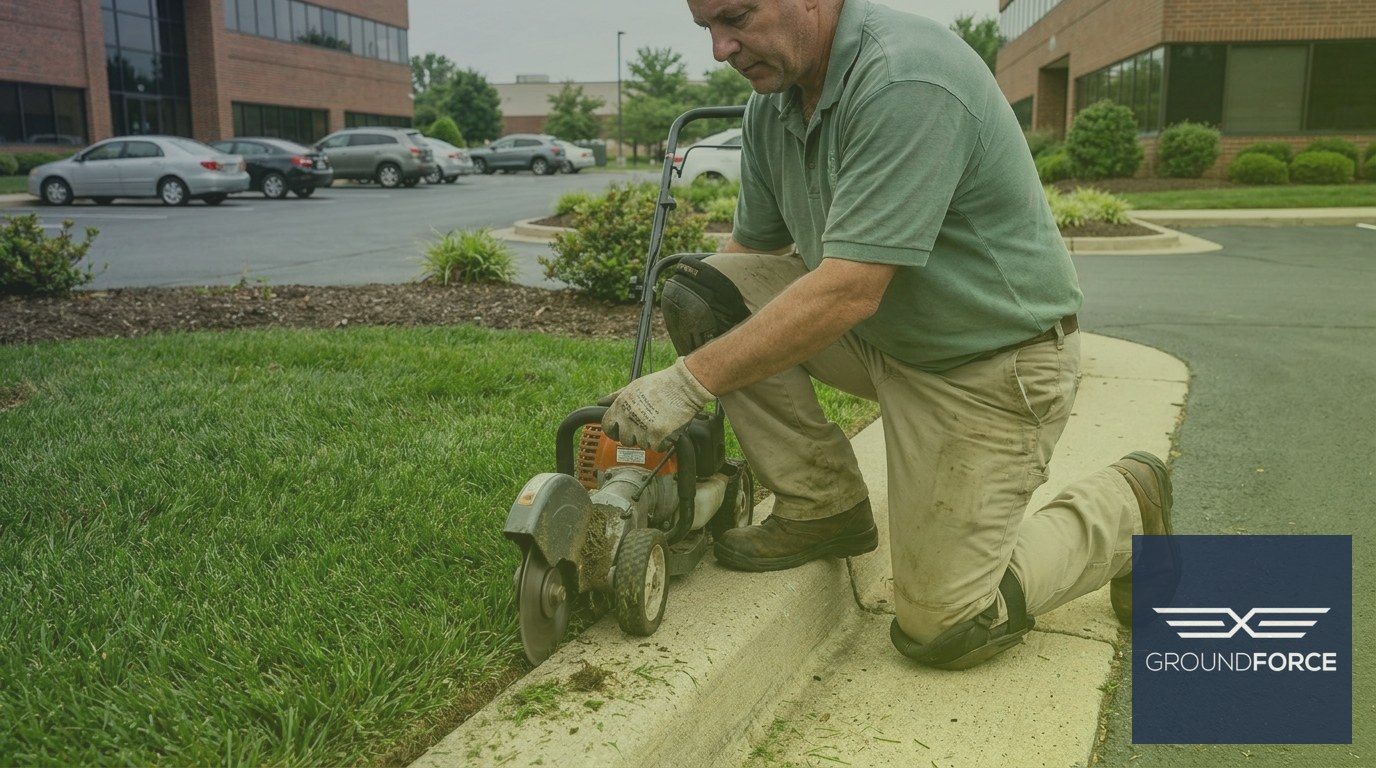
Crews scout every visit for emerging weed pressure and apply targeted spot treatment before visible infestation spreads across common areas, which limits herbicide to affected zones instead of blanket-spraying the property. Edging and cleanup along curbs, sidewalks, and parking islands close out each service, because those hard borders carry the property’s professional presentation for tenants and visitors.
How does Ground Force keep business park turf programs eco-friendly without sacrificing appearance standards?
Ground Force applies eco-friendly turf practices to business park turf management through reduced-synthetic-input fertilization, targeted spot treatment over broadcast spraying, and soil health monitoring. Appearance standards hold because every input is timed and dosed by measurement, not habit.
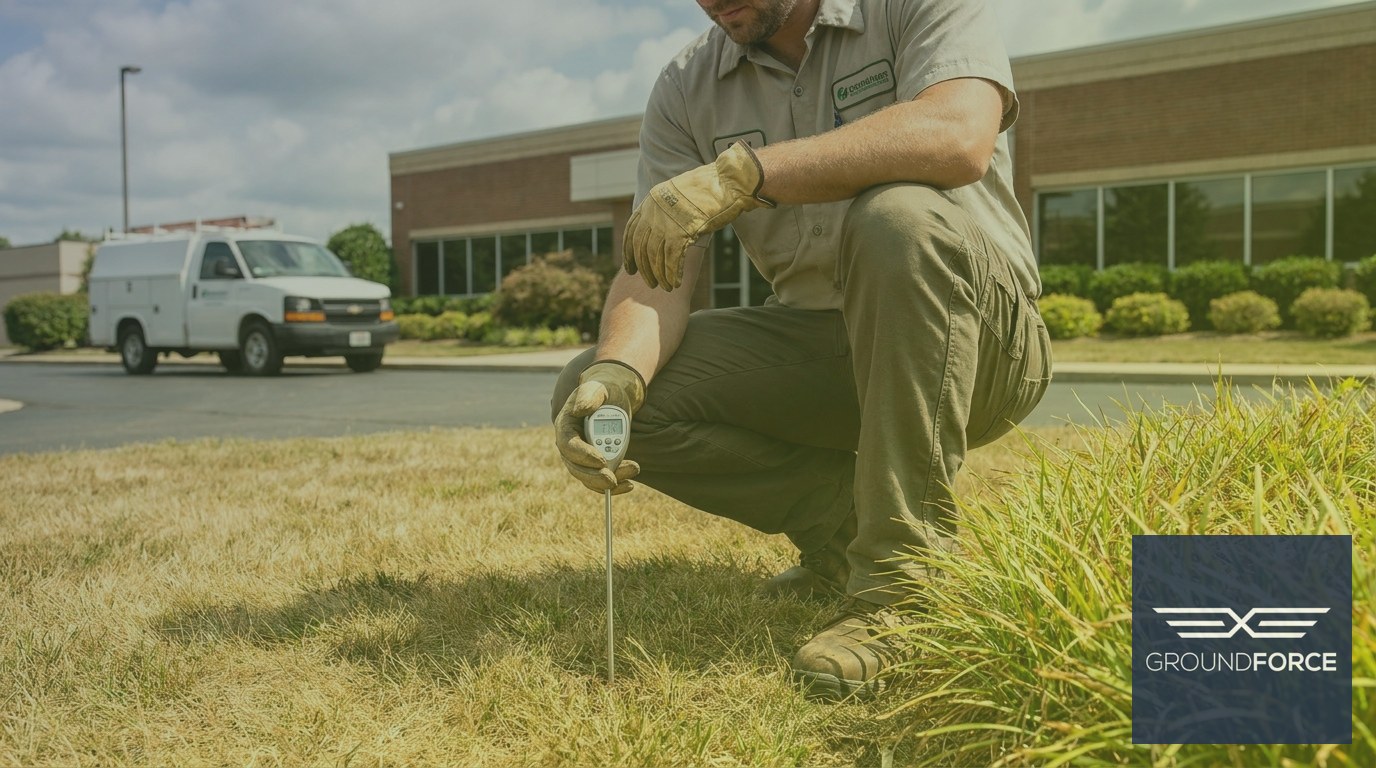
A structured turf program contains mowing schedules calibrated to Georgia’s warm-season growth peaks, fertilization timed to soil temperature, and weed intervention before visible infestation.
1. Reduced-synthetic-input fertilization. Programs run on slow-release, organic-based nitrogen. The University of Georgia Cooperative Extension reported in 2025 that these sources require fewer applications, reduce leaching losses, and carry low burn potential. Organic matter from these products builds soil that buffers Georgia summer heat stress, delivering measurably better long-term density on contiguous acreage, while synthetic-only programs create fertilizer dependency that accelerates turf thinning during drought. The sustainable fertilization for Georgia campuses covers product selection and rates. 2. Threshold-based weed and pest control. Integrated pest management principles set monitoring thresholds that determine intervention timing, replacing preventive broadcast applications. 3. Targeted spot treatment. Crews treat active problem sites instead of blanket spraying, cutting the chemical load reaching stormwater drainage systems adjacent to business park hardscape. 4. Soil health monitoring. Compaction, pH, and organic matter readings diagnose turf decline before symptoms surface, reducing input waste and improving density over time. The core aeration timing for Georgia turf covers compaction relief.
Georgia’s humid subtropical climate creates a narrow spring green-up window, late March through April, where fertilization timed too early or too late costs the entire season’s density potential. Texas A&M AgriLife Extension notes that organic nitrogen sources release nitrogen too slowly for turf growth in cool soils, so Ground Force schedules by soil temperature, eliminating guesswork.
Business park turf fails most visibly at entry corridors and parking island edges because mowing equipment turns at those points and creates repetitive scalping. Ground Force programs turn-point overlap so edges recover; a program that ignores turn geometry produces chronic bare patches regardless of fertilization quality.
What grass types are common on Georgia business park and office campus properties, and how does that affect the program?
Bermuda grass and Zoysia grass are the dominant warm-season turf species on Georgia business park and office campus properties, with Tall Fescue filling shaded zones. Each species carries distinct mowing, recovery, and fertilization requirements, so the turf program must be built species by species.
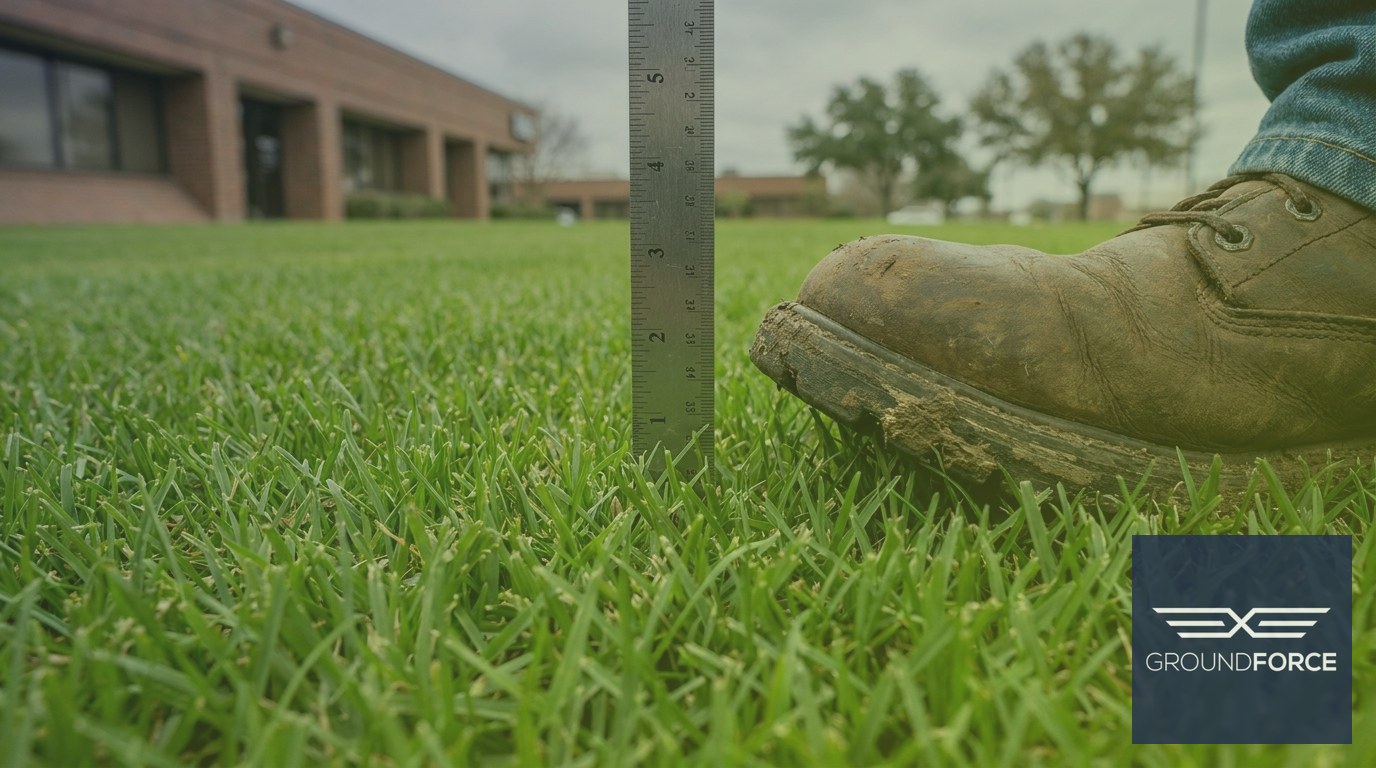
Bermuda grass dominates high-traffic business park turf because it tolerates heavy foot traffic and recovers rapidly through the Georgia summer. That vigor requires precise mowing height management to prevent thatch buildup: University of Arkansas Division of Agriculture extension guidance sets hybrid Bermudagrass at 0.5 to 1.5 inches and common Bermudagrass at 1.5 to 2.5 inches. Oklahoma State University Extension reported in 2017 that thatch in warm-season lawns should not exceed 1/2 inch. Past that depth, Bermudagrass thins and turns disease-prone.
Zoysia grass suits upscale office campus settings through a dense canopy that suppresses weeds naturally and drought tolerance that holds turf through dry stretches. Zoysia grows slowly. Over-mowing triggers long recovery windows and visible scalping scars that persist for weeks.
Many Georgia office campuses run mixed species, with Bermuda in open fields and Fescue in shaded areas. Fescue zones require completely separate mowing height and fertilization timing from adjacent Bermuda, and failing to split these zones is one of the most common provider errors on mixed-species Georgia commercial properties. The mechanics of warm-season vs. cool-season grass selection explain the mismatch: Fescue grows on a cool-season calendar that Bermuda’s schedule cannot serve. Mixed-species properties therefore require split-program scheduling, which generic providers often fail to deliver.
How do business park managers know when their current turf program is failing and it’s time to switch providers?
Business park managers recognize a failing turf program through three observable indicators: bare patches that survive fertilization cycles, weeds that return within weeks of treatment, and mowing intervals that leave turf overgrown between visits. Each pattern traces to a correctable process failure.
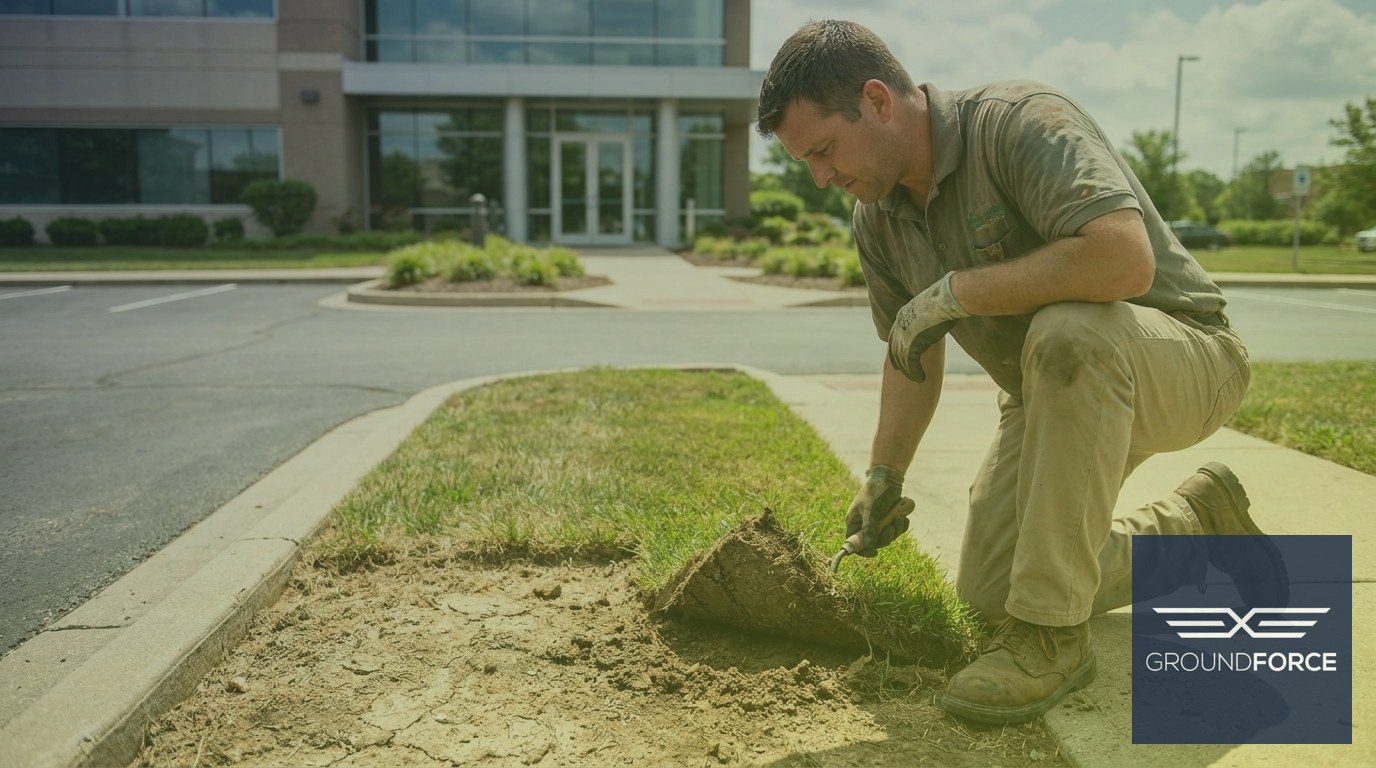
1. Recurring thin or bare patches at entry corridors and parking island edges. When these patches persist through repeated fertilization cycles, the cause is mowing technique, not nutrient deficiency. According to the Michigan State University Turfgrass Information Center (2002), turfgrass in compacted areas develops shallow rooting, low air porosity, and reduced infiltration, producing thin turf and bare areas that do not respond to fertilizer or water. Mower decks that scalp high-traffic edges and repeated wheel traffic over the same corridor create exactly this compaction. More fertilizer cannot fix a mechanical problem.
2. Weed pressure that re-emerges within weeks of treatment. Fast weed recurrence indicates reactive-only spraying without scouting or threshold-based intervention. A provider who treats only visible weeds never addresses germination timing, pre-emergent windows, or the conditions letting weeds establish in the first place.
3. Inconsistent mowing intervals that leave turf overgrown before visits. Overgrown turf at the time of service signals a provider managing too many accounts without route-appropriate scheduling. The crew then scalps the overgrown stand to catch up, which feeds the bare-patch cycle described above.
The signs are mechanical, not mysterious. Managers who document these warning signs of a failing turf plan hold objective grounds for a change rather than a vague complaint. Documented turf care schedules for Georgia’s climate should precede selecting a Georgia commercial turf provider, because a replacement contract built on the same route logic and reactive chemistry will reproduce the same turf within one growing season.
Sources
- Oklahoma State University Extension, “Thatch Management in Lawns” (2017)
- University of Georgia Cooperative Extension, “Turfgrass Fertility: Understanding Fertilizer Labels, Macronutrients, and Micronutrients” (2026)
- University of Georgia Cooperative Extension, “Turfgrass Fertility: Understanding Fertilizer Labels, Macronutrients, and Micronutrients (UGA Cooperative Extension Circular 1058)” (2025)