
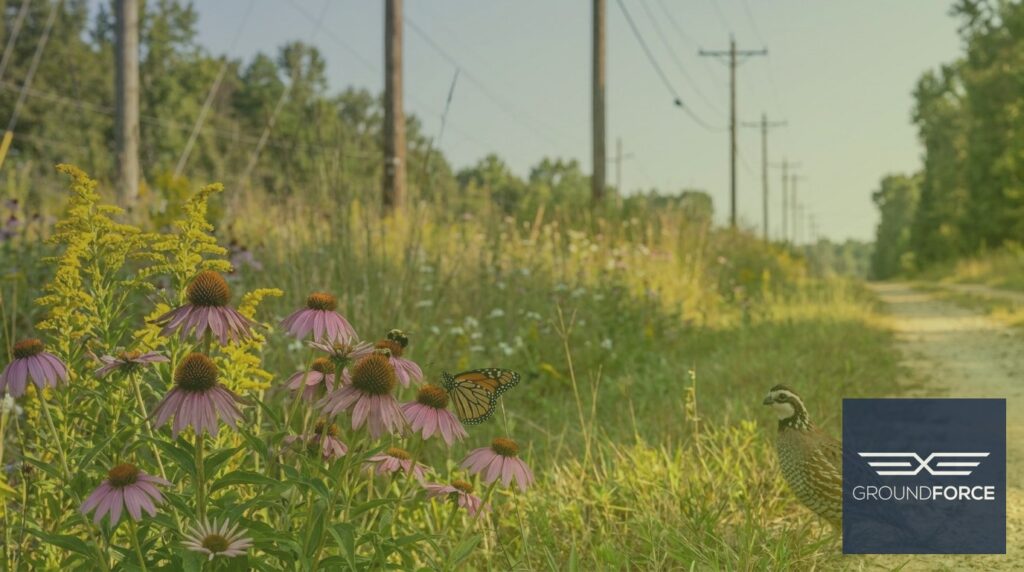
Commercial vegetation management in Georgia directly shapes habitat for native bees, monarch butterflies, bobwhite quail, and dozens of bird species across roadsides, utility corridors, and commercial properties. Every vegetation management decision, from mowing timing to herbicide selection, either removes or sustains the host plants and cover those species require. Vegetation management programs that account for mowing timing and herbicide selection can satisfy landowner compliance requirements while sustaining the habitat Georgia’s native wildlife requires, because the same practices serve both.
How does commercial vegetation management in Georgia affect native pollinators and wildlife?
Commercial vegetation management directly affects pollinator habitat quality on commercial and utility properties in Georgia. Every mowing cycle, herbicide application, and clearing decision removes, suppresses, or alters the plant communities that feed and shelter native bees, butterflies, birds, and other wildlife.
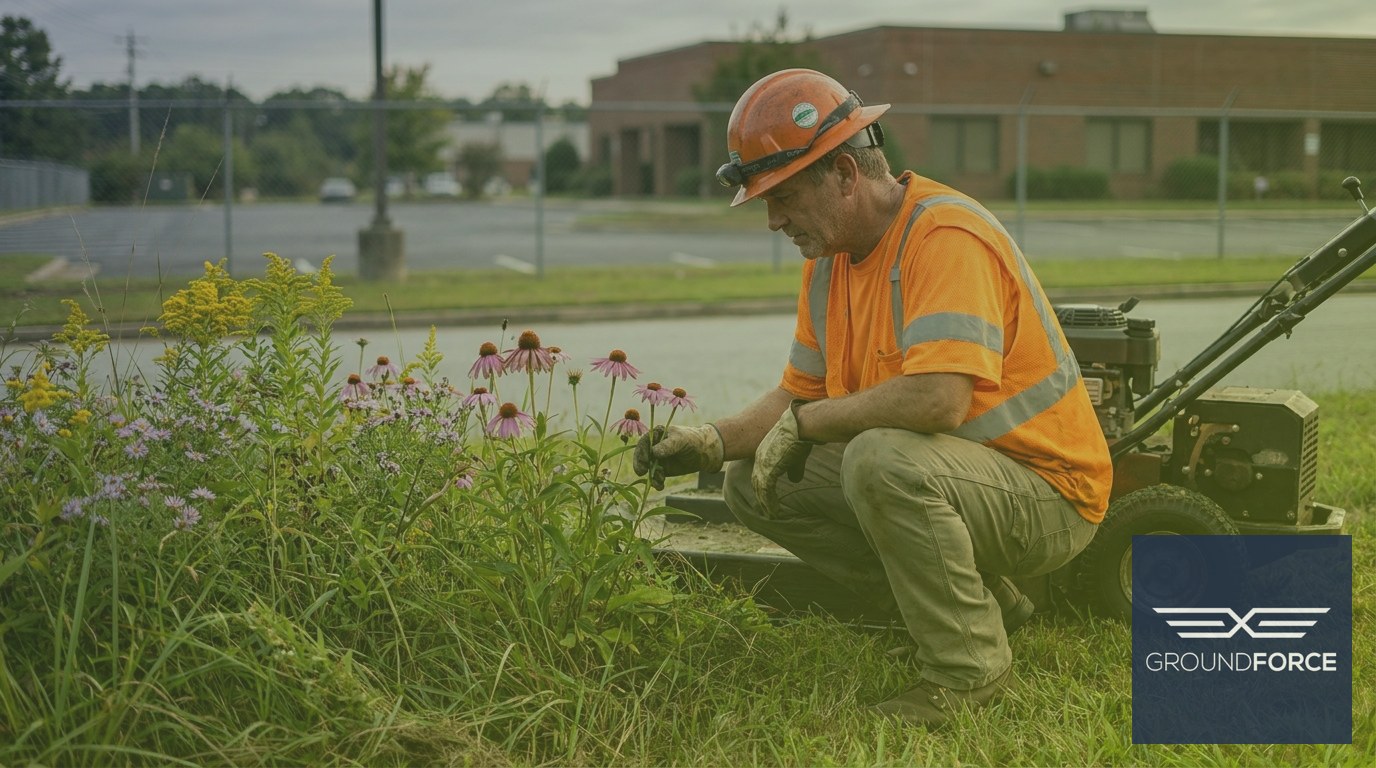
Three mechanisms drive that impact:
1. Removal. Clearing eliminates flowering forbs and shrubs outright. Pollinators lose nectar and pollen sources, and birds lose seed, fruit, and the insect prey those plants support. 2. Suppression. Repeated mowing or broadcast herbicide holds vegetation in a juvenile state. Plants never flower or set seed, and the food supply disappears even where green cover remains. 3. Alteration. Selective chemistry shifts species composition, and a simplified plant community supports a simplified wildlife community.
Georgia’s geography raises the stakes. The state spans the Piedmont, the Coastal Plain, and the Blue Ridge, and managed properties in each region host distinct native species with different habitat needs. A powerline corridor in the Blue Ridge intersects different plant communities than a distribution center site in the Coastal Plain, so no single statewide prescription fits both. The Coastal Plain alone covers about 60 percent of the state and forms part of the world’s 36th Biodiversity Hotspot, according to the University of Georgia Department of Entomology. The New Georgia Encyclopedia (2017) counts more than 4,000 species of native or naturalized vascular plants and vertebrate animals in Georgia, with at least 10 percent in danger of extinction. The U.S. Fish & Wildlife Service lists over 650 Georgia plant species of special concern, 25 protected under the Endangered Species Act, and 130 protected by state wildlife protection laws.
The operational distinction that matters is between ecologically indiscriminate and ecologically targeted management. Indiscriminate practice treats every plant as a liability: blanket herbicide, uniform mowing, and clearing timed without regard to bloom or nesting seasons. Targeted practice treats vegetation as a resource to be shaped. Targeted programs remove invasive and incompatible species, retain native flowering plants where safety clearances allow, and schedule work around pollinator activity. At landscape scale the difference compounds, because commercial and utility corridors cross thousands of contiguous acres. Indiscriminate practice degrades habitat across entire regions; targeted practice lets those same corridors function as habitat. The wildlife habitat and Georgia land stewardship documents the mowing heights, treatment windows, and buffer practices that protect ground-nesting bees and nesting birds.
Ground Force designed its eco-responsible program to address these stakes in the Georgia commercial market. Ground Force crews inventory site vegetation before work begins, flag native species worth retaining, and apply selective treatments rather than broadcast chemistry. Eco-responsible vegetation management in Georgia connects these field practices to commercial property performance.
What is Integrated Vegetation Management and how does it protect wildlife?
Integrated Vegetation Management (IVM) is a science-based approach that combines mechanical, chemical, biological, and cultural control methods to achieve vegetation objectives while minimizing non-target impacts. IVM’s selective application preserves the food sources, cover, and movement corridors wildlife depends on.
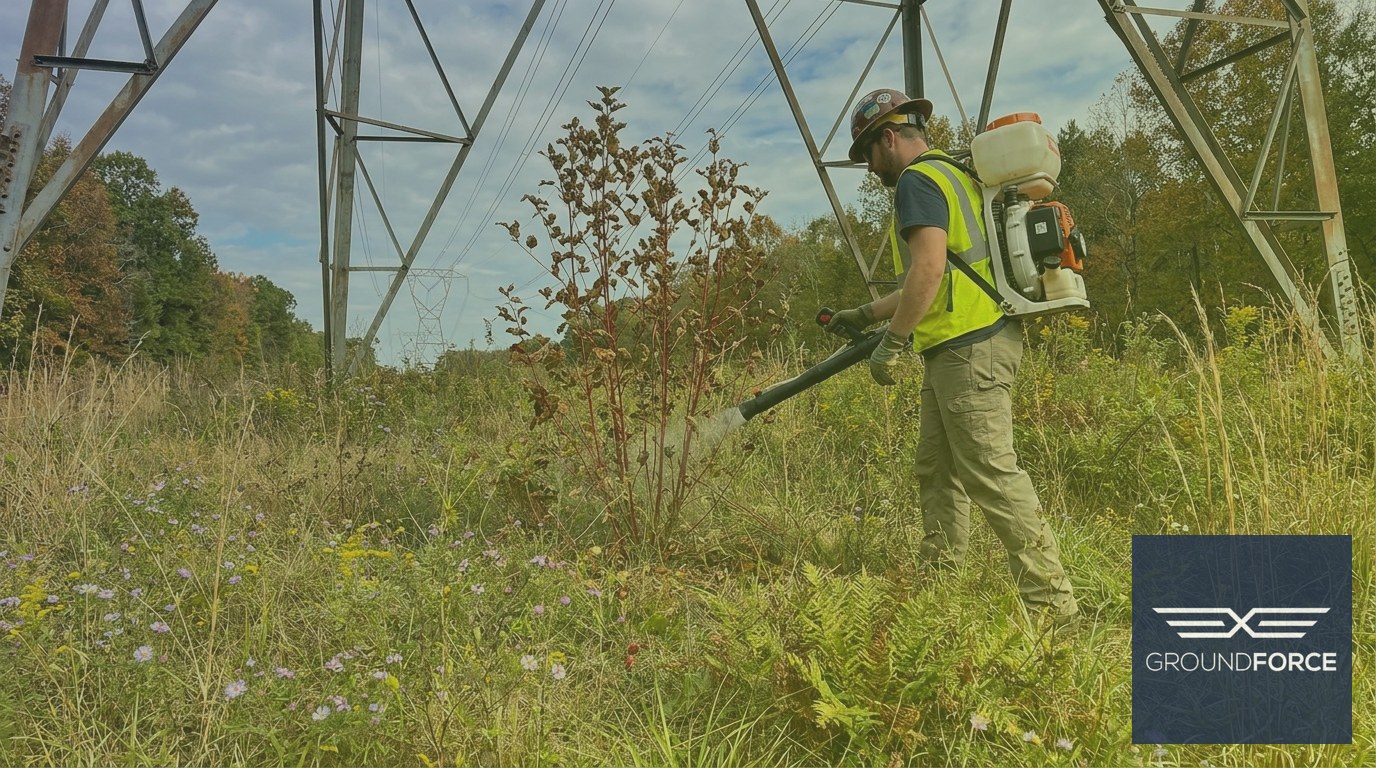
Selective targeting separates IVM from broadcast treatment. Broadcast application treats every plant in a corridor as a target; IVM removes only the species that conflict with the management objective, such as tall-growing trees beneath transmission lines. Surrounding forage, cover, and nesting structure survive, so pollinators retain nectar sources and birds retain nesting habitat.
The habitat value scales across large acreage. According to a 2024 Bay Journal report, the United States contains 60 million acres of rights-of-way, a total larger than the national park system, and every acre requires maintenance and can serve as pollinator and wildlife habitat. A 2021 PubMed Central study found that rights-of-way management holds plant communities in early succession, which correlates positively with bee diversity and abundance, particularly for solitary bees, while meeting conservation objectives at no additional cost.
Integrated Vegetation Management (IVM) is the framework used by eco-responsible commercial vegetation managers to balance control objectives with wildlife habitat retention. Georgia contractors practicing eco-responsible clearing and habitat preservation apply IVM across commercial sites, utility corridors, and rights-of-way. The wildlife-friendly vegetation management practices cover the techniques, timing windows, and species considerations behind each control decision.
A commercial IVM program in Georgia combines four control categories:
- Mechanical control: mowing, brush cutting, and selective clearing scheduled outside nesting and peak bloom periods.
- Chemical control: targeted treatment of individual stems and invasive patches instead of broadcast spraying, leaving non-target forage intact.
- Biological and cultural control: competitive low-growing plant communities and biological agents suppress target species without disturbing surrounding habitat.
- Buffer zone retention: unmowed strips along wetland edges and stream banks. Georgia water quality rules already require many of these buffers, and each buffer also functions as a wildlife movement corridor, a compounding ecological benefit at no additional operational cost.
How can commercial vegetation managers protect Georgia’s pollinators during operations?
Commercial vegetation managers protect Georgia’s pollinators by timing herbicide applications outside bloom periods, scouting treatment zones for actively flowering plants, limiting high-toxicity surfactants and adjuvants, avoiding soil disturbance near ground-nesting bee colonies, and retaining native milkweed on managed land.
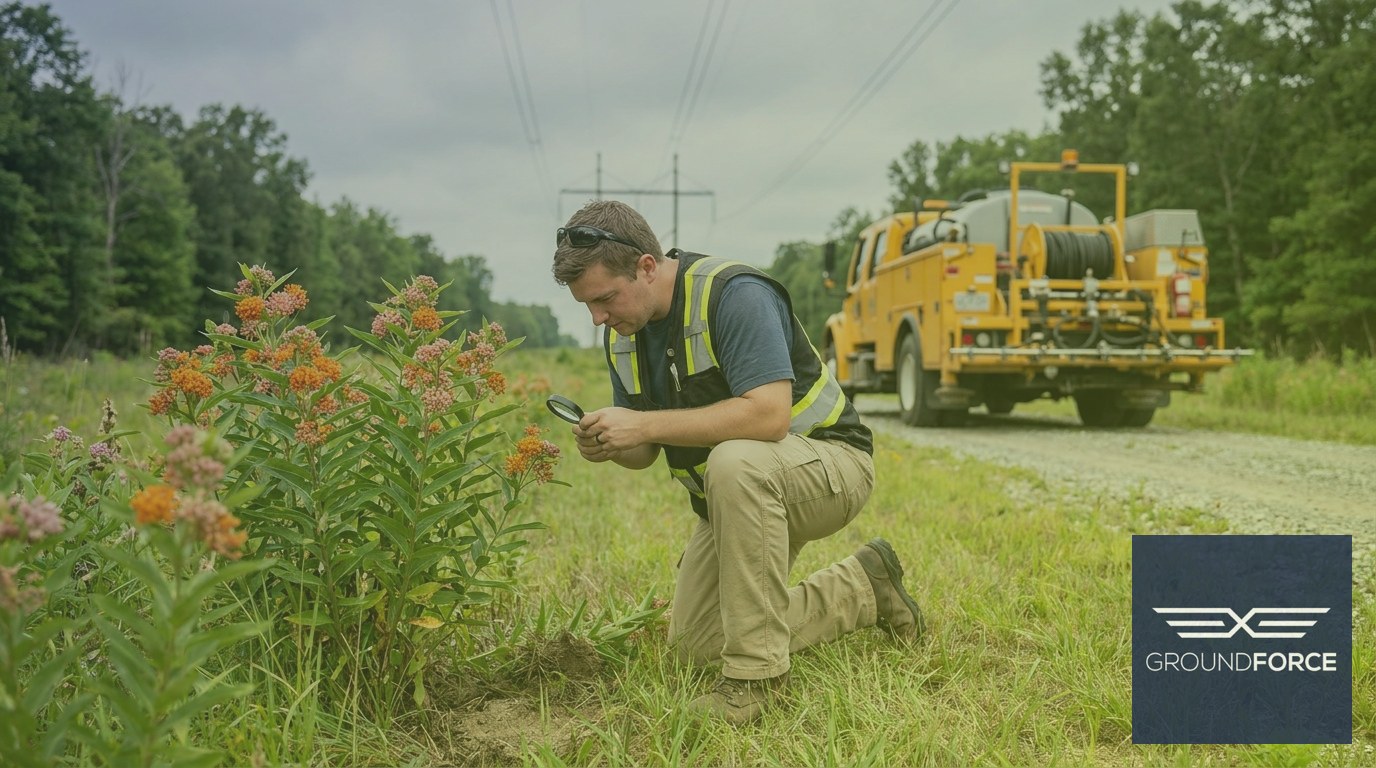
The operational core of protecting Georgia’s native pollinators is targeting in space and time, not substituting one product for another. Herbicide application timing is a primary lever for reducing pollinator exposure during commercial vegetation management operations, and effective herbicide timing to minimize pollinator exposure requires field-level scouting of bloom conditions rather than a label swap. Crews identify actively flowering plants within and adjacent to treatment zones, then schedule applications outside those windows, and that scouting discipline determines when to apply herbicides safely near pollinators. According to a 2021 Electrical Contractor magazine report, low-volume, selective herbicide treatments along an electrical transmission right-of-way created optimal pollinator habitat and produced significant increases in the diversity and abundance of butterflies and bees.
Product selection remains a secondary but real factor. Surfactant toxicity and adjuvant chemistry shape actual exposure risk, so applicators favor selective formulations at low volumes. Georgia’s native bee diversity, including mining bees, sweat bees, and bumble bees, extends pollinator risk beyond managed honeybees, so crews flag and buffer bare-ground nesting areas before mowing or disking because mechanical soil disturbance destroys nesting sites directly.
Georgia’s commercial and utility properties represent an underutilized opportunity for monarch butterfly milkweed habitat at landscape scale. The U.S. Fish & Wildlife Service (2020) reports that monarchs depend on Georgia’s floral resources during spring and fall migration to and from their Mexican wintering grounds, and the agency’s Nationwide Candidate Conservation Agreement for Monarch Butterfly on Energy and Transportation Lands gives utility managers a formal enrollment mechanism. Native milkweed ranks among the highest-value habitat species supporting Georgia pollinators on commercial sites, which makes creating pollinator habitat within commercial vegetation management programs a practical operational goal rather than an added expense. Established monarch butterfly milkweed programs on commercial and utility properties convert low-visibility strips into breeding habitat.
How does right-of-way vegetation management affect birds and avian habitat in Georgia?
Right-of-way vegetation management affects Georgia birds through two opposing mechanisms: removing invasive shrub monocultures that offer poor habitat and building stable low-grow communities of native grasses and forbs that ground-nesting species such as northern bobwhite quail and prairie warblers require.
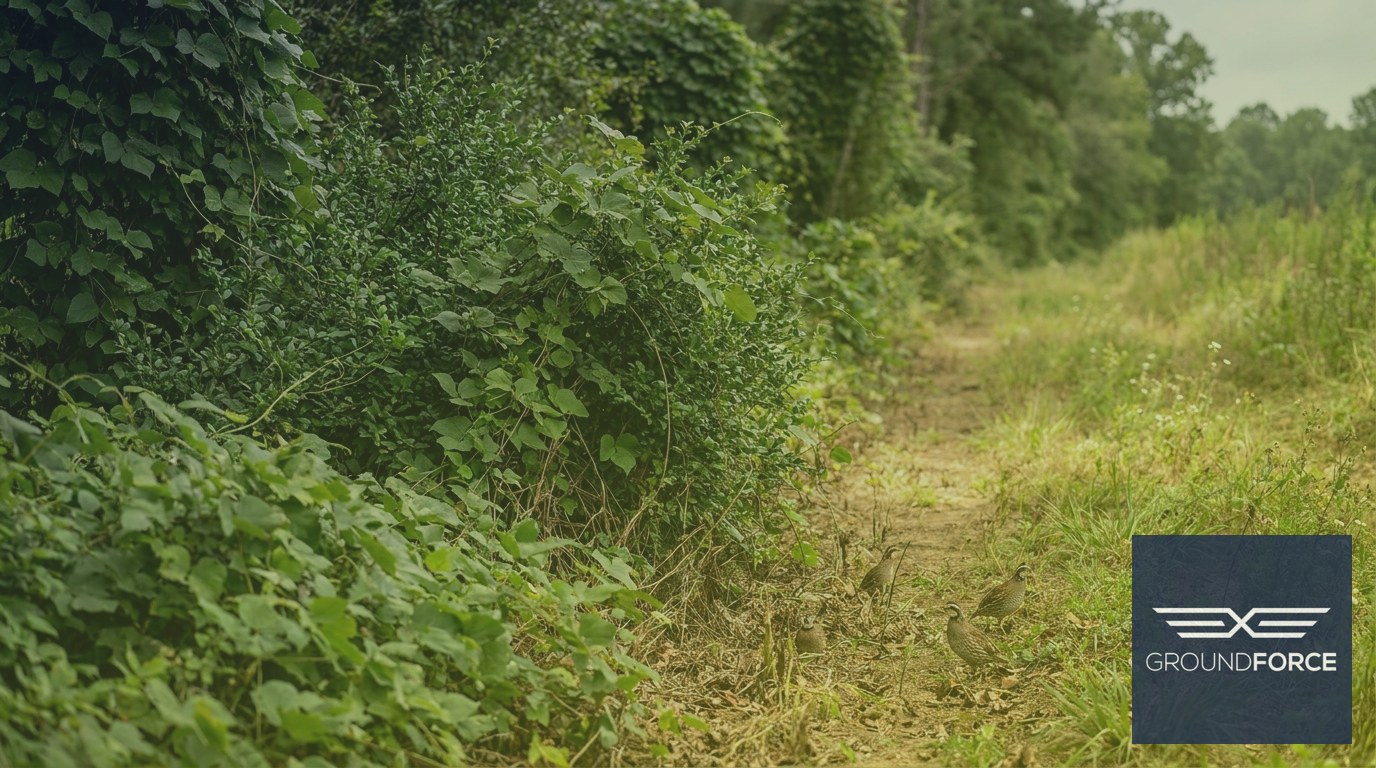
The mechanism runs in sequence:
1. Invasive monocultures establish low-value cover. Unmanaged Georgia corridors fill with Chinese privet and kudzu, dense tangles that provide structurally poor nesting and foraging habitat for most native bird species. 2. Low-grow management removes the monoculture. Selective herbicide and mowing cycles eliminate invasive shrubs while retaining native seed banks. North Georgia EMC maintains more than 6,500 miles of electrical line across seven northwest Georgia counties on a five-year tree-trimming and herbicide cycle, according to North Georgia EMC. 3. Native grasses and forbs stabilize the corridor. Right-of-way low-grow vegetation management creates open shrubby habitat that benefits ground-nesting birds including northern bobwhite quail. Prairie warblers use the same brushy edge structure. 4. Birds occupy the managed corridor. The result functions as early-successional habitat, a condition increasingly scarce across Georgia’s maturing forests and intensive farmland.
The common assumption that all vegetation removal harms birds ignores the replacement community. A corridor cleared of privet and held in native grasses gains avian diversity; a corridor abandoned to privet loses it. The standard applied on these corridors matters at scale: Yale Environment 360 reports that transmission rights-of-way total roughly 9 million acres nationwide, with pipeline corridors adding another 12 million, a combined footprint larger than one-third the area of the national park system.
The northern bobwhite quail is the practical yardstick. Bobwhite populations in Georgia have declined significantly alongside agricultural intensification, so a corridor program producing quail-compatible structure is producing wildlife-compatible habitat by measurable proxy.
A companion resource documents how ROW programs affect avian habitat at the species level across Georgia transmission corridors.
How do native plants within commercial vegetation programs support pollinators and reduce management costs?
Native plant communities reduce long-term vegetation management cost while supporting pollinators, birds, and wildlife on commercial properties. Established native stands require fewer mowing cycles, less herbicide, and less replanting than ground dominated by invasive species, and designated habitat zones carry a lower per-acre treatment cost.
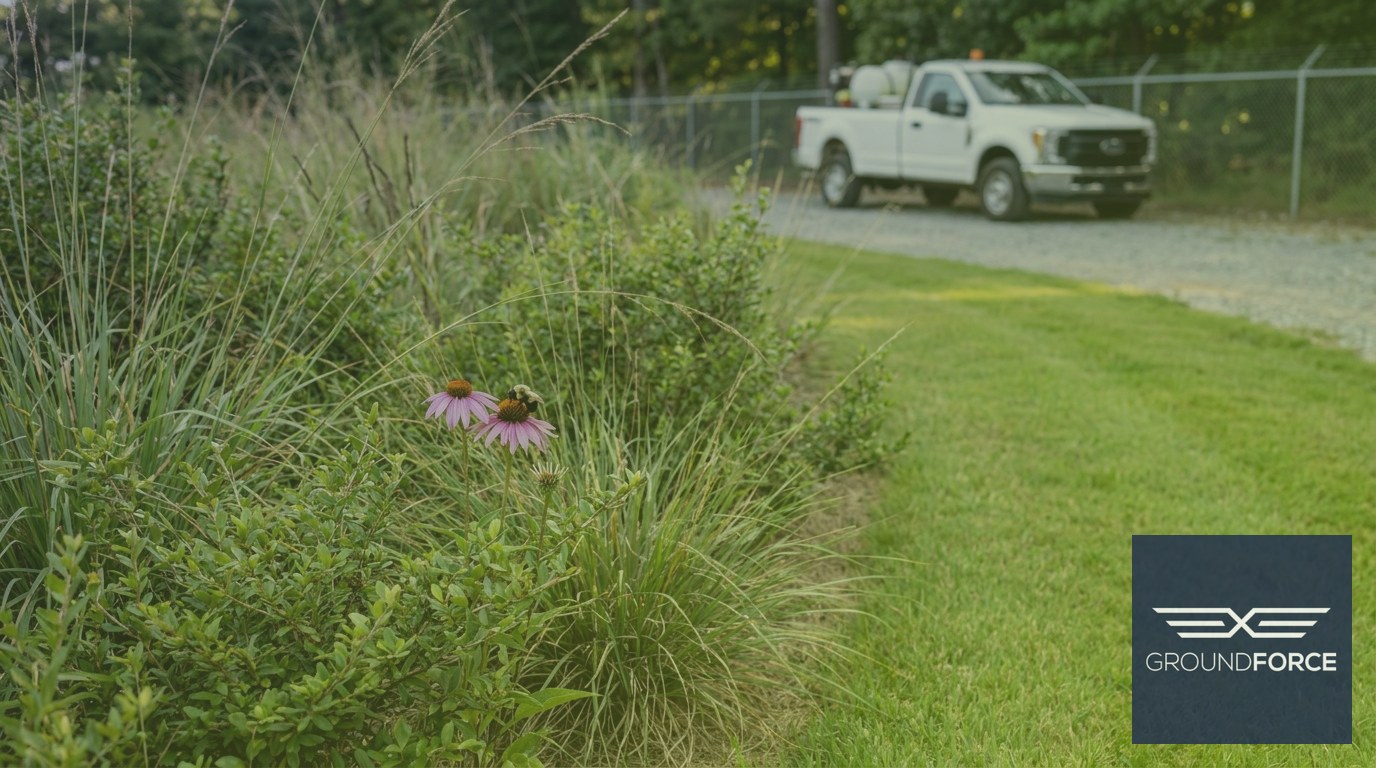
Native plant communities require less active management input once established than disturbed-plant communities dominated by invasive species. Native plantings front-load labor into site preparation and active oversight through the establishment period; after canopy closure, the native stand largely maintains itself, while invasive-colonized ground demands repeated herbicide applications and mowing passes every season.
Designating native habitat strips inside the managed boundary re-zones the management objective for those acres, typically replacing turf-level control with periodic monitoring. Total controlled acreage stays intact, and per-acre treatment cost drops within the designated zones.
Native plants support native bees, butterflies, and birds that exotic ornamentals and turfgrass do not. The monarch butterfly milkweed programs on commercial properties convert low-visibility strips into breeding habitat.
The Xerces Society for Invertebrate Conservation reports that transportation rights-of-way in the United States encompass more than 10 million acres of land. According to Electrical Contractor magazine (2021), a study in Biological Conservation found that high-voltage power line corridors alone can potentially provide approximately 5 million acres of habitat. Commercial parcels joined by native strips operate as pollinator corridors in managed vegetation, applying the corridor principle at parcel scale.
Georgia site managers can review species selection and establishment sequencing in The Role of Native Plants in Eco-Responsible Commercial Vegetation Programs, and pollinator protection practices in How Commercial Vegetation Management Can Protect Georgia’s Native Pollinators. Wildlife-supporting native plant programs combine both functions inside one maintenance budget.
Sources
- New Georgia Encyclopedia, “Species Extinction and Endangered Species” (2017)
- Yale Environment 360, “Electric Power Rights of Way: A New Frontier for Conservation”
- Electrical Contractor magazine, “Rights-of-Way Are for the Birds: Managing power line corridors to help wildlife” (2021)
- Xerces Society for Invertebrate Conservation, “Managing Roadsides and Rights-of-Way for Pollinators”
- Bay Journal, “Power, pipeline corridors are becoming wildlife habitat” (2024)
- North Georgia EMC, “Vegetation Management Services”