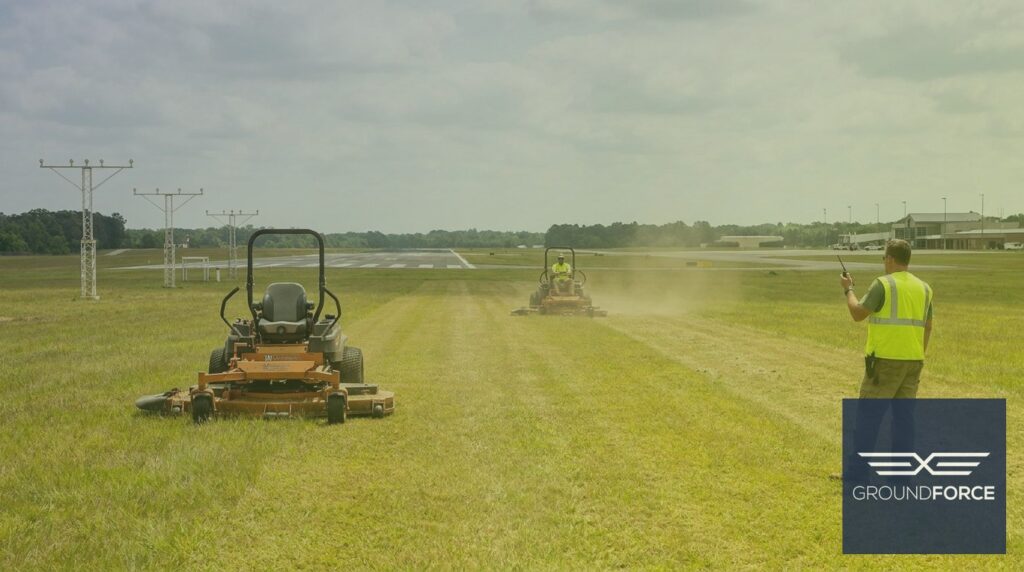
Airside vegetation management at Georgia airports operates as a federal safety compliance function under FAA Advisory Circular 150/5200-33 and Part 77 obstruction standards. Uncontrolled grass heights, woody encroachment, and dense perimeter cover attract birds and mammals, and each attractant raises bird strike risk and invites FAA enforcement. Ground Force delivers AC 150/5200-33-compliant vegetation management that keeps runways, safety areas, and approach corridors within regulatory tolerance year-round.
What FAA standards govern vegetation management on the airside of Georgia airports?
FAA Advisory Circular 150/5200-33 governs vegetation management practices on certificated airport airside areas as a wildlife hazard control, and 14 CFR Part 77 obstruction standards separately regulate tree and shrub height near approach and departure corridors. Part 139 certificated Georgia airports must satisfy both frameworks.
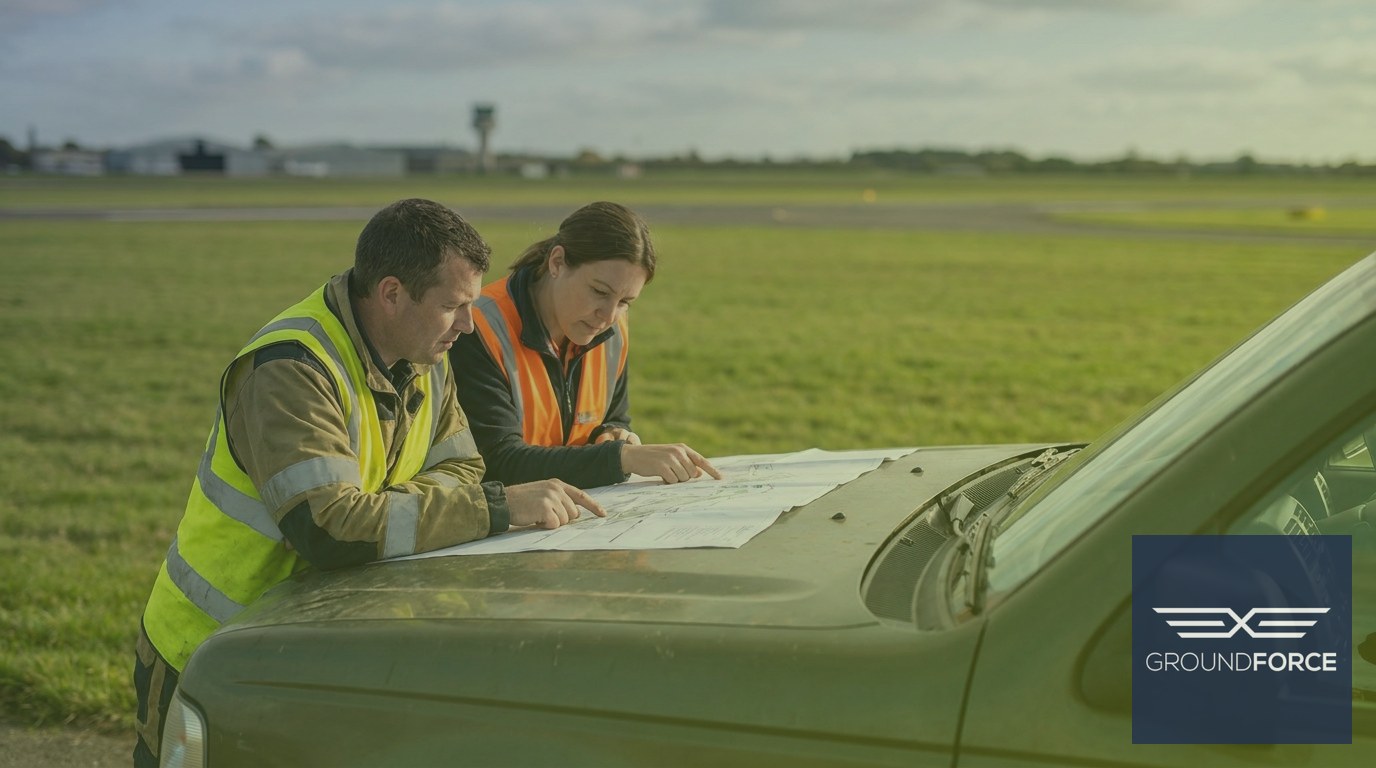
AC 150/5200-33, titled “Hazardous Wildlife Attractants on or Near Airports,” is the FAA’s primary guidance document for wildlife hazard management. The Advisory Circular treats vegetation as both habitat and attractant: turf, shrubs, and trees supply food, cover, and nesting sites for the species behind strike risk. Airport operators translate FAA Advisory Circular 150/5200-33 requirements into mowing specifications, planting selections, and drainage standards for vegetated areas.
Applicability in Georgia runs through 14 CFR Part 139, the certification regulation for airports serving scheduled air carrier operations. Hartsfield-Jackson Atlanta International Airport and Georgia’s other commercial service airports fall squarely inside that framework. General aviation airports not certificated under Part 139 are not formally subject to AC 150/5200-33, but FAA grant assurances tied to Airport Improvement Program funding still impose wildlife hazard obligations. Most publicly funded Georgia general aviation airports therefore operate under equivalent practical requirements even without a formal certificate.
The FAA defines vegetation as a wildlife attractant by function, not by species list alone. Seed-bearing grasses feed flocking birds, dense woody cover shelters mammals and roosting flocks, and standing water inside vegetated swales draws waterfowl. On grass height, the Advisory Circular sets no single universal number. The guidance prohibits vegetation that attracts wildlife and references an acceptable turf range, typically 7 to 14 inches, because that height discourages foraging by starlings, geese, and similar species. An airport cannot scalp everything to two inches and assume compliance; seed-head structure and plant composition attract or repel wildlife as much as blade height does.
14 CFR Part 77 supplies the second regulatory driver. Part 77 establishes imaginary surfaces around runways, and any tree or shrub penetrating an approach, departure, or transitional surface constitutes an obstruction. Airside vegetation programs clear woody growth in those corridors regardless of the wildlife analysis.
Non-compliance surfaces as a documented finding during FAA certification inspections. When inspectors observe an attractant created by unmanaged vegetation, or when a significant wildlife strike occurs in a poorly managed vegetated area, that vegetation failure directly triggers a required Wildlife Hazard Assessment, and the Assessment frequently matures into a binding Wildlife Hazard Management Plan. Sustained findings put the airport’s operating certificate at risk. The FAA wildlife hazard compliance overview details this escalation path from inspection finding to assessment to certificate action.
How does airside vegetation attract wildlife hazards and increase bird strike risk at Georgia airports?
Airside vegetation attracts wildlife by supplying food, cover, and roosting structure, and each attractant concentrates animals beside runways where strikes occur. Uncontrolled airside vegetation causes wildlife attractant conditions that increase bird strike risk, and uncontrolled airside vegetation can also trigger FAA enforcement action during airport certification inspections.
Three vegetation conditions account for most wildlife hazard activity on Georgia airfields:
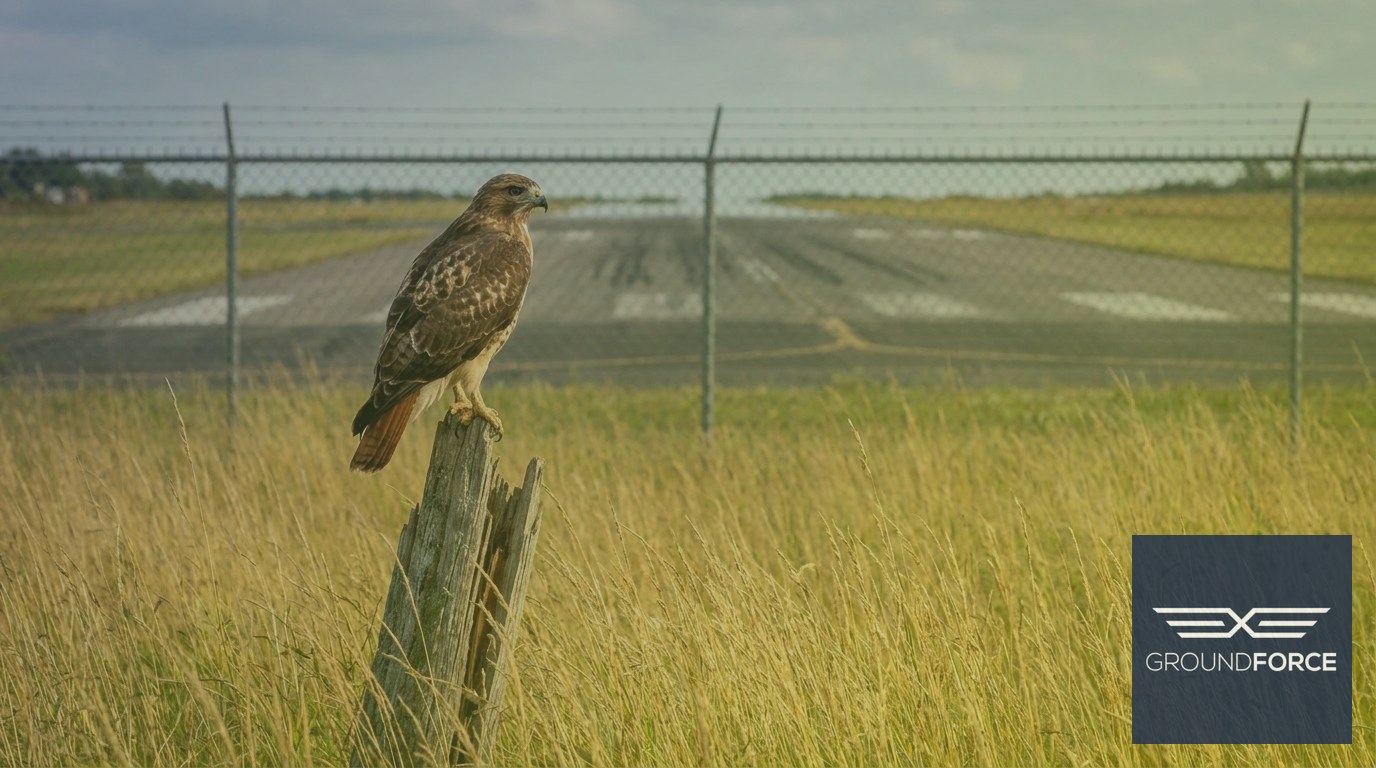
1. Tall grass conceals prey. Unmowed turf hides rodent populations, and raptors such as red-tailed hawks hunt low over airfields where that prey base thrives. The grass height thresholds and bird attraction documented in FAA airfield guidance explain why mowing turf removes the forage base raptors hunt.
2. Seed-bearing forbs feed flocking birds. Seed heads on unmowed forbs draw mourning doves, blackbirds, and waterfowl into open movement areas. Flocking species multiply exposure, since one ingestion event can involve several birds.
3. Woody edge cover shelters large animals. Brush lines and perimeter tree rows give white-tailed deer and coyotes travel corridors and give turkey vultures roosting structure inside the airfield boundary.
Georgia’s hazard profile centers on species tied to specific vegetation. Canada geese favor short turf adjoining stormwater ponds and emergent wetland edges. Black vultures and turkey vultures roost in mature tree lines and soar over open mowed ground. White-tailed deer bed and browse in brushy fencerows and unmaintained perimeter strips, then cross runways at dawn and dusk.
The FAA Wildlife Strike Database records these events, and strike costs include destroyed engines, airframe repair, aircraft downtime, and runway closures that halt operations. Vegetation management remains the most cost-effective preventive control because mowing and habitat removal eliminate the attractant before animals enter the aircraft environment, while hazing and relocation address the animal only after habitat has drawn it in. The FAA regulatory framework for airfield wildlife assigns that habitat obligation to the airport operator, so unmanaged vegetation is a compliance liability as well as a safety hazard.
What does Ground Force’s FAA-compliant airside vegetation management service include?
Ground Force delivers FAA-compliant airside vegetation management across Georgia airports including grass height control, woody vegetation removal, and herbicide programs. The FAA-compliant airside vegetation management scope covers runway safety area mowing, approach-corridor clearing under Part 77, perimeter treatments, and coordinated airside operations with FOD prevention.
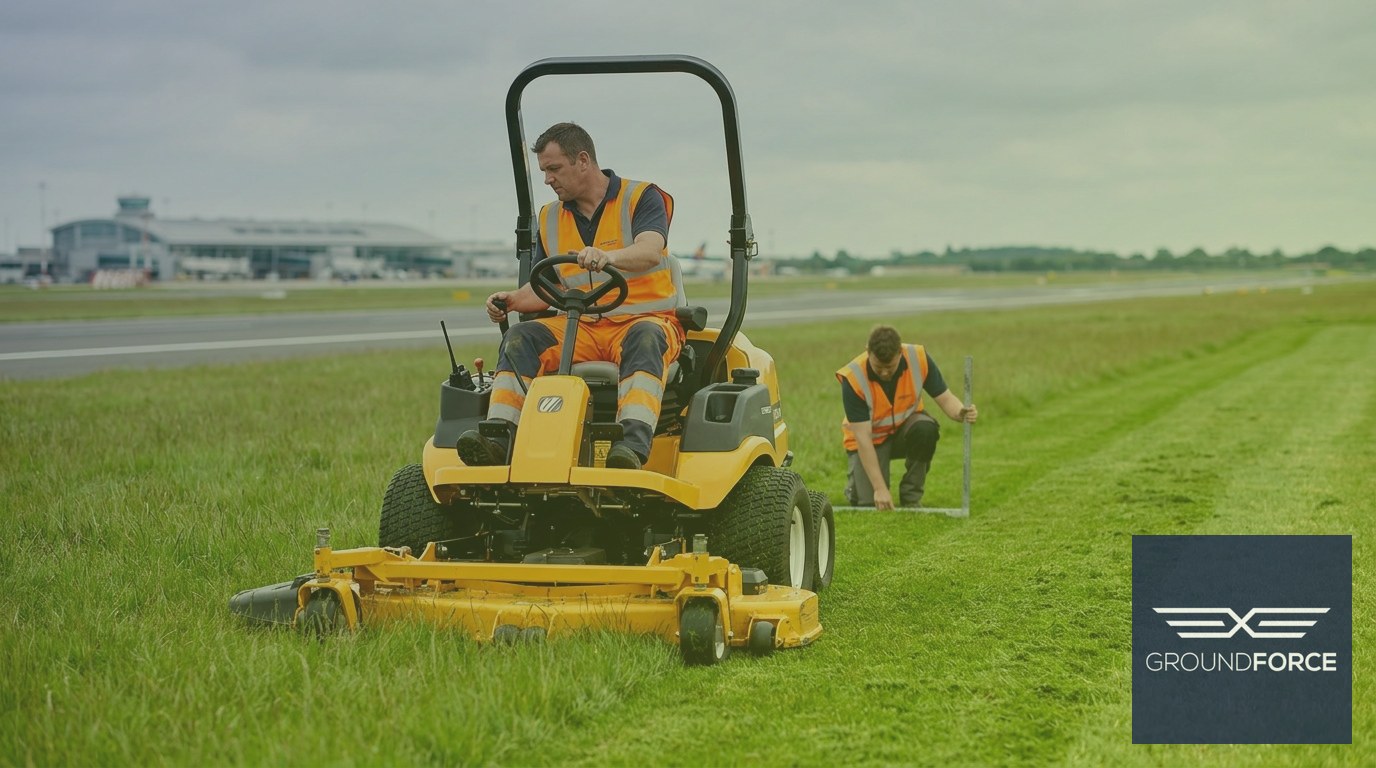
Grass height management. Ground Force mows runway safety areas, object-free zones, and runway clear zones to FAA-specified tolerances under the runway safety area mowing standards. Georgia’s climate accelerates airside vegetation growth rates, requiring higher mowing frequency than national averages to maintain FAA-specified heights. The warm-season turf common at Georgia airports, Bermuda, bahia, and tall fescue blends, grows two to three times faster from May through September than cool-season grass, so a mowing interval compliant in March can produce a wildlife-attractant condition by late May without schedule adjustment. Ground Force adjusts mowing schedules seasonally.
Runway Object Free Areas and Obstacle Free Zones carry stricter tolerances than the broader runway safety area: vegetation must stay below 7 inches, and mowing equipment cannot create a FOD hazard, which constrains equipment selection.
Herbicide programs. Ground Force’s herbicide programs for airport perimeters treat perimeter fences, taxiway edges, and pavement joints, pairing selective products near maintained turf with non-selective products on pavement and along fence lines under Georgia environmental compliance requirements. Ground Force structures these applications as an eco-friendly integrated pest management program that favors targeted selective chemistry over blanket non-selective spraying. Perimeter fence lines are a compliance flashpoint in Georgia: vegetation growing through chain-link fencing compromises wildlife exclusion and creates an FAA inspection finding, so the program protects both vegetation control and fence integrity.
Tree and shrub removal. Ground Force removes trees and shrubs that penetrate approach and departure corridors, keeping Part 77 obstruction surfaces clear of vegetation.
Airside operational protocols. Crews coordinate with airport operations before entering movement areas, follow FOD prevention procedures, and observe equipment access restrictions on active airfields.
How does Part 77 drive tree and shrub removal programs in airport approach and departure corridors?
Part 77 obstruction standards drive tree and shrub removal programs in airport approach, departure, and transition surfaces by converting five imaginary surfaces into enforceable height limits. Any woody growth that penetrates a surface becomes a removal target, and allowable vegetation height rises with distance from the runway threshold.
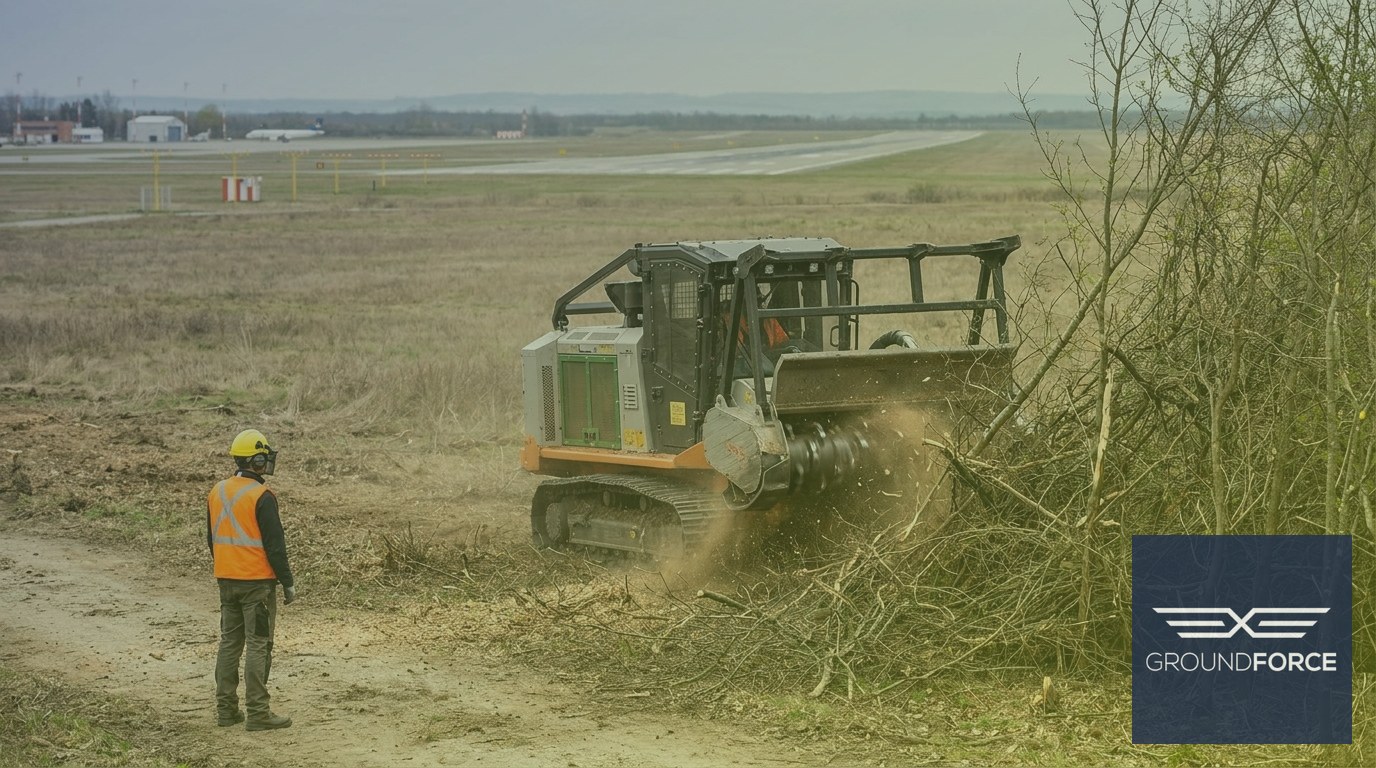
The five imaginary surfaces are the approach surface, the departure surface, the transitional surface, the horizontal surface, and the conical surface. Approach and departure surfaces slope upward from the runway ends, so a tree tolerated far from the threshold becomes a violation close to it. Transitional surfaces flank the runway and its approach zones, while horizontal and conical surfaces cap height above and around the airfield.
Penetration response follows a four-step sequence:
1. Survey. Ground Force supports aerial and ground surveys that map tree and shrub crown elevations against each surface, and every stem crossing a surface is logged as a penetration. 2. Notify. The airport sponsor carries a regulatory obligation, through its FAA grant assurances and certification requirements, to report identified penetrations to the FAA and to remediate them. Filing notice is mandatory. 3. Remove. Ground Force executes tree removal in airport approach corridors through sectional dismantling near active pavement, stump treatment, and haul-off, with all work performed under the airport’s escort, badging, and movement-area rules. 4. Suppress. Scheduled re-inspection and targeted herbicide or mechanical control hold regrowth below surface elevations between clearance cycles.
The FAC-003 utility vegetation enforcement standards documents a parallel federal regime for transmission lines, where reportable vegetation contact carries penalties. Airports operate under the same enforceable-clearance logic.
How does airside vegetation management fit into an airport’s Wildlife Hazard Management Plan?
Airport vegetation management integrates into the Wildlife Hazard Management Plan required by the FAA for certificated airports as a first-tier habitat control measure. The plan names vegetation species, mowing heights, and inspection frequencies that make airfield acreage unattractive to hazardous wildlife, and FAA reviewers verify the airport executes those written controls.
1. Trigger and assessment. The FAA requires a Wildlife Hazard Management Plan after a qualifying wildlife strike or when an FAA-directed Wildlife Hazard Assessment identifies attractants. The plan must inventory habitat hazards on airport property and prescribe corrective habitat management for each one.
2. Habitat controls before hazing or lethal take. The vegetation control within wildlife hazard plans ranks as the first tier of response, ahead of pyrotechnics, trapping, or lethal removal. Turf height management, removal of seed-bearing plants, and clearing of brush deny wildlife the food and cover that draw hazardous species to the airfield.
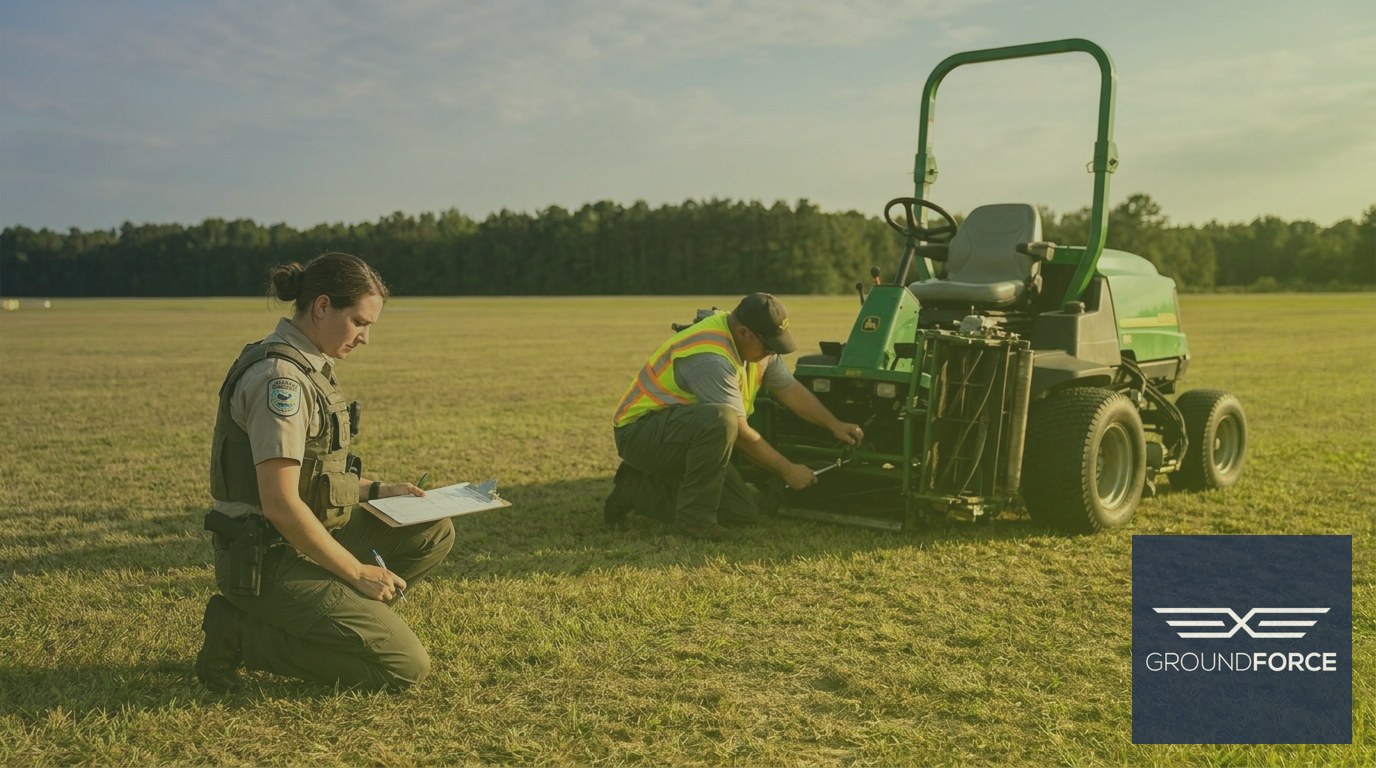
3. Documentation of the contracted program. A WHMP must name who performs each measure and how often. A contracted program such as Ground Force’s airside service can supply the required documentation through mowing schedules, height targets, and dated service logs.
4. FAA review. Certification inspectors compare field conditions against the written plan, and current mowing and inspection records demonstrate compliance.
Airside and landside vegetation work sit under entirely different regulatory frameworks. Airside work answers to FAA safety standards and requires coordination with airport operations to prevent runway incursions, while landside landscaping remains an aesthetic, civil function. Smaller Georgia airports create a documented compliance risk when a single landscaping contractor handles both scopes without distinguishing the two frameworks.