
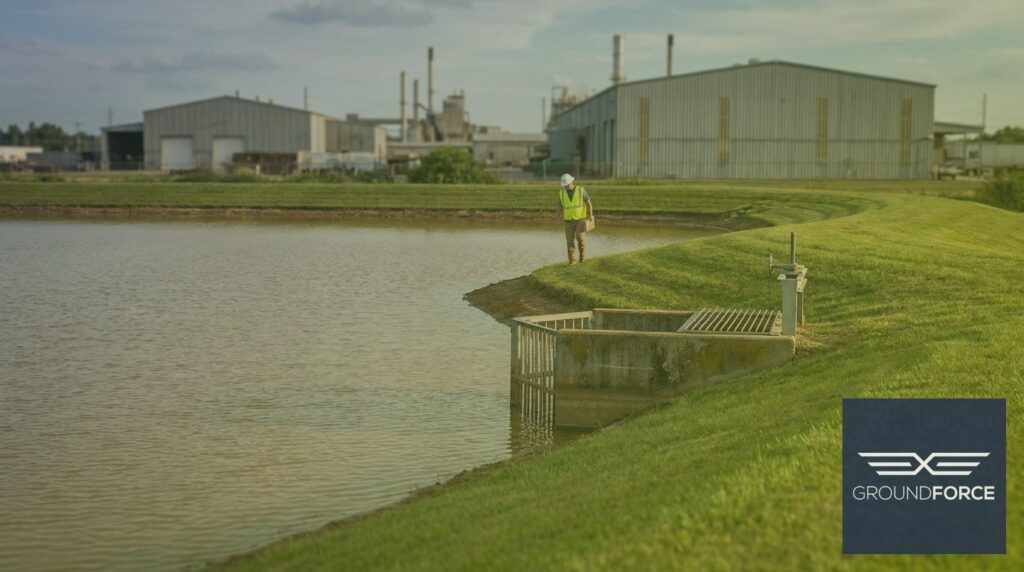
Retention pond vegetation management is a legal obligation for industrial facilities in Georgia: NPDES permits require controlled pond vegetation as part of each facility’s stormwater pollution prevention plan (SWPPP). Neglected vegetation reduces pond storage capacity, hides structural damage from inspectors, and invites invasive species that spread beyond the basin. Ground Force delivers industrial-grade vegetation management that keeps stormwater infrastructure inspection-ready and compliant year-round.
What makes retention pond vegetation management different for industrial properties?
Industrial retention pond vegetation management differs from standard commercial or HOA pond maintenance in scope, chemical use restrictions, and regulatory documentation demands. Industrial operators manage pond vegetation as a permit compliance obligation under NPDES and Georgia EPD enforcement, not as a cosmetic amenity.
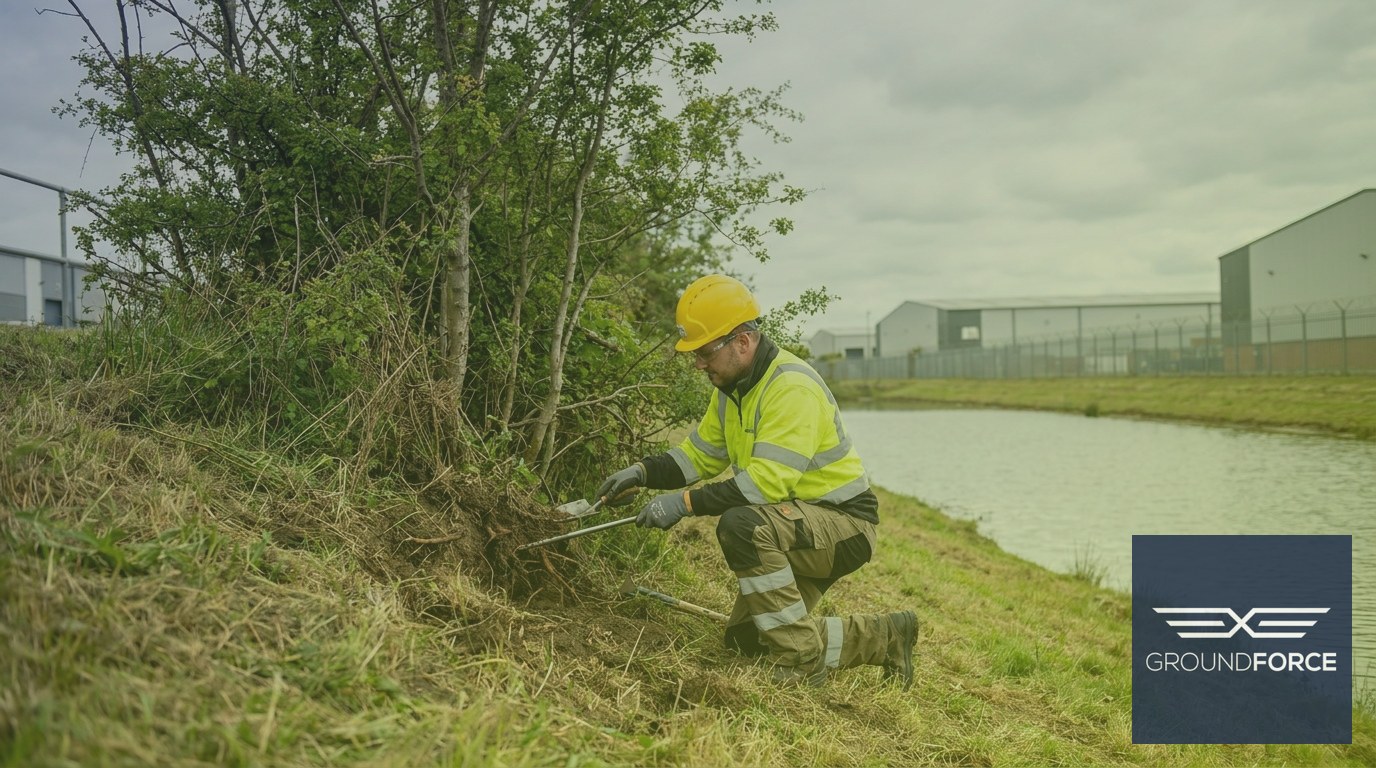
Facilities holding NPDES industrial stormwater permits answer to Georgia EPD inspectors, and vegetation that impedes outlet structures or destabilizes berms becomes a documented permit deficiency. The Association of State Dam Safety Officials reports that trees and brush growing on embankments and abutments physically impede inspection access, clog drainage systems, mask underlying structural concerns, and create habitat for burrowing animals whose activity alters embankment stability. Maryland Department of the Environment BMP design criteria show how engineers codify that risk: woody vegetation may not be planted on or allowed to grow within 15 feet of the toe of an embankment or within 25 feet of the principal spillway structure.
Every herbicide applied at or near the water line of an industrial pond must carry an EPA-registered aquatic label, and industrial work adds a restriction layer that commercial and HOA ponds never carry. Product selection, application timing, and treated acreage must satisfy the buffer zones and discharge restrictions written into each facility’s individual permit conditions. A permit can prohibit application before forecast rain or within a defined distance of a discharge point. Standard commercial and HOA pond maintenance carries no permit-specific buffer zones or discharge restrictions; those limits exist only inside an industrial facility’s NPDES permit conditions.
vegetation management for industrial compliance requires a recordkeeping trail that commercial pond contracts never demand: treatment logs, product labels, application maps, and applicator license numbers must exist in a form inspectors can review, because those records become part of the facility’s SWPPP and each herbicide application must trace back to a credentialed contractor. requires a recordkeeping trail that commercial pond contracts never demand: treatment logs, product labels, application maps, and applicator license numbers must exist in a form inspectors can review, because those records become part of the facility’s SWPPP and each herbicide application must trace back to a credentialed contractor.
Industrial stormwater systems also mix structure types. A single facility may pair a wet retention basin holding a permanent pool with a dry detention basin designed to empty between storms, and each structure type demands a distinct mowing, woody-removal, and herbicide protocol. Vegetation management for wet and dry detention basins at industrial sites reflects that split: managing plants in wet vs. dry basins means emergent vegetation in a permanent pool requires aquatic-labeled treatment, while a dry basin’s floor and outlet works need turf management and scheduled woody vegetation removal.
Site access at industrial properties adds logistical requirements absent from commercial and HOA contexts. Crews work around active industrial operations, restricted zones, and hazmat adjacency, often under facility escort and safety orientation requirements that no HOA contract imposes. Facilities generating or storing hazardous materials face additional buffer vegetation requirements near secondary containment areas, and vegetation work near those zones requires coordination with the facility’s environmental health and safety team before cutting or spraying begins.
How does retention pond vegetation management connect to NPDES permit compliance for industrial facilities in Georgia?
Industrial NPDES permits in Georgia require documented retention pond vegetation management as a stormwater control measure. The Georgia Environmental Protection Division enforces the requirement through SWPPP reviews and facility inspections, and unmanaged vegetation triggers notices of violation, corrective action orders, or permit jeopardy.
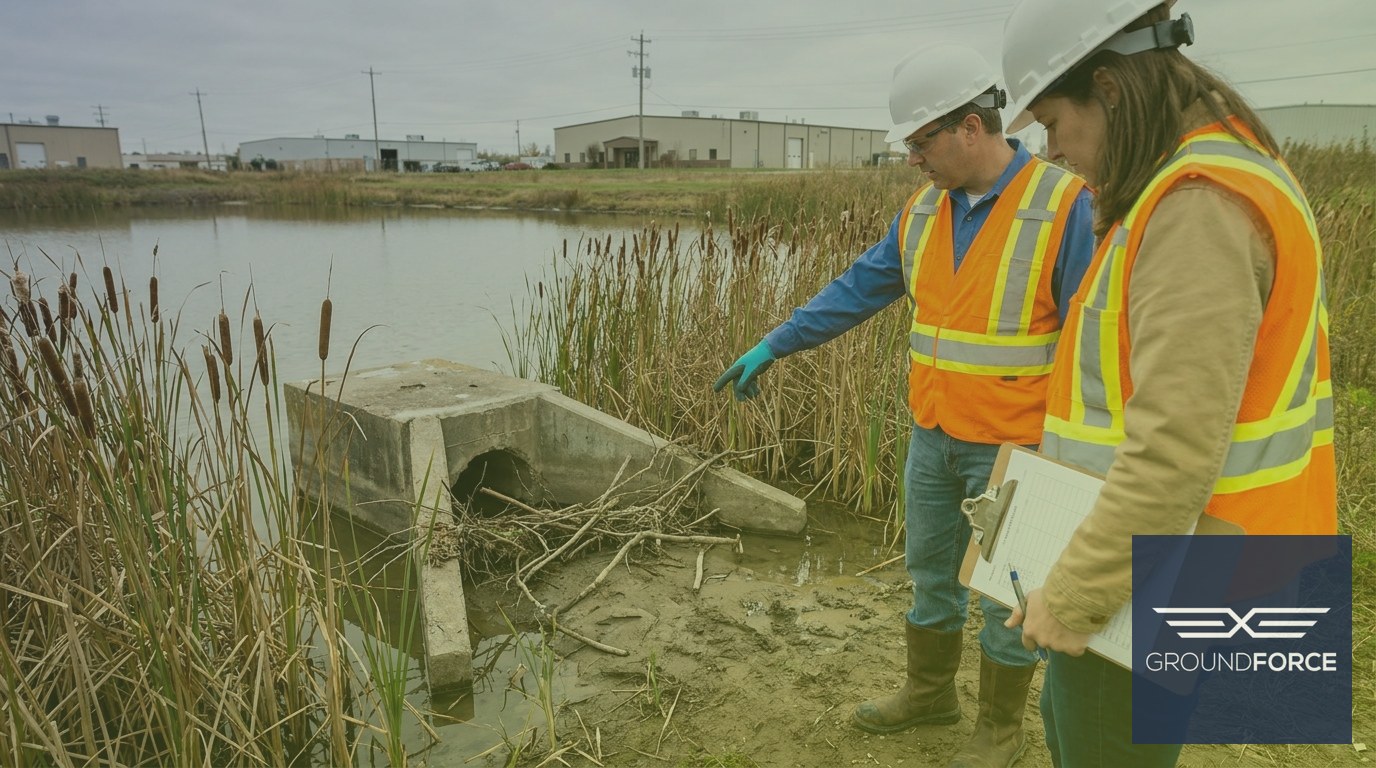
The federal stormwater rules for pond vegetation trace to 40 CFR §122.26, which All4 Inc. (2022) identifies as the mandate for industrial facilities with stormwater discharges to hold an NPDES permit. The Georgia Environmental Protection Division administers the Industrial General Permit (Permit No. GAR050000) under NPDES, and the permit obligates covered facilities to maintain stormwater controls, including retention pond vegetative buffers, as documented elements of their SWPPPs (Georgia EPD, 2023).
Georgia EPD (2023) reports 100 to 125 facility inspections per year under the Industrial General Permit, and inspectors use the standardized Facility Inspection Checklist (Form GAR050000, March 2023) to evaluate berm stability, outlet structure clearance, and buffer vegetation condition. The required inspection cycles for industrial ponds follow the order of the permit, and Georgia EPD inspectors issue permit citations for most checklist items. Vegetation management at these ponds is a structural compliance task, not groundskeeping: inspectors cite woody vegetation encroaching on berms and embankments as a structural integrity risk, and an encroachment finding supports a notice of violation.
Third-party vegetation management records support SWPPP documentation and satisfy inspector evidence requirements at industrial facilities, with each record logging service dates, treatments applied, applicator license numbers, and site observations. Facilities must document contractor credentials for SWPPP inclusion. Industrial facilities can verify current Georgia EPD inspection and documentation expectations against the 2026 Georgia pond permit updates.
What vegetation problems most commonly threaten industrial retention ponds in Georgia?
Woody growth on berms, invasive emergent stands of Phragmites australis and cattails at control structures, and dense vegetation that traps sediment and shrinks storage volume are the vegetation problems that most commonly threaten industrial retention ponds in Georgia. Each failure mode surfaces in Georgia EPD inspection reports.
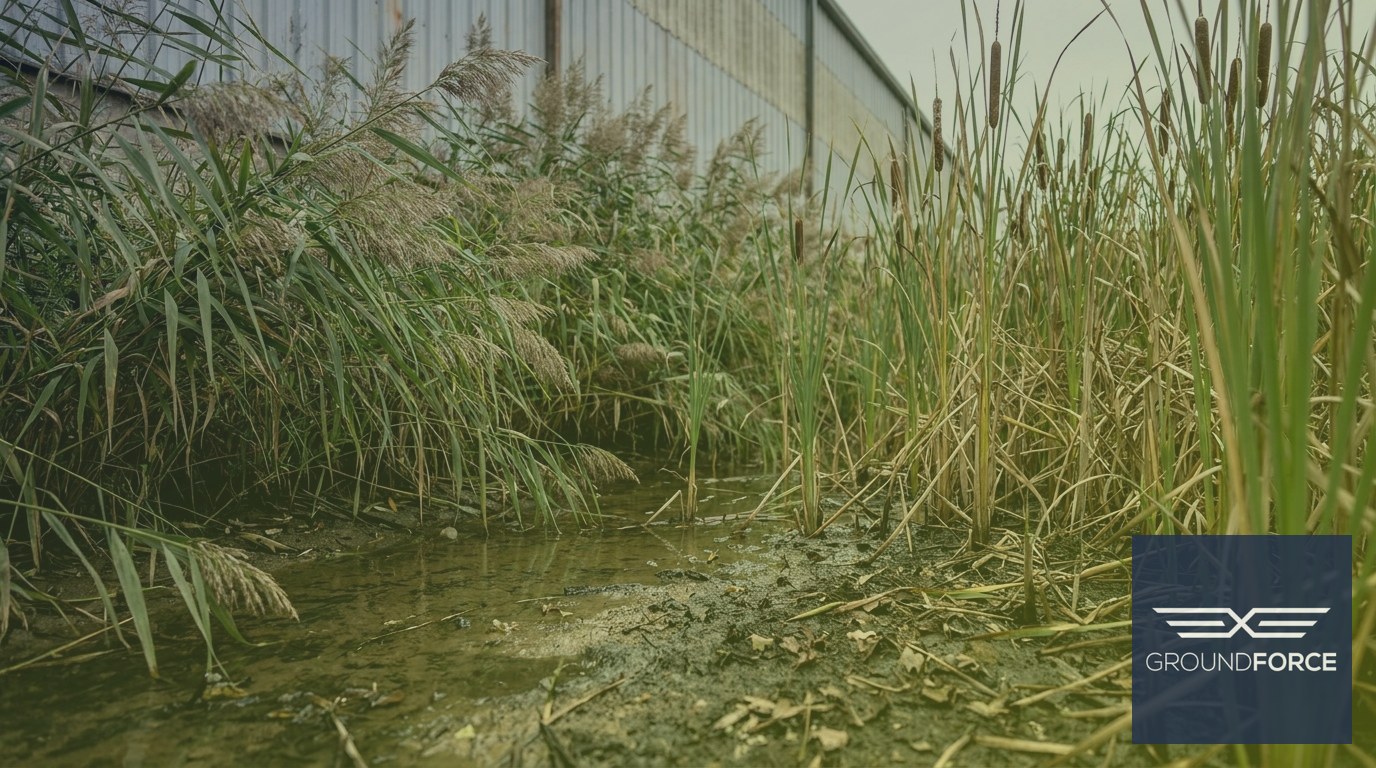
Woody vegetation on embankments. Unmanaged vegetation on retention pond banks causes berm erosion, sediment loading, and reduced pond storage capacity. Trees rooted in berms are a recurring Georgia EPD inspection finding because root systems penetrate and weaken embankment soil, compromising structural integrity. The Association of State Dam Safety Officials holds that trees and woody vegetation should be eliminated from all water impounding structures.
Invasive emergent species. Phragmites australis and Typha (cattails) are common invasive species at Georgia industrial retention ponds and obstruct outlet structures when unmanaged. Phragmites and cattails colonize shallow margins and spread aggressively through rhizomes, and dense stands at inlet and outlet structures reduce hydraulic capacity.
Sediment trapping and storage loss. Dense emergent vegetation accelerates sediment trapping, and the trapped sediment reduces effective pond storage volume over time. According to the Lower DuPage River Watershed Coalition (2022), invasive plants such as Phragmites australis, cattails, and reed canary grass fill in detention ponds by trapping sediment, reducing flood storage capacity below design levels. At a Georgia industrial site, that capacity loss becomes a compliance finding: the retention pond no longer holds the design volume required under the facility’s NPDES permit and SWPPP. The preventing sediment buildup through vegetation details how scheduled emergent control preserves design storage between dredging cycles.
Wet ponds versus dry basins. Wet retention ponds hold a permanent pool and require aquatic and emergent vegetation control, while dry detention basins drain between storm events and primarily need mowing regimens and invasive species exclusion. Treating both feature types identically is a common compliance gap at industrial properties.
What does Ground Force’s industrial retention pond vegetation management service include?
Ground Force provides industrial retention pond vegetation management across Georgia including mowing, herbicide treatment, and invasive species removal. Ground Force also delivers inspection-ready documentation and scheduled treatment programs timed to Georgia’s seasonal vegetation growth cycles and state permit inspection dates.
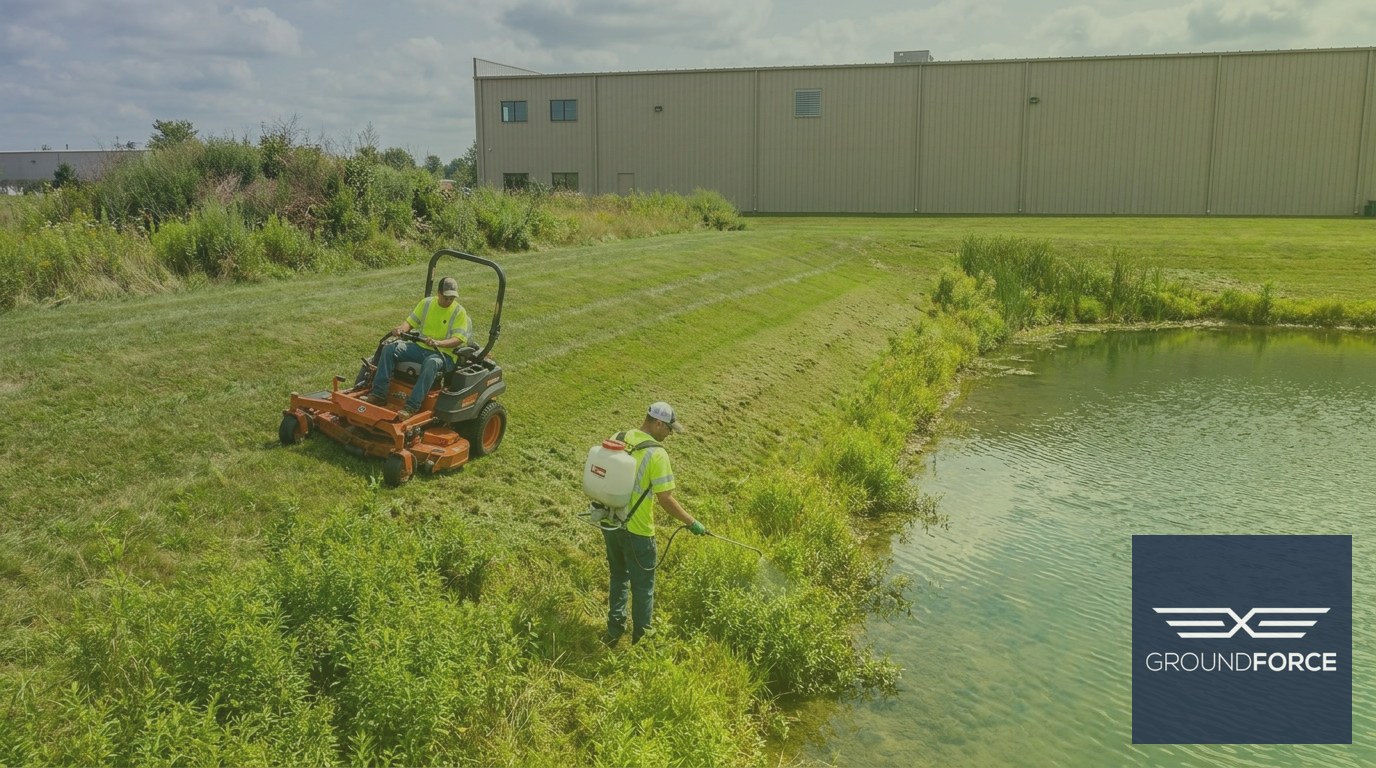
Ground Force crews mow and mechanically cut bank and berm vegetation on fixed intervals. Maintained grass cover stabilizes embankment soils, and early removal of woody growth keeps root systems from compromising berm structure.
Ground Force applies aquatic herbicides to emergent and invasive species using only products carrying U.S. Environmental Protection Agency-registered labels, and Ground Force assigns every application to state-certified, licensed aquatic applicators. Ground Force technicians identify invasive species during routine site visits, and confirmed infestations move into a targeted removal program rather than receiving blanket treatment.
Every service visit closes with a written report formatted for SWPPP binders and environmental audit files, recording the date, product, rate, and treated area. Ground Force files each report under the industrial pond inspection compliance program, so permit inspectors receive complete records during audits.
Treatment calendars follow Georgia’s seasonal growth cycles and permit inspection timing, so vegetation never outruns a scheduled inspection. Ground Force determines visit frequency from how often should industrial retention ponds be inspected and treated, and Ground Force standardizes mowing intervals, herbicide selection, and removal protocols for Georgia conditions through the industrial pond vegetation programs.
Multi-tenant industrial parks with shared retention infrastructure often split compliance responsibility between tenants. Ground Force can serve as the single vendor managing vegetation across the shared system while issuing per-tenant documentation, operating as the third-party industrial stormwater vegetation management provider for the entire park. Industrial owners who need third-party vegetation management for industrial stormwater systems gain one accountable vendor and one consolidated audit file.
Sources
- Georgia Environmental Protection Division, “NPDES Industrial Storm Water General Permits” (2023)
- All4 Inc., “Georgia Industrial Stormwater – Change is Coming!” (2022)
- U.S. Environmental Protection Agency, “Pesticide Permitting | US EPA” (2026)
- U.S. Environmental Protection Agency, “Pesticide Permitting-Frequent Questions | US EPA” (2026)
- U.S. Environmental Protection Agency, “Federal Certification Standards for Pesticide Applicators” (2026)