
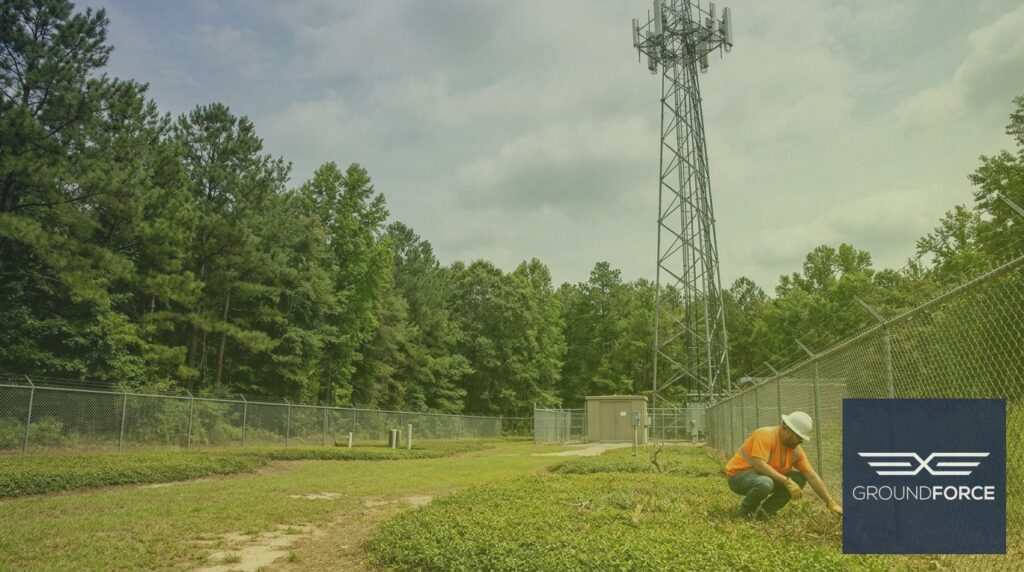
Multi-site telecom vegetation management programs centralize vegetation control for regional and national operators running dozens or hundreds of Georgia tower sites. A Georgia tower portfolio managed through disconnected single-site vendors accumulates specification drift, duplicated overhead, and undocumented compliance exposure. Ground Force administers every site in a multi-site program under one specification, one reporting standard, and one accountable point of contact. Route-dense scheduling across the Georgia portfolio lowers per-site cost while closing the compliance gaps that fragmented vendors leave open.
What does a multi-site telecom vegetation management program in Georgia involve?
A multi-site telecom vegetation management program in Georgia is a centrally coordinated contract that controls vegetation across an entire portfolio of tower and infrastructure sites under unified specifications, standardized scheduling, and consolidated reporting, rather than through a separate work order for each site.
Ground Force’s multi-site telecom vegetation programs require centralized scheduling, standardized specifications, and unified reporting across all Georgia portfolio sites. The program sets specifications once at the portfolio level, so every site receives identical clearance widths, mowing heights, and herbicide protocols, and the operator receives one consolidated compliance record instead of dozens of scattered invoices. Scale drives the program model. According to a 2024 Wireless Infrastructure Association count, 154,800 purpose-built cellular towers and 248,050 macrocell sites operated across the United States, and site-by-site contracting fragments quickly for operators managing a large tower portfolio in Georgia.
Four core services anchor every program: access road clearance, compound perimeter mowing, herbicide treatment, and invasive species suppression. Invasive suppression carries unusual weight in Georgia, where non-native privet occupies nearly 717,000 acres of forest land and has held the top spot on the Georgia Forestry Commission’s Dirty Dozen List since 2009, according to a 2023 UGA Cooperative Extension report. The Georgia Forestry Commission reported in 2023 that 77 Georgia counties have recorded cogongrass detections since 2007.
Georgia contains six distinct climate regions, including the humid subtropical Coastal Plain, the moderate Piedmont, and the cool, high-precipitation Blue Ridge, according to Earth-Site Education (2022). Growth rates differ across those regions, so a uniform statewide calendar over-treats slow-growth sites and under-treats fast-growth sites. A uniform statewide calendar fails tower portfolios across Georgia. A well-designed program therefore sets treatment cycles by regional growth rates within the portfolio: herbicide timing calibrated for tower site vegetation control in Gwinnett will miss the optimal treatment window at Coastal Plain sites, where mild winters start the growing season earlier.
Ground Force is a Georgia-based regional vegetation management specialist with multi-site telecom program experience, and the company acts as the single accountable vendor across all program sites. The program structure accommodates both telecom procurement models, because tower companies typically centralize vendor decisions at the portfolio level while wireless carriers route site-level approval through network operations.
How does specification standardization work across a large Georgia telecom tower portfolio?
Specification standardization applies one written set of vegetation control standards to every tower site in a Georgia portfolio. Ground Force locks clearance widths, vegetation heights, and treatment methods into the master contract, so each site meets identical compliance requirements regardless of local conditions.
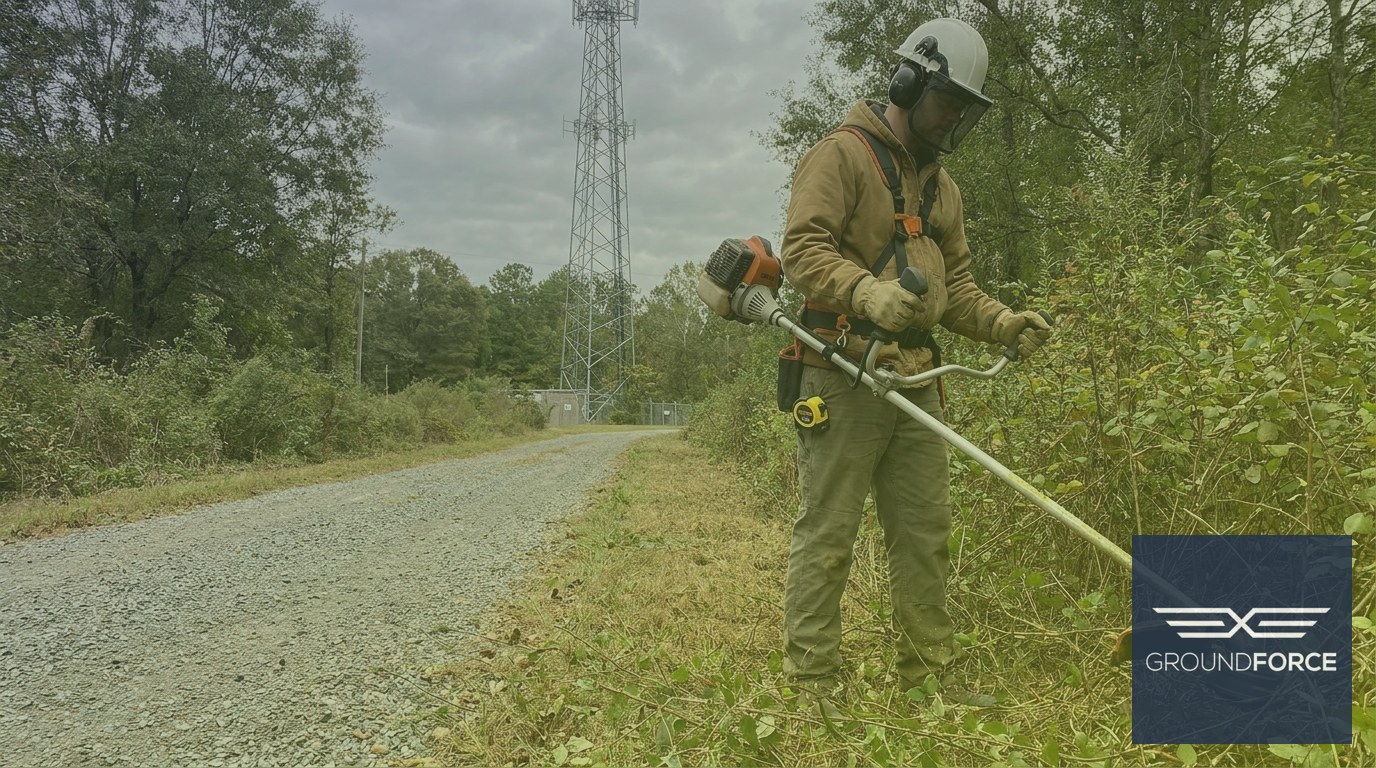
A telecom vegetation specification defines four measurable controls:
- Access road clearance widths: the horizontal and vertical envelope kept free of woody growth along the access drive.
- Compound perimeter heights: the maximum vegetation height permitted inside and immediately around the fenced compound.
- Tree encroachment limits: the distance trees may approach guy wires, antennas, and fence lines before removal is triggered.
- Herbicide method selection: the approved application methods and product categories for each site type.
Specification standardization prevents compliance gaps and inconsistent vegetation heights or clearance widths that create lease violation and safety liability risk. Portfolios managed through separate local vendors accumulate specification drift: each vendor applies different widths, heights, and treatment methods, and that variation compounds into lease non-compliance and failed safety audits across the portfolio. Georgia’s growing zones run from 6b in the northern mountains to 9a in the coastal southeast, according to Greensoul.blog (2026), so growth pressure differs by site while the standard must not.
Ground Force eliminates drift by locking the specification at the contract level, not the site level:
1. Survey the portfolio and document existing vegetation conditions at each tower. 2. Draft one specification set covering all four controls. 3. Bind the specification into the master service contract as a schedule, not a per-site work order. 4. Brief every crew from the same document and inspect each site against it. 5. Report variances against the single standard so corrections happen before audits do.
The cross-site specification consistency for telecom covers how to standardize vegetation control specifications across multiple telecom sites, from the master schedule through field verification.
What reporting and documentation does a multi-site telecom vegetation program provide?
A multi-site telecom vegetation program provides per-site treatment logs, herbicide application records, before-and-after site photography, service completion confirmations, and portfolio-level compliance reports that support regulatory audits, lease renewals, and internal operations reviews for Georgia tower portfolios.
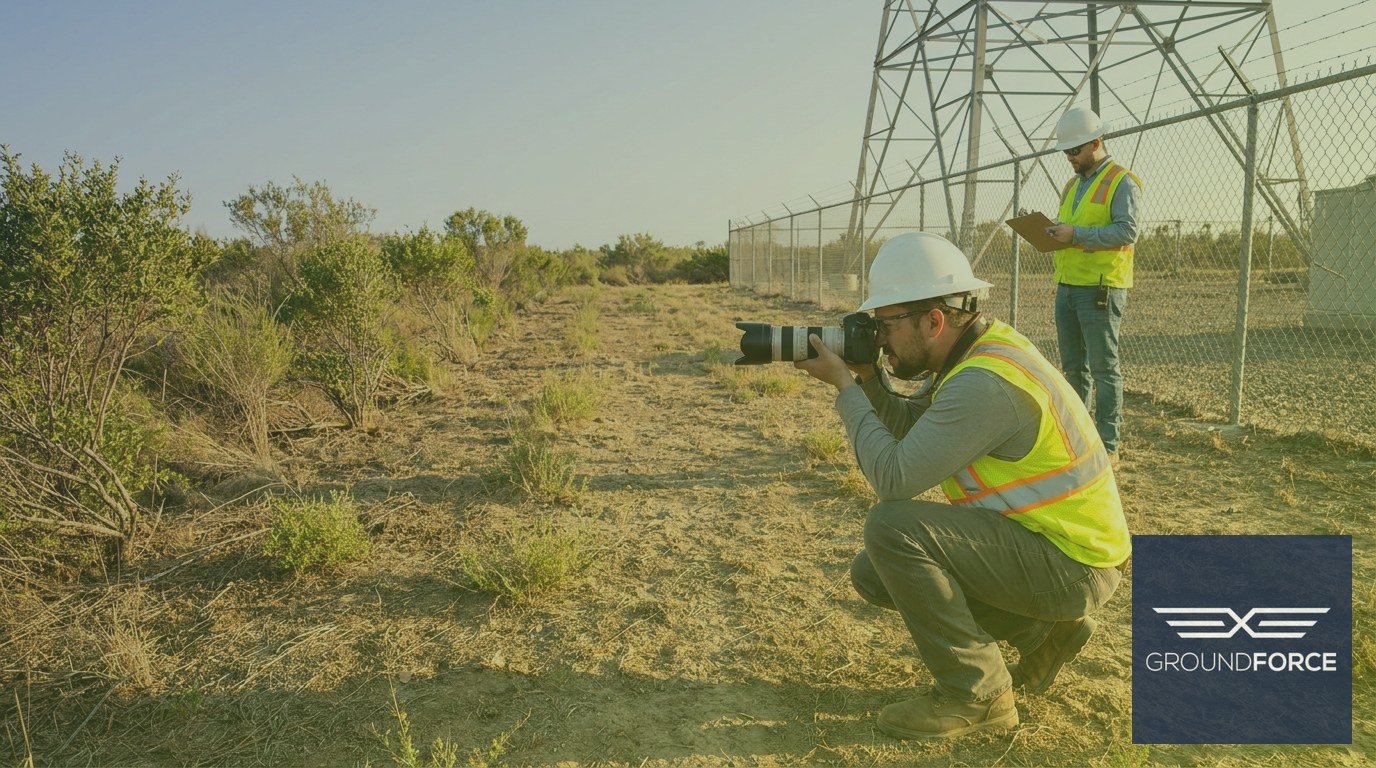
Multi-site telecom vegetation programs include scheduled service cycles, site-by-site documentation, and compliance reporting deliverables. Each treatment log records the date, crew, target vegetation, herbicide product, and application rate. Paired photographs document conditions before and after treatment. Every record ties to a specific tower site. The reporting and documentation for multi-site telecom vegetation programs details the format and delivery schedule for each record type.
Portfolio-level reporting consolidates site-level documentation across tower portfolios into summaries that compliance teams present during audits, landowners request at lease renewal, and operations managers use in contractor performance reviews. The Georgia Department of Agriculture licenses commercial pesticide applicators, and Georgia program files retain applicator license numbers with application records for every treated site.
Environmental compliance obligations, including sensitive habitat avoidance and restricted pesticide use near wetlands, apply at every program site rather than only at flagged locations. The environmental compliance across your tower portfolio covers those Georgia requirements in full.
How does a multi-site program reduce vegetation management costs for telecom operators?
A multi-site program replaces individual site agreements with one portfolio-scale vegetation contract, which produces lower per-site cost through volume pricing and reduced vendor coordination overhead across the operator’s entire Georgia tower portfolio.
The cost reduction comes from four mechanics:
1. Volume pricing concentrates purchasing power. Committing dozens of tower sites to a single agreement lets the contractor spread equipment, crews, and planning costs across the whole portfolio, so each site prices below its standalone rate. The negotiating volume pricing across tower portfolios explains how committed site counts convert into rate tiers.
2. Hidden coordination costs disappear. Site-by-site contracting stacks a separate mobilization fee onto every truck roll, sends multiple vendors to inspect the same corridors, and consumes staff hours reconciling competing schedules and invoices. Standard per-site price comparisons miss all three, so a portfolio contract’s true savings exceed the visible line-item discount.
3. Bundled services cut unit costs. One crew mowing, applying herbicide, and clearing access roads in a single mobilization costs less per service than three separate dispatches. Georgia magnifies this effect: the College of Coastal Georgia cites a U.S. Department of Agriculture estimate that kudzu spreads across roughly 150,000 acres annually and drives about $6 billion in yearly herbicide control costs, making herbicide the line item where bundling discipline pays most.
4. Contract terms compound the savings. The multi-site contract duration decisions covers how longer terms trade scheduling flexibility against deeper rate reductions, while the savings themselves compound as these mechanics stack across every site in a full portfolio.
Why choose a regional Georgia vegetation management specialist over a national contractor for a multi-site telecom program?
A regional Georgia vegetation management specialist serves multi-site telecom portfolios with faster mobilization, Georgia-specific herbicide licensing, and direct knowledge of local vegetation pressure, giving operators one accountable vendor where national contractors split responsibility across subcontracted crews.
Mobilization speed comes from geography. A regional specialist stages crews, spray rigs, and clearing equipment inside Georgia, so a tower site in Macon and a site in Rome share the same dispatch window instead of waiting on a national contractor’s multi-state routing schedule. Storm response follows the same logic: when a hurricane crosses south Georgia, the closest qualified crew is already in-state.
Herbicide licensing is state-specific, and Georgia enforces the distinction. The Georgia Pesticide Use and Application Act of 1976 requires any business applying pesticides to another party’s land to hold a pesticide contractor’s license from the Commissioner of Agriculture. The Georgia Department of Agriculture requires at least one full-time certified commercial applicator per license, renewed annually, and Justia’s 2024 publication of the Georgia Official Code sets a $55.00 annual fee with a certified applicator at each business location. Rights-of-way is a licensed application category under the Georgia Department of Agriculture’s Pesticide Program, which covers tower compounds and access corridors. A Georgia specialist also reads local pressure directly: kudzu swallows compound fence lines each summer, Chinese privet colonizes shaded perimeters, and cogongrass defeats treatment windows that control lesser grasses.
Accountability survives only when one vendor self-performs. National contractors typically sign multi-state agreements, then subcontract each market to local crews who never saw the operator’s specification. Control erodes at every handoff. Operators comparing regional vs. national telecom vegetation vendors should ask who holds the spray license and who answers when a site fails inspection; that single-contact standard keeps vegetation management consistent across a large telecom tower portfolio in Georgia.
Fiber and data infrastructure sites share clearance goals with tower compounds but add distinct requirements around cable routes, pedestals, and access points, so a program covering both asset types scopes vegetation control for fiber and data infrastructure sites separately from tower compound work.
Sources
- Earth-Site Education, “Climate Zones of Georgia: Different Climate Regions of Georgia” (2022)
- Greensoul.blog, “What Planting Zone is Georgia? [Full Garden Map Guide]” (2026)
- Georgia Forestry Commission, “2023 Dirty Dozen List” (2023)
- College of Coastal Georgia, “Invasive Species Can Be Costly”
- Georgia Department of Agriculture, “Pesticide Contractors”
- Georgia Department of Agriculture, “Agricultural Pest Control”