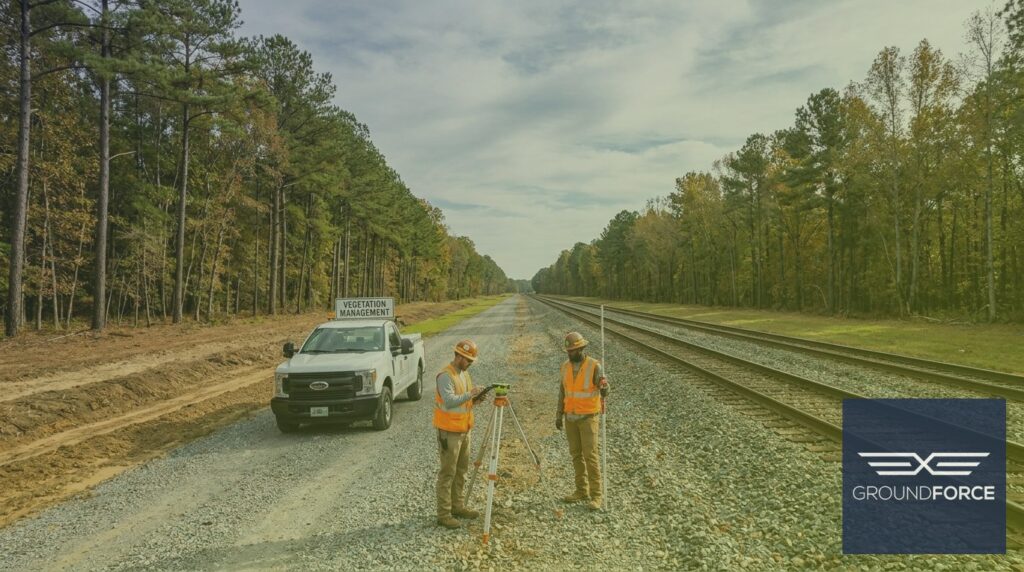
Railroad right-of-way vegetation management in Georgia controls vegetation along active rail corridors to protect track infrastructure, signal systems, and operational safety. Federal Railroad Administration safety requirements, live train schedules, and work zones spanning ballast, track structure, and tall-growth areas separate railroad right-of-way management from every roadside or utility corridor program. Ground Force delivers Georgia rail operators and infrastructure contractors an integrated, FRA-aware vegetation management program built for live-rail environments.
What makes railroad right-of-way vegetation management different from other ROW programs?
Railroad right-of-way vegetation management is a federally regulated infrastructure safety practice governed by FRA requirements. Railroad ROW programs differ from roadside, municipal, and utility ROW programs in four specific ways: federal track-safety oversight, three distinct control zones, live-rail access constraints, and non-negotiable signal sight distances.
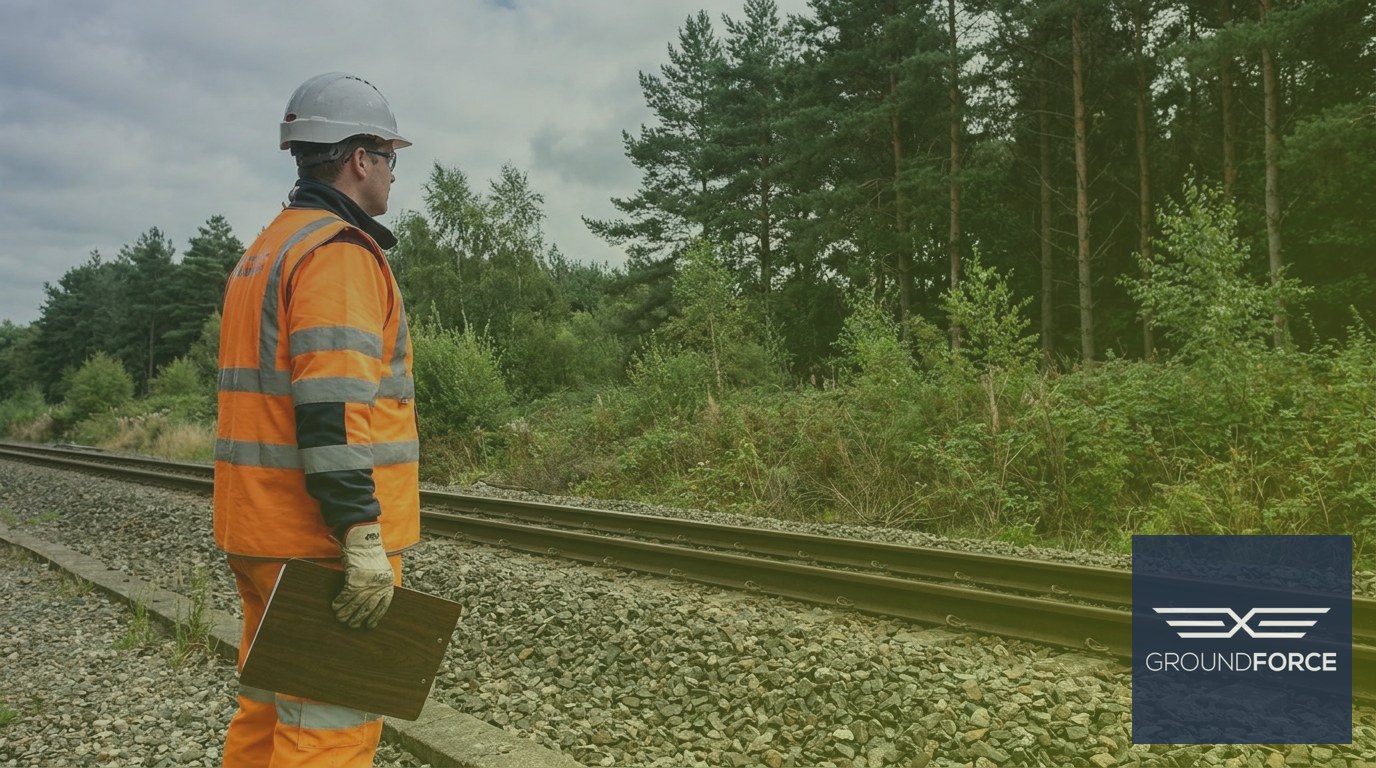
The differences start with federal oversight. Under 49 CFR § 213.37, vegetation on or immediately adjacent to the roadbed must be controlled so the vegetation does not become a fire hazard to track-carrying structures, obstruct visibility of railroad signs and signals along the right-of-way and at highway-rail crossings, interfere with railroad employees performing normal trackside duties, or prevent proper functioning of signal and communication lines, according to the Legal Information Institute at Cornell Law School. The FRA does not prescribe a single vegetation management standard the way NERC FAC-003 prescribes fixed clearance distances for power line easement vegetation programs. Railroad obligations derive from the general Track Safety Standards, so each railroad’s own vegetation management plan becomes the operative compliance document. A contractor who cannot document program design and re-treatment cycles creates liability exposure for the operator, not just a maintenance gap.
A railroad ROW also contains three distinct vegetation zones, and each zone demands a different control method. The ballast and track structure zone requires a bare-ground herbicide program that keeps ballast draining, ties inspectable, and fuel away from track-carrying structures. The corridor edges require selective brush control that preserves sight lines and walking access for track inspectors. The tall-growth buffer beyond the edges requires forestry mowing and hazard-tree removal so dead or leaning stems cannot reach the rail. A roadside cross-section has no load-bearing track structure at its center, and a utility corridor has no ballast zone at all.
Access is the third dividing line. Railroad ROW vegetation management precedes roadside and utility ROW programs in operational complexity because of live-rail access constraints: crews work under roadway-worker flagging protection, occupy track only under permits coordinated with the train dispatcher, and schedule cutting around train windows that can shut a site down with little notice. Pipeline and utility corridor vegetation control is scheduled around landowners and weather, and roadside mowing is scheduled around traffic; neither contends with live operations on the work surface.
Signal visibility makes vegetation height tolerances operationally non-negotiable. The Federal Railroad Administration (2026) classifies vegetation that obstructs the visibility of railroad signs and signals as a deviation from the Track Safety Standards and identifies six signal types whose visibility must be closely observed: block signals, interlocking signals, speed signs, close clearance signs, whistle posts, and mileposts. The Federal Railroad Administration (2026) also notes that intermittent vegetation brushing the sides of rolling stock can injure an employee riding on a car side, and that vegetation interfering with trackside duties remains a compliance issue even when the growth poses no immediate hazard. A sapling a roadside authority would treat as cosmetic can constitute a federal deviation at a highway-rail crossing.
Each of these differences, from ballast treatment cycles to flagging coordination, receives project-level coverage in what sets railroad ROW programs apart.
How is vegetation controlled in railroad ballast and track zones?
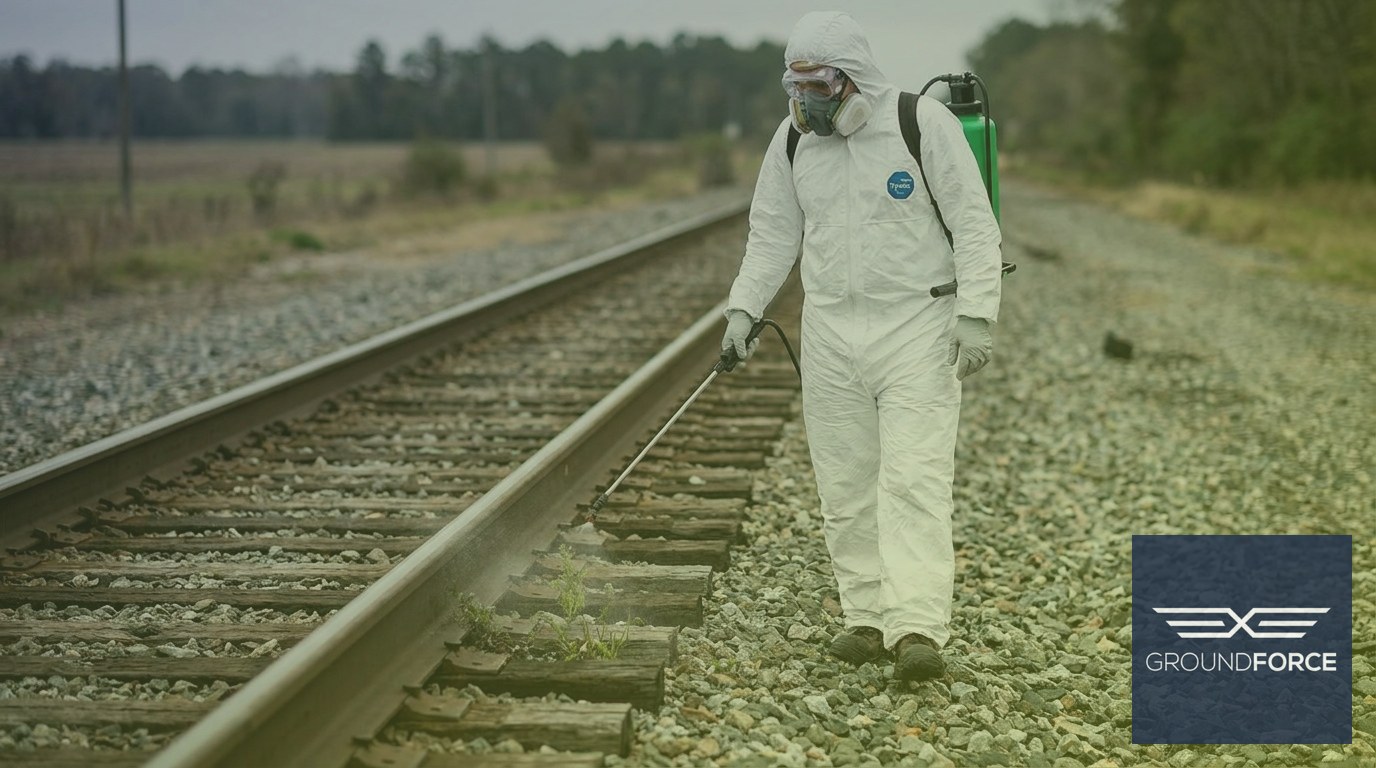
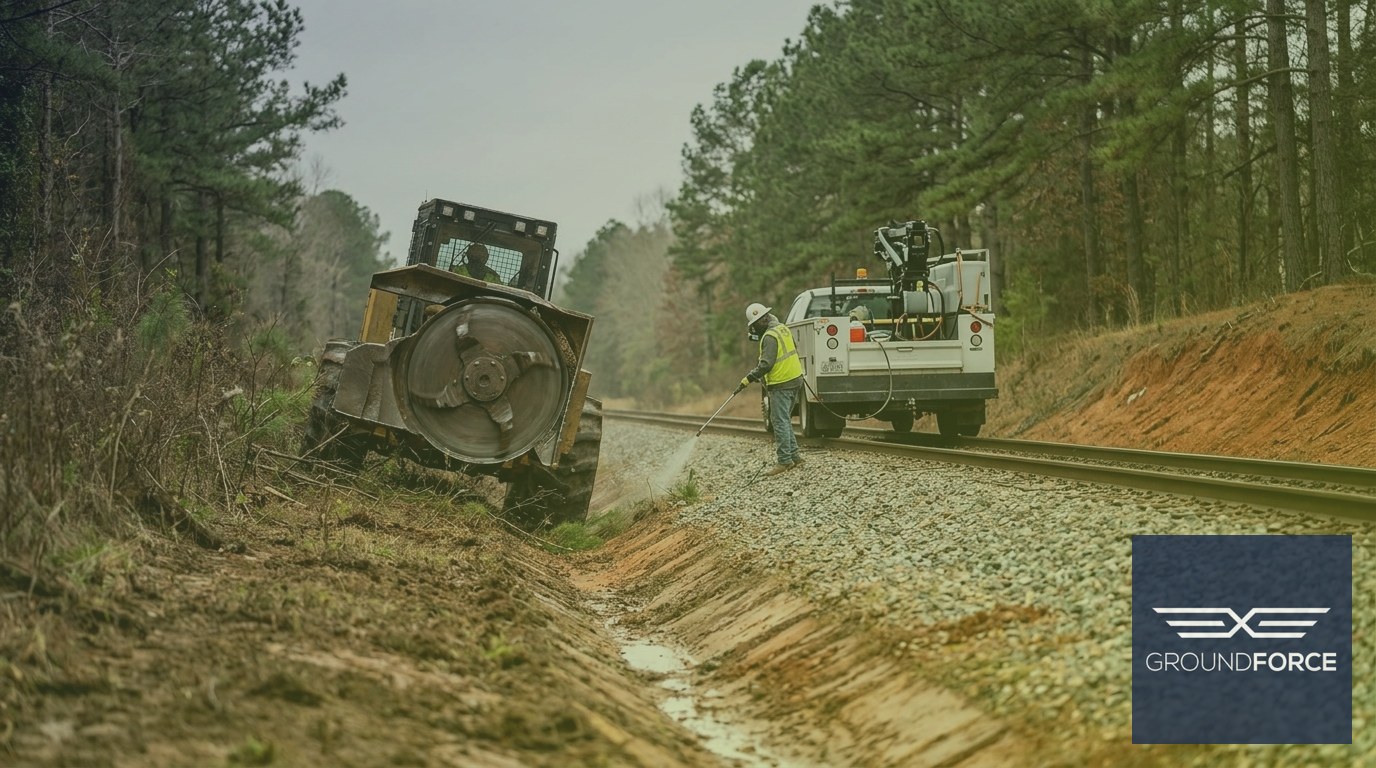
Contractors control vegetation in railroad ballast and track zones primarily with non-selective herbicide programs applied to ballast and track corridors, preventing vegetation intrusion into tie, sub-ballast, and drainage layers. Georgia programs time applications against warm-season regrowth and observe Georgia EPD buffer rules near drainage structures.
1. Assess ballast fouling first. Ballast zone vegetation is caused by seed intrusion and moisture retention in the track sub-structure, and roots plus accumulated organic matter fill ballast voids that must stay open for drainage. Because the failure mechanism is structural before it is visible, inspection should measure fouling, not just visible growth.
2. Apply the herbicide program. Contractors apply non-selective herbicide programs to railroad ballast and track corridors to prevent vegetation intrusion into tie and sub-ballast layers, combining residual and contact products within ballast and track chemical vegetation control. Managers pair these treatments with railroad ROW brush control on shoulders and embankments, because adjacent brush supplies the seed that re-fouls treated ballast.
3. Time treatments for Georgia’s warm season. Warm, wet Georgia summers accelerate regrowth, so product selection and re-treatment intervals must account for sustained warm-season weed pressure. Programs typically schedule a pre-emergent application before spring germination and a mid-season residual pass.
4. Protect drainage structures. Georgia EPD water quality rules and buffer zone requirements apply near drainage structures adjacent to rail corridors, so applicators adjust products and setbacks at ditches, culverts, and crossings. Drainage ditch and culvert vegetation is often overlooked, yet vegetative blockage of ballast drainage is a leading contributor to slow orders and track geometry defects.
Success is judged on track condition, not cosmetics. The Federal Railroad Administration’s 2019 Track Safety Standards Fact Sheet lists ballast, drainage, and vegetation as one roadbed inspection category, and peer-reviewed research published in ScienceDirect found higher degradation rates 10 times more likely at highly fouled ballast locations and 30% more likely where drainage is poor. Ballast treatment programs must be evaluated on track inspection outcomes, not just visible vegetation suppression.
What are the risks and requirements for tree trimming and removal along Georgia rail corridors?
Tree trimming and removal along Georgia rail corridors controls tall-growing vegetation that threatens signal visibility, engineer line-of-sight, and track infrastructure. Federal rules mandate clearance standards around active track, and Georgia’s rapid loblolly pine and sweetgum growth forces shorter control cycles than drier regions require.
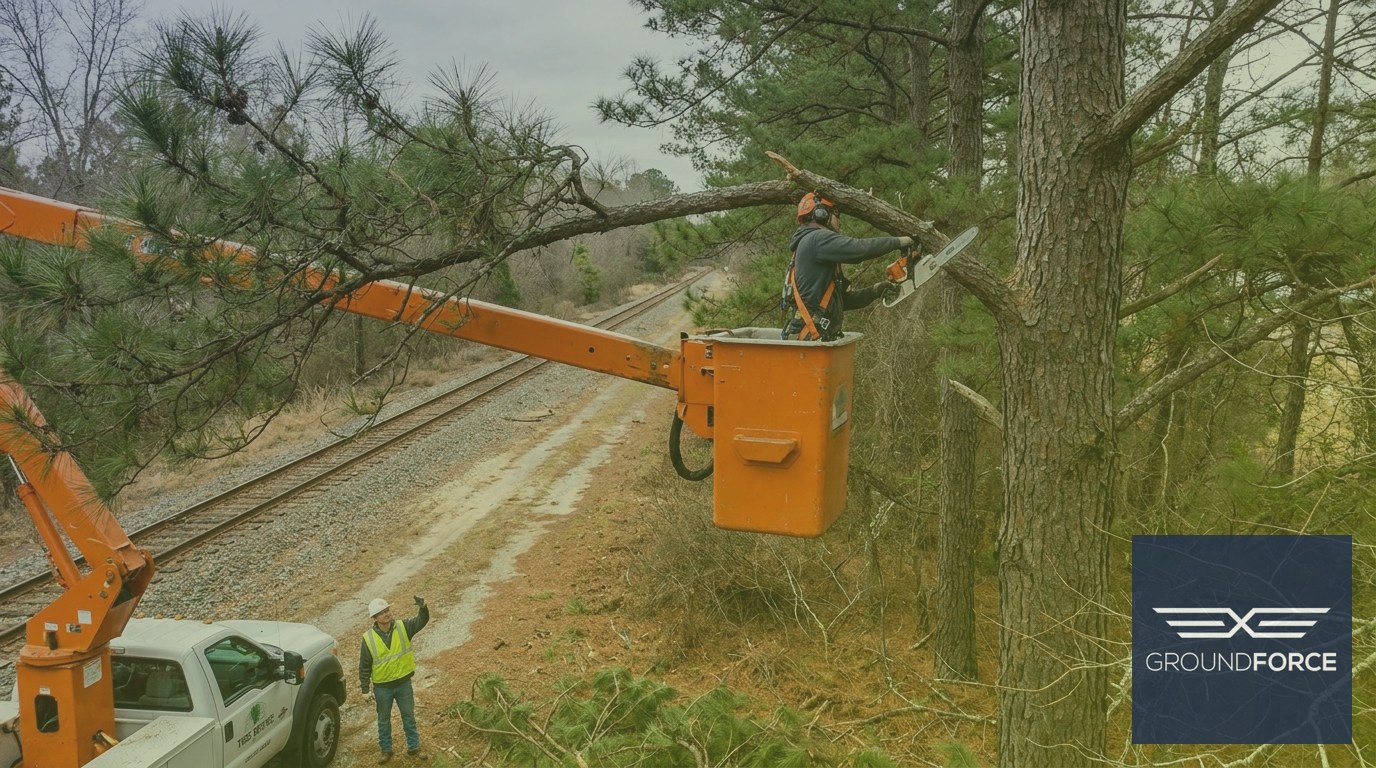
Tall-growing vegetation adjacent to rail lines has a standing risk of signal obstruction, line-of-sight hazard, and catastrophic windthrow onto active track. Four operational requirements follow.
- Windthrow and overhang. Failed trees derail trains. Removing leaners, dead stems, and overhanging limbs within striking distance of active track is a safety imperative, not a cosmetic task.
- Signal and sight-line clearance. Vegetation must not block signals, crossing sight triangles, or the engineer’s forward view. The federal railroad vegetation regulations set the compliance baseline, and carriers inspect these clearances on fixed schedules.
- Accelerated encroachment. NC State Extension identifies loblolly pine as the fastest-growing pine, reaching 60 to 90 feet tall with a 20 to 40 foot crown. The USDA Forest Service records Georgia site indices of 65 to 95 feet in the Piedmont and 75 to 100 feet in the Coastal Plain at base age 50, and reports more than 70 percent of sweetgum on Georgia Piedmont plots as sprout origin, which means cutting alone resprouts. The Atlanta History Center noted in 2022 that loblolly pine, sweetgum, and tulip poplar colonize cleared edges first, so mechanically cleared corridor edges rebuild canopy fast.
- Sensitive-habitat segments. Some Georgia corridors cross state-designated sensitive habitat or wetland buffer zones, and vegetation in those segments requires herbicide-free mechanical control even where the adjacent ballast zone runs a chemical program. The minimising ecological impact in rail ROW programs explains how operators sequence both methods across a mixed corridor.
The tree trimming and removal along rail rights-of-way details species-specific cutting cycles, clearance distances, and disposal standards for Georgia corridors.
How do railroad vegetation management crews schedule work around active train operations?
Railroad vegetation management crews schedule work around active train operations by obtaining track occupancy windows from the railroad’s dispatching authority before any equipment enters the right-of-way. Rail corridor vegetation work requires coordination with train dispatch and flagging protocols before crews access track zones.
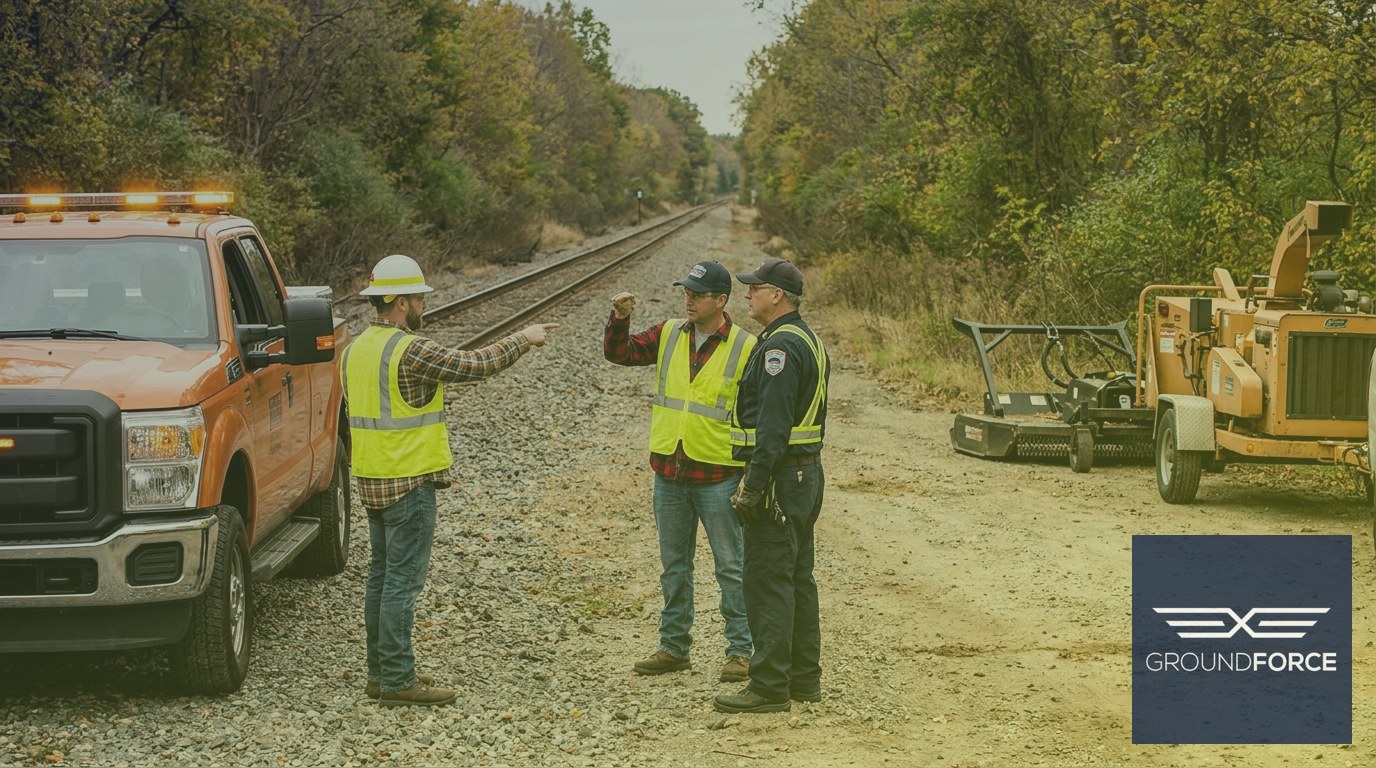
1. Secure authorization first. Crews obtain flagging protection or a track occupancy permit before entering a track zone. This authorization is a non-negotiable safety requirement, and no saw, mower, or spray rig crosses the rail without it. 2. Identify the territory type. Signaled territory lets the dispatcher hold or reroute trains around an occupied track. Dark territory has no signal control, so access depends on direct coordination with train movements rather than dispatcher-issued signal protection. 3. Match the corridor’s traffic pattern. Georgia freight corridors operated by CSX and Norfolk Southern carry different scheduling complexity and approval lead times than passenger-adjacent lines shared with Amtrak or commuter service, where work windows run shorter and approvals take longer.
Georgia rail corridors carry freight and passenger operations on overlapping windows, so a crew cannot coordinate with a single dispatcher and treat the schedule as settled. Multi-track corridors require a separate occupancy authority for each track a crew occupies, shared-use lines require approval from both the host railroad and the passenger operator, and dark territory requires its own access protocol because no signal system enforces separation. An inexperienced contractor will not know to ask about these distinctions. Experienced crews treat minimizing service disruption during rail vegetation work as the scheduling objective behind every occupancy request. Scheduling Rail Corridor Vegetation Management Around Train Operations covers the approval sequence and lead-time planning for Georgia corridors.
What does Ground Force’s railroad vegetation management service cover in Georgia?
Ground Force’s railroad vegetation management service covers the full rail corridor: ballast zone herbicide programs, corridor edge mowing and brush control, tall-growth tree removal, and drainage management. Ground Force railroad vegetation programs apply to Class I carriers and short-line railroads operating in Georgia.
The Georgia Department of Transportation describes Georgia’s system as the largest rail network in the Southeast. The Association of American Railroads reports that CSX operates 1,538 miles and Norfolk Southern operates 1,706 miles in Georgia, with the state’s remaining track divided among short-line railroads. According to Georgia Humanities and the University of Georgia Press (2023), those short lines serve as local feeders to the CSX and Norfolk Southern main lines.
Ground Force builds each railroad program on integrated vegetation management (IVM) principles, combining selective, low-volume herbicide use in the ballast zone, mechanical mowing and cutting at the corridor edge, and scheduled tree removal that protects drainage ditches, crossings, and signal sight lines. The IVM design minimizes total chemical load while still meeting FRA-derived safety thresholds for clearance and visibility. The Environmental Stewardship in Railroad Vegetation Control Programs details how Ground Force sequences mechanical and chemical controls to reduce herbicide volume across a corridor.
Documentation closes the loop. The FRA Vegetation Management Requirements for Class I and Short-Line Railroads defines the visibility and clearance standards that shape Ground Force’s treatment records. Short-line railroads in Georgia often lack in-house vegetation management staff and rely entirely on contractors. A documented, repeatable program from Ground Force gives those short-line operators direct evidence of compliance during FRA inspections.