
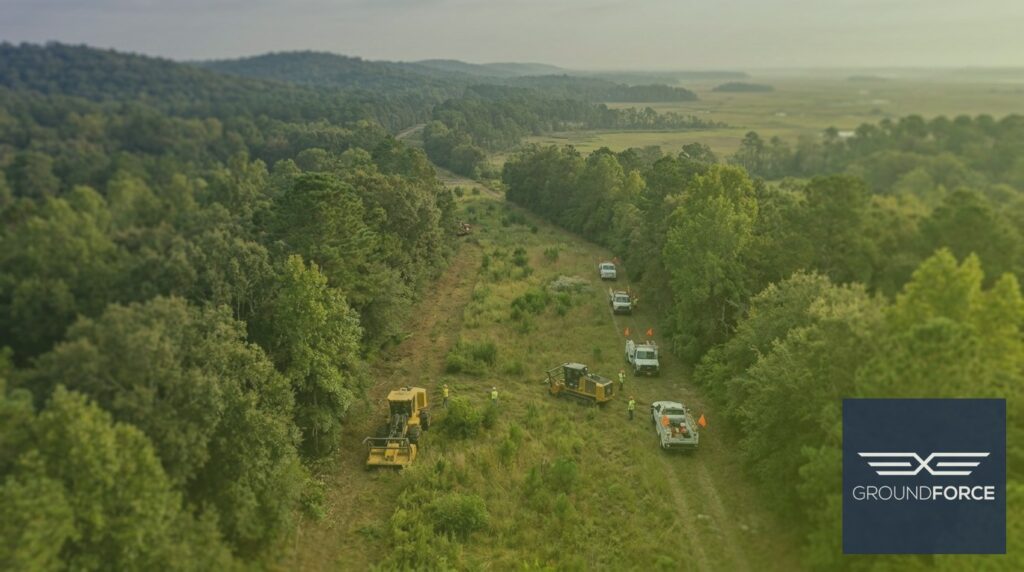
Georgia’s ecological diversity, spanning the Blue Ridge Mountains, Piedmont plateau, Gulf Coastal Plain, and Atlantic Coastal Plain, shapes every commercial vegetation management decision in the state. Commercial land managers who ignore Georgia’s distinct soils, hydrology, and native plant communities face higher costs, recurring failures, and accelerating invasive species pressure. Ground Force builds every vegetation management program on site ecology. Soil conditions, water movement, and native plant communities form the starting point of each plan.
How Does Georgia’s Ecological Geography Shape Commercial Vegetation Management Needs?
Georgia’s physiographic provinces produce distinct soil types, moisture regimes, and native plant communities that determine appropriate vegetation management strategies. Commercial vegetation management in Georgia requires site-specific ecological knowledge because a single statewide approach fails across the Blue Ridge, the Piedmont, and the Coastal Plain.
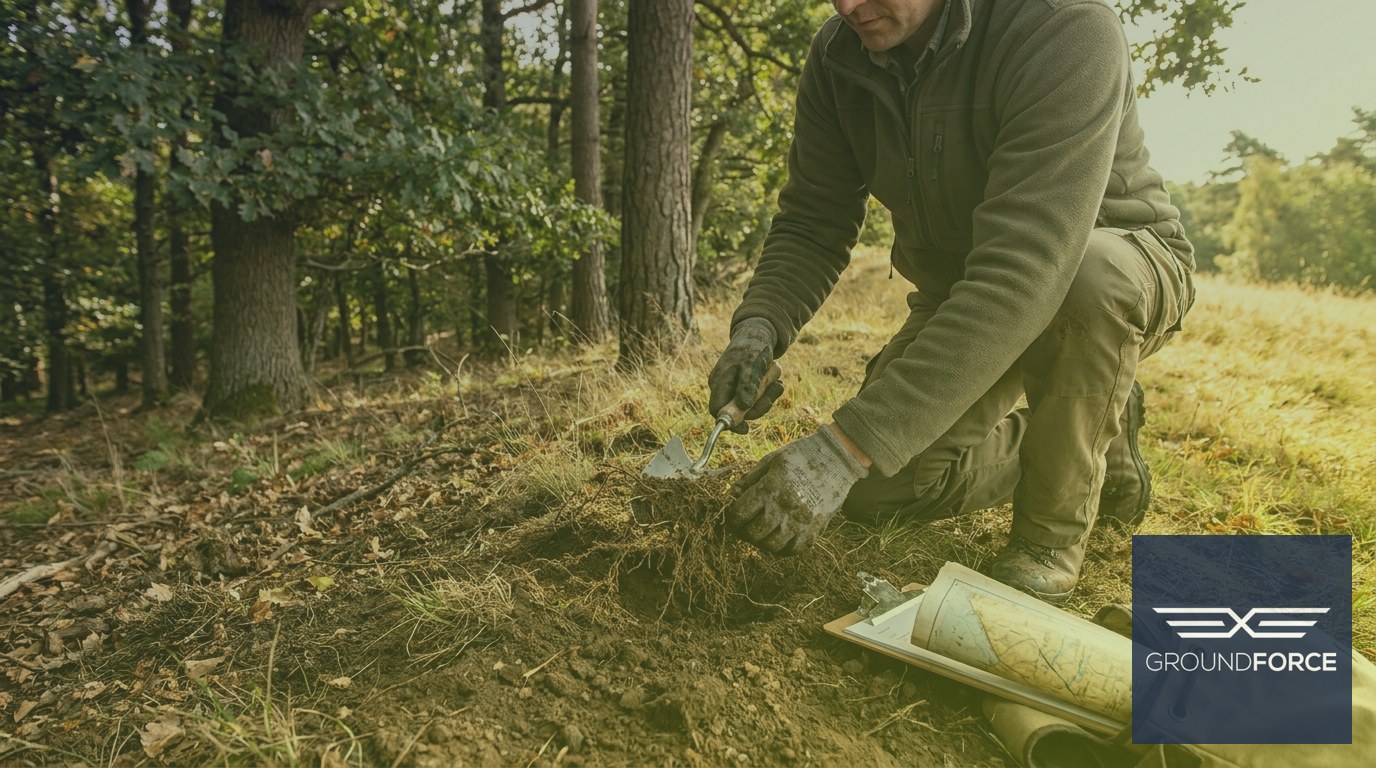
Georgia divides into five primary physiographic provinces, and each province generates its own vegetation pressure profile:
1. Blue Ridge. Steep slopes, Georgia’s highest rainfall, and dense hardwood understories make erosion control and slope stabilization the dominant concerns, with rapid understory regrowth along road and utility corridors. 2. Ridge and Valley. Fertile limestone-derived valley soils support aggressive early-successional growth, while forested ridges channel invasive spread along the corridors between them. 3. Appalachian Plateau. Thin sandstone soils and heavy forest cover slow regrowth but complicate equipment access, so management concentrates on rights-of-way and boundary maintenance. 4. Piedmont. Rolling terrain, heavy red clay, and Georgia’s densest development pressure create prime conditions for kudzu and Chinese privet, especially on disturbed construction and industrial sites. 5. Coastal Plain. Sandy, fast-draining soils and a long, hot growing season favor fire-adapted longleaf pine communities but also Georgia’s fastest vegetative regrowth and its most aggressive invasive grasses.
Soils divide them further. Piedmont red clay drains slowly and, despite a stable appearance, compacts aggressively under equipment traffic. That compaction destroys subsurface root structure and opens bare-soil invasion corridors that accelerate kudzu and privet establishment, a dynamic that uniform mowing schedules ignore entirely. Coastal Plain sands drain quickly, resist compaction, and allow deep-rooted natives such as longleaf pine to establish, but the same sands leach nutrients and favor invasive grasses over slower native forbs.
Georgia’s humid subtropical climate compounds the pressure. Long growing seasons and high rainfall variability push regrowth rates well beyond those of drier southeastern states, compressing management cycles from annual visits to multi-visit programs. The drought-and-deluge rainfall pattern, driven by periodic La Niña cycles, means programs calibrated for average rainfall years underperform in both directions: drought stresses native plantings while deluges accelerate invasive seed dispersal along drainage corridors. Rainfall timing and temperature regimes set species-level treatment windows across the state’s provinces.
Transition zones between provinces create the most complex sites. The Fall Line, the geologic boundary running through Augusta, Macon, and Columbus, marks a soil shift and an invasive-species shift: privet and kudzu dominate north of the line, while cogongrass spreads increasingly south of the line, so integrated management programs differ on either side. The Georgia Forestry Commission reported in 2023 that cogongrass (Imperata cylindrica) infestations occur primarily in south Georgia, though the species is capable of growing throughout the state. Plant communities from both provinces compete along these boundaries, and mixed sites demand blended prescriptions.
Together, the five provinces define the land management’s role in ecosystem health for commercial property across Georgia: matching equipment, timing, and treatment programs to the ecological conditions of each site.
What does a science-based approach to vegetation management mean in Georgia’s ecological context?
A science-based approach means the site’s ecology dictates the treatment, never the reverse. Science-based vegetation management treats ecological site conditions, soils, hydrology, native seed bank, and adjacent land use, as primary inputs before any control method is selected. The ecological site assessment is the prerequisite step: it reads soil type, drainage patterns, existing native seed bank, and neighboring land use so the chosen method works with the site rather than against it.
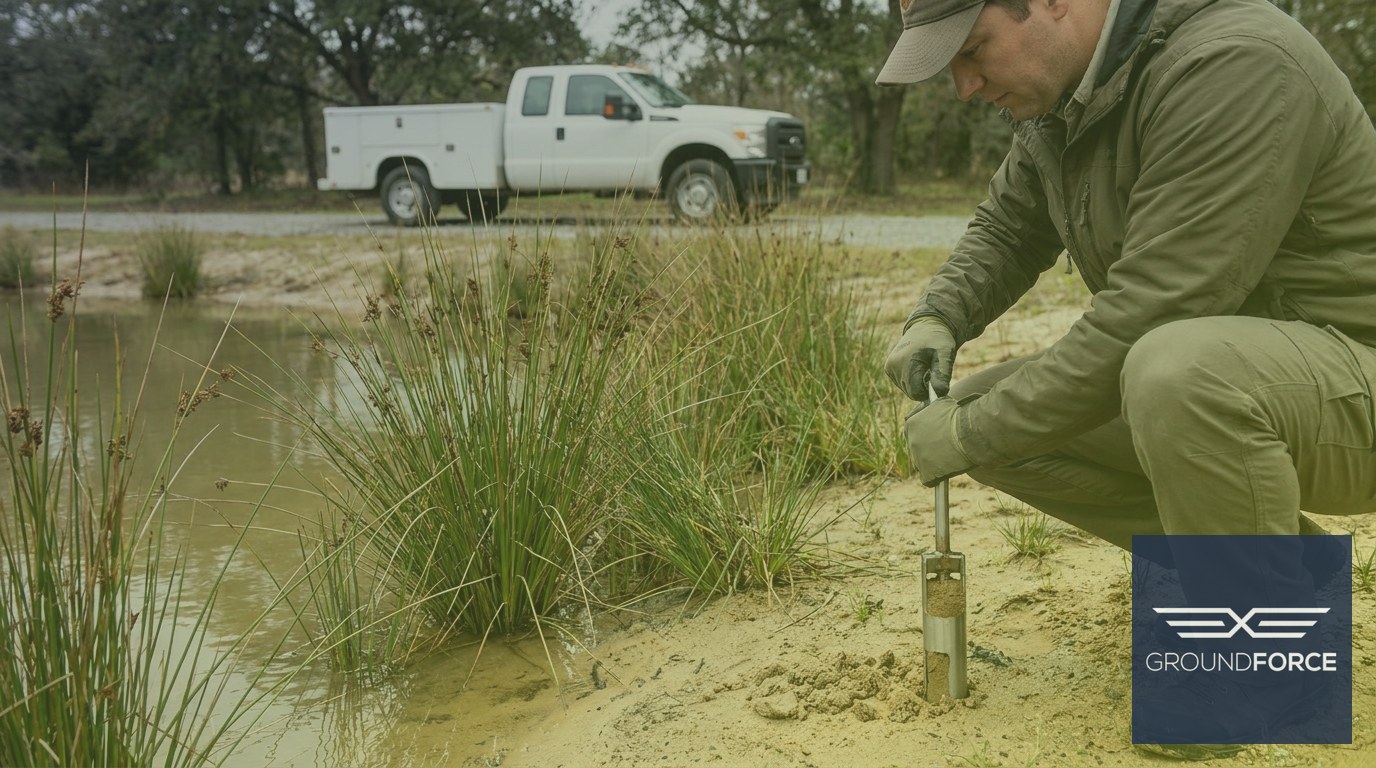
Site context is not transferable across Georgia. The same herbicide program that achieves compliance on a Piedmont industrial corridor can fail or cause regulatory exposure on a Coastal Plain retention pond edge, where higher water tables, sandy soils, and aquatic buffer rules change both efficacy and legal obligations. Applying one region’s program to another region’s site is how contractors drift from core vegetation management goals and methods into compliance risk.
The distinction between vegetation suppression and vegetation management drives long-term cost. Suppression delivers short-term compliance: a single herbicide pass that clears the site this quarter. Management delivers long-term ecological stabilization, which lowers total program cost over time. The data confirms the difference. In a 2005 USDA Forest Service study removing Chinese privet from Georgia Piedmont riparian forests, only about 7% of mulched plots and 3% of felled plots were re-infested five years later, while native herbaceous plants covered 70% of mulched plots versus 20% of untreated controls. The common framing of invasive removal as a one-time event is demonstrably incorrect: Chinese privet resprouts from root fragments within one growing season, and cogongrass rhizome systems extend 4 to 6 feet below grade. University of Georgia and USDA Cooperative Extension guidance notes cogongrass often regenerates within a year of a single application and requires a minimum of two treatments annually, with older infestations needing 2 to 3 years. A single treatment cycle reliably produces reinfestation at higher density.
Integrated Pest Management (IPM) principles, using biological, mechanical, and chemical controls in sequence rather than defaulting to herbicide, are increasingly required in Georgia municipal and utility contracts and form the operational backbone of a science-based program. The Georgia-specific IVM application practices document how that sequencing works in the field, while the Ground Force Georgia ecosystem management approach explains how site assessment, treatment sequencing, and multi-year planning combine. Property owners ready to formalize that sequence can follow How to Develop a Long-Term Vegetation Management Plan for Commercial Properties.
Which invasive plant species pose the greatest threat to commercial land managers in Georgia?
Kudzu, Chinese privet, and cogongrass are among the most economically damaging invasive plants for commercial land managers in Georgia. Invasive plant species in Georgia cause accelerating displacement of native vegetation, increased management costs, and structural damage to infrastructure corridors.
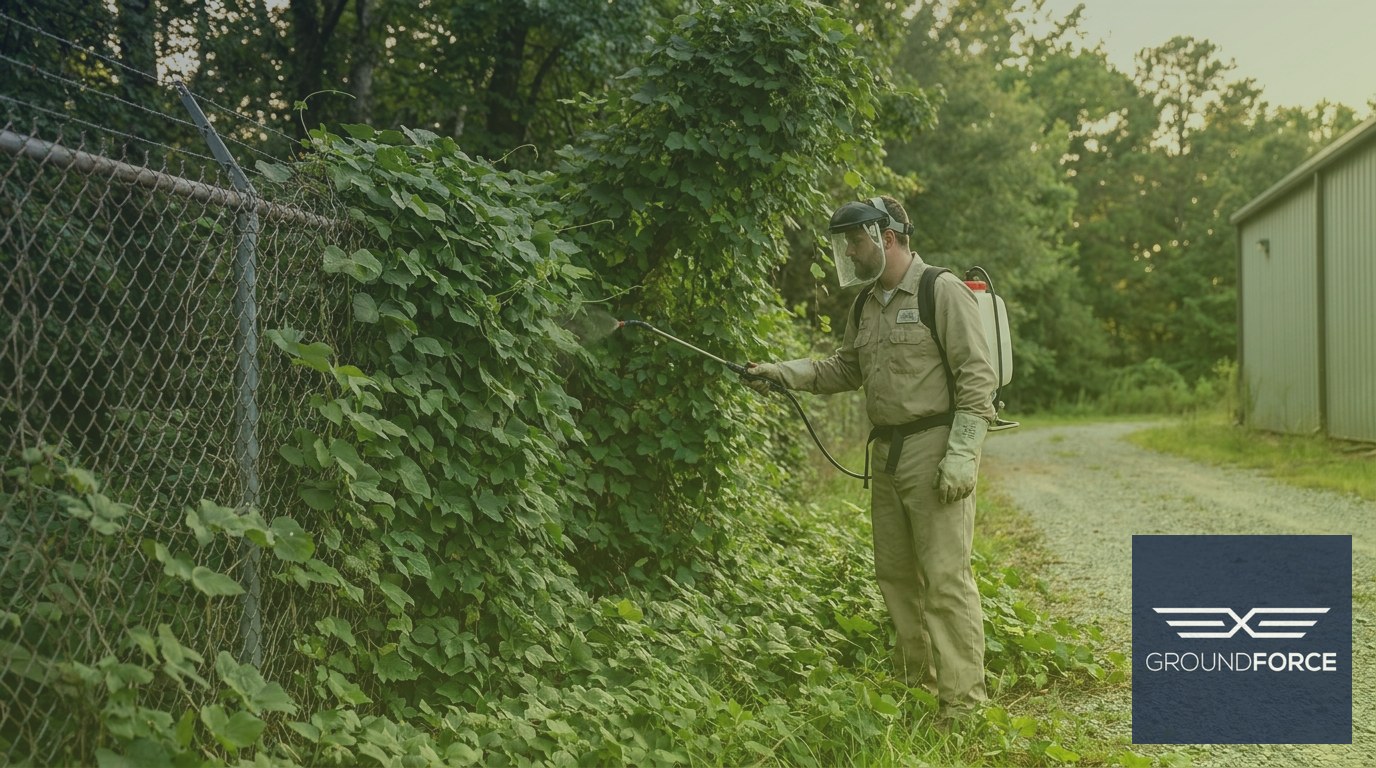
Kudzu grows up to one foot per day in early summer, smothering ground vegetation and engulfing fences, utility poles, and entire structures, according to ScienceInsights (2026). University of Georgia Cooperative Extension (2023) records kudzu claiming nearly 27,000 Georgia acres on the Georgia Forestry Commission’s first Dirty Dozen list, peaking above 42,000 acres in 2011 before falling to just under 31,000 acres by 2017. Delayed treatment multiplies eradication cost: forestry companies spend roughly $500 per hectare per year for five years to control established stands (Grokipedia, 2026).
Chinese privet has held the top ranking on the Georgia Forestry Commission’s Dirty Dozen list since 2009, occupying 644,317 Georgia acres by 2017 (University of Georgia Cooperative Extension; Pickens Progress, 2021). A U.S. Forest Service estimate cited by Smithsonian Magazine (2024) places Asian privet on approximately 3.2 million acres, 14 times kudzu’s territory. Privet dominates Piedmont riparian corridors, produces copious bird-dispersed seed, and resprouts from roots and stumps after cutting, defeating single-treatment programs (Alabama Cooperative Extension System, 2025).
Cogongrass is a federally listed noxious weed and the seventh worst weed in the world (Georgia Forestry Commission, 2023). Its rhizomes extend up to 48 inches below grade (USDA APHIS, 2019), each plant produces up to 3,000 seeds per season, and wind, vehicles, equipment, and contaminated soil spread it along south Georgia roadsides and utility rights-of-way (Mississippi State University Extension).
Treating these invaders as a one-time removal event fails in Georgia. Privet resprouts from root fragments within one growing season, and cogongrass rhizomes survive 48 inches below grade, so a single treatment cycle without a multi-year integrated program reliably produces reinfestation at higher density.
Mimosa and Bradford pear act as secondary invaders, colonizing freshly disturbed commercial sites faster than native competitors, and property managers frequently underestimate both. Japanese stiltgrass expands rapidly through shaded Piedmont corridors and is frequently misidentified as a native annual grass, allowing it to complete seed set before treatment occurs.
How do native plant communities support long-term commercial land management goals in Georgia?
Native plant communities provide long-term vegetation stability, erosion control, and reduced management frequency when deliberately integrated into commercial land programs. Established native groundcovers suppress invasive species, sustain pollinator habitat, and give Georgia commercial properties measurable content for sustainability reporting.
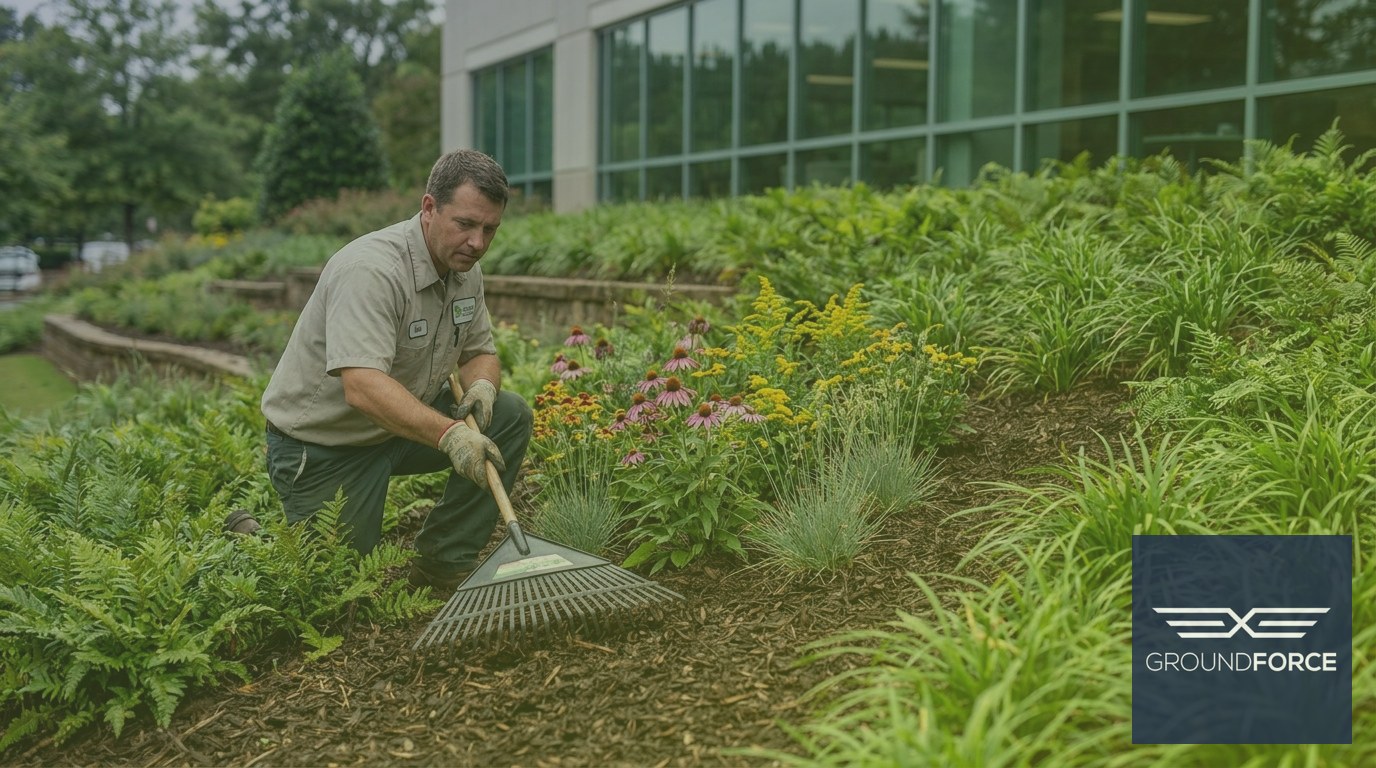
1. Suppress invasive establishment over a multi-year program. Established native groundcovers occupy the surface and root-zone space that invasive seedlings require. Each season of intact native cover shrinks the invasive seed bank, so scheduled herbicide application frequency declines across the program cycle.
2. Match species to commercial site constraints. Native bunch grasses and low-growing sedges tolerate routine mowing regimes, mature below standard clearance heights, and maintain stormwater infiltration functions through dense fibrous root systems in swales, retention basins, and rights-of-way. Native groundcover installation does not require owners to sacrifice site accessibility or safety compliance. Managers select native species with growth habits compatible with clearance requirements, so sight lines and egress remain intact while established cover suppresses invasive reestablishment.
3. Build pollinator habitat that supports ESG reporting. Native plant cover sustains pollinator habitat, and pollinator response is measurable. According to USDA Forest Service Research and Development (2013), Georgia Piedmont plots cleared of Chinese privet supported nearly three times as many pollinator species and captured four times more individuals than control plots, giving commercial owners documented metrics for corporate ESG and sustainability reporting. The Pollinators, Wildlife, and Eco-Responsible Vegetation Management in Georgia resource documents Georgia pollinator and wildlife stewardship practices for commercial sites.
Regional species selection draws on the Georgia plant communities and land ecology cataloged in Georgia’s Climate and Plant Ecology: What Land Managers Need to Know. The structured long-term vegetation plan development process sequences native installation, establishment, and monitoring across budget cycles.
What environmental regulations govern commercial vegetation management in Georgia?
Eco-friendly vegetation management in Georgia intersects with Georgia EPD stormwater regulations, Clean Water Act buffer requirements, and county-level land disturbance permits. Four distinct regulatory bodies govern how commercial sites clear, maintain, and restore vegetation, and compliance with one body does not satisfy the others.
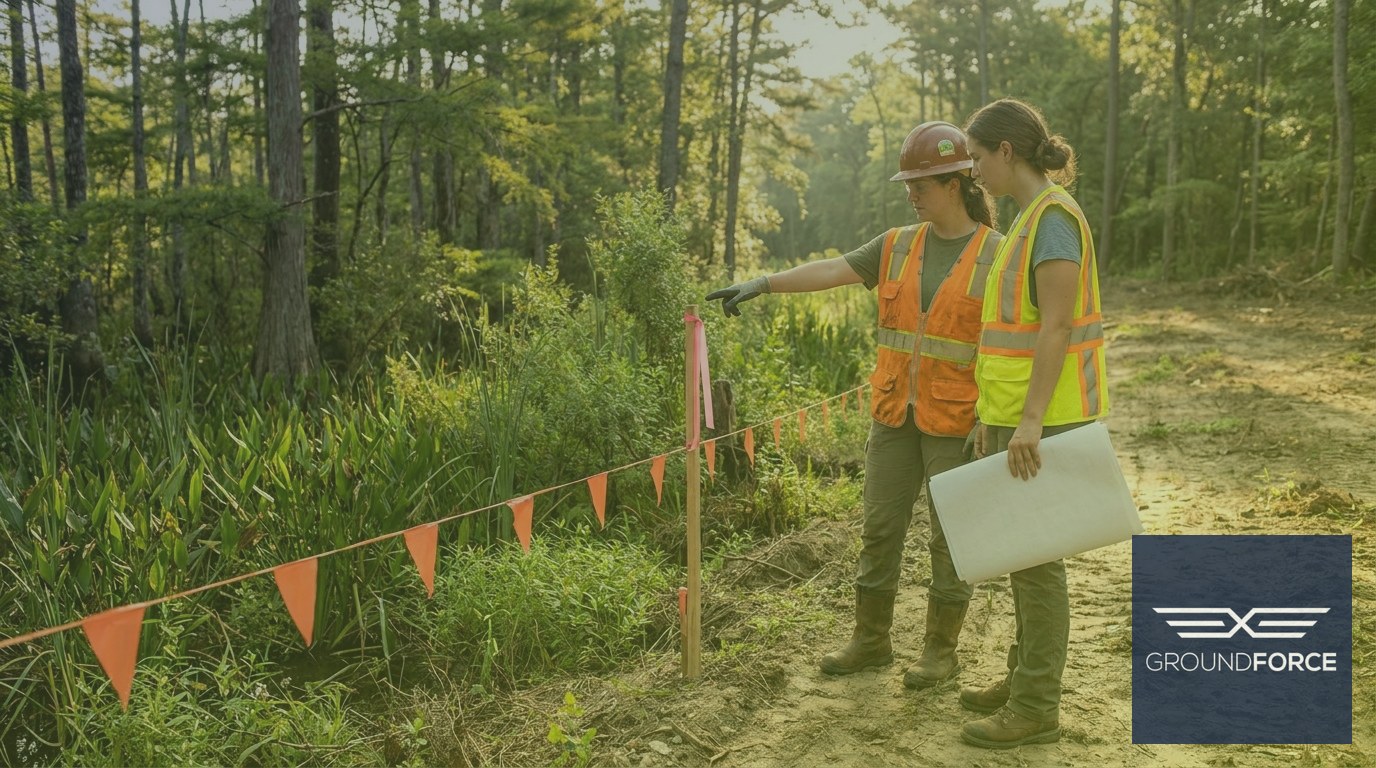
The Georgia Environmental Protection Division administers the NPDES General Permit for stormwater discharges from construction and industrial activity. Vegetation cover on a commercial parcel directly determines permit outcomes: established plant cover stabilizes soil, slows runoff, and keeps sediment out of storm drains, while stripped or poorly maintained sites fail inspections and trigger enforcement. The Georgia land manager’s waterway guide explains how vegetated buffers, swales, and ground cover function as compliance infrastructure rather than landscaping choices.
The U.S. Army Corps of Engineers holds Section 404 jurisdiction over wetlands and waters of the United States. Vegetation management within buffer zones adjacent to jurisdictional wetlands requires pre-authorization before cutting, clearing, or herbicide treatment begins, because even routine maintenance can constitute a regulated discharge or fill activity.
The Georgia Forestry Commission oversees timber harvest notification and best management practices for vegetation removal, while county governments issue land disturbance permits for commercial parcels separately. Georgia’s Erosion and Sedimentation Act requires that any land disturbance over one acre, including vegetation clearing on commercial sites, be covered by an approved erosion control plan, making vegetation management decisions a permitting issue rather than a purely horticultural one.
GDOT right-of-way vegetation rules form a fourth, non-aligned framework governing roadside parcels. EPD, the Corps, the Forestry Commission, and GDOT do not coordinate their standards, so a property manager who satisfies one agency remains exposed to the rest. A property manager achieves full compliance across all four agencies only by building one integrated ecological plan that addresses each agency’s standards.