
Georgia’s humid subtropical climate, highly variable soils, and diverse native plant communities create vegetation management conditions that differ fundamentally from the rest of the southeastern United States. Georgia’s climate and plant ecology determine how, when, and why land managers must calibrate vegetation management decisions to the state’s specific ecological conditions. Land managers who apply generic southeastern vegetation management templates to Georgia routinely under-treat regrowth, mis-time herbicide applications, and accelerate invasive species pressure on commercial properties.
Why does Georgia’s climate make vegetation management more demanding than in other southeastern states?
Georgia’s humid subtropical climate pairs high heat and high humidity with abundant year-round rainfall, and that combination keeps vegetation actively growing and regrowing far longer each year than treatment programs designed for cooler or drier regions assume.
According to NOAA’s National Centers for Environmental Information (2022), Georgia experiences long, hot, humid summers and short, usually mild winters because of its subtropical position and its proximity to the Gulf of Mexico and the Atlantic Ocean. Warm air holds moisture, frequent rainfall keeps soils wet, and plants across the state remain metabolically active for most of the calendar year rather than entering a long winter dormancy.
Georgia’s humid subtropical climate causes a growing season that extends 7 to 9 months in most of the state, driving faster vegetation regrowth after treatment than land managers from drier regions expect. The Piedmont sustains active growth for 7 to 9 months, the Coastal Plain pushes toward 10 months, and mid-Atlantic states work within a season of only 5 to 6 months. The Georgia climate effect on plant recovery shows up most clearly in the weeks after clearing, when warm temperatures and moist soil push cut stems and intact root systems back into vigorous growth.
Warmth plus moisture shortens the effective control window after both mechanical and chemical treatment. Mowed or cut species resprout quickly from undamaged root crowns, and systemic herbicides translocate rapidly through actively growing plants, which changes both timing and re-entry decisions. Sustained high humidity keeps soil and plant moisture elevated through the treatment season, and that moisture availability is the mechanism behind the compressed window. Treatment frequencies imported from national templates or from cooler, drier climates leave untreated gaps between applications, so Georgia programs require recalibrated re-treatment intervals to hold control through the full season.
Seasonal drought modifies this pattern. The late-summer dry period common in the Georgia Coastal Plain temporarily slows regrowth and can reduce foliar herbicide efficacy by limiting plant transpiration, so effective programs build in timing flexibility rather than following rigid calendar scheduling.
What are Georgia’s climate zones and how do they vary across the state?
Georgia’s climate divides into distinct sub-zones carried by its four major physiographic regions: the Blue Ridge, the Ridge and Valley, the Piedmont, and the Coastal Plain. The Köppen-Geiger classification identifies most of the state as humid subtropical (Cfa), according to Grokipedia (2026), but each region modifies that baseline with its own temperature, frost, and rainfall profile. The New Georgia Encyclopedia (2023) notes that Georgia spans only about 300 miles north to south, yet elevation runs from sea level to more than 4,700 feet, which drives the variation.
- Blue Ridge: The mountain region is cooler than the rest of Georgia, with average January and July temperatures of 39°F and 78°F (Wikipedia), and the state’s heaviest rainfall.
- Ridge and Valley: This northwest region shares the cooler, wetter character of the adjacent Blue Ridge, with precipitation more evenly distributed across seasons, per Britannica.
- Piedmont: Atlanta in the upper Piedmont averages a last frost near March 25 and first frost around November 10, yielding about 230 growing days (MySoilType).
- Coastal Plain: Savannah and the Georgia coast enjoy 270 to 280 frost-free days, with the last frost around February 25 (MySoilType).
Temperature and frost dates separate the regions sharply. The Blue Ridge averages roughly 180 frost-free days, while the Coastal Plain averages near 270, and the average date of last spring frost runs from late February along the coast to early May in the mountains, according to WeatherSTEM and the National Centers for Environmental Information.
Precipitation also shifts by region. Annual rainfall ranges from forty inches in central Georgia to more than seventy-four inches in the northeast mountains (Natural Resources Spatial Analysis Lab, University of Georgia), while the southeast Coastal Plain sees more concentrated summer rains and pronounced summer dry periods (Britannica).
USDA Plant Hardiness Zones 6b through 9a span Georgia from the mountains to the coast, so land managers selecting plants for cold tolerance should consult the USDA map for a specific site rather than generalizing from one zone.
A single statewide treatment calendar cannot serve all Georgia properties. A program calibrated for metro Atlanta (Piedmont) will be mistimed and under-powered if applied unchanged to a Coastal Plain site near Valdosta or a mountain site in Rabun County, because region drives frost windows, growth onset, and treatment timing. The resource Georgia’s Climate Zones Explained: How They Affect Vegetation Management Timing details those regional adjustments, covering the regional climate zone impact on plant management and the resulting climate-driven turf scheduling in Georgia.
How do Georgia’s soil types affect weed pressure and vegetation control programs?
Georgia’s three dominant soil profiles, Piedmont red clay, Coastal Plain sandy loam, and shallow mountain soils, control how herbicides move, how long residual activity lasts, and which weed species germinate, so soil type must drive product selection, application rates, and monitoring frequency alongside plant species identification. CommercialToolry.com (2026) characterizes the Piedmont as clay-heavy, the Coastal Plain as sandy loam, and the mountains as rocky and acidic.
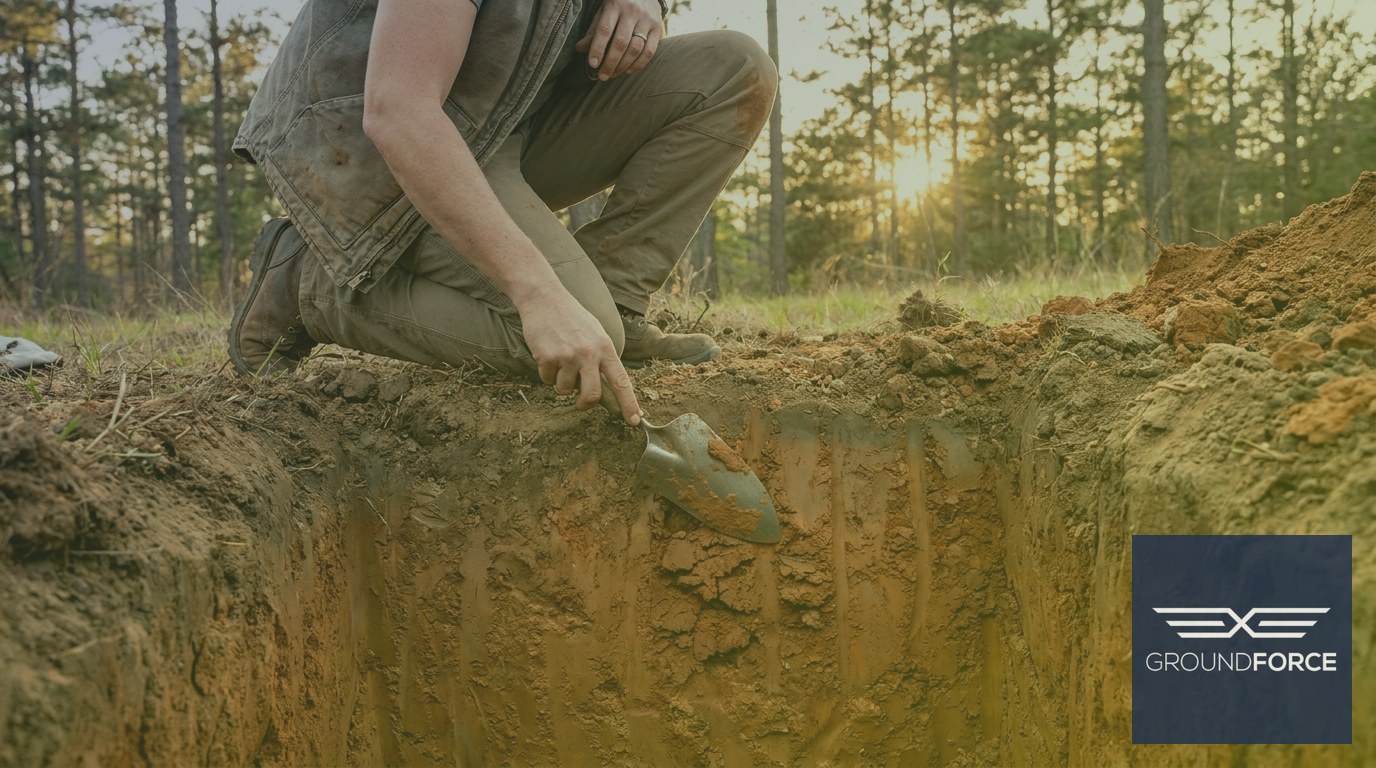
1. Piedmont red clay. Georgia red clay soils of the Piedmont affect pre-emergent herbicide performance by reducing downward mobility and concentrating active ingredients near the soil surface, requiring adjusted application rates and timing. According to the U.S. Geological Survey (1990), Piedmont soils typically run less than 1 meter thick with infiltration rates of only 6 to 15 cm/h. Lawn Squad (2026) reports that pre-emergent products applied to central Georgia red clay must receive about half an inch of water within 24 hours, or the product sits on the clay and breaks down in sunlight before activating. The nuance cuts both ways. Low permeability protects residual activity, but drought cracks the clay and opens preferential flow channels that let herbicide bypass the target zone entirely, a Piedmont-specific failure mode that generic label guidance does not address, which makes drought-responsive vegetation management strategies essential on these sites.
2. Coastal Plain sandy soils. Sandy Coastal Plain soils affect herbicide leaching risk and weed seed bank dynamics differently than clay soils, requiring different product selection and rate adjustments. University of Minnesota Extension (2025) guidance shows that coarse sandy soils with low organic matter let herbicides leach past the germination zone and generally need lower rates than loams or clays, which shortens residual windows and favors a deeper-germinating, drought-tolerant weed seed bank.
3. Mountain soils. Slopes change the calculation. In the Blue Ridge and Ridge and Valley regions, soils sit shallow over rock and erode readily, so vegetation management on these sites must prioritize ground cover retention, which shapes which control methods are appropriate.
4. Program design. The relationship between Georgia soil types and weed pressure means soil mapping belongs in every commercial program plan. Georgia Soil Types and Their Impact on Weed Pressure and Vegetation Control details region-by-region rate and product guidance.
What native plant communities are found in Georgia, and why do land managers need to recognize them?
Georgia supports four native plant communities that commercial land managers must recognize: Piedmont prairie remnants, longleaf pine-wiregrass understories on the Coastal Plain, riparian hardwood corridors, and Appalachian cove forests. Recognizing these communities guides site assessment, protects valuable plants, and informs revegetation.
Each community occupies a distinct landscape position. Piedmont prairie remnants persist as grassland openings where native grasses and forbs dominate thin, fire-maintained soils. The longleaf pine-wiregrass understory blankets the Coastal Plain and depends on frequent, low-intensity fire. Riparian hardwood corridors line Georgia’s streams and rivers with flood-tolerant canopy trees. Appalachian cove forests occupy moist, sheltered slopes in the north Georgia mountains.
Land managers use Georgia’s native plant communities as reference benchmarks to distinguish desirable natives from invasive or weedy species during vegetation management site assessments. A crew that recognizes wiregrass and prairie forbs as community indicators avoids treating those species as weeds, and recognition prevents the accidental removal of ecologically valuable plants during clearing or herbicide applications. Georgia regional ecosystems for land managers groups these communities by physiographic province, from the Blue Ridge to the Coastal Plain.
Native plant reference knowledge supports eco-responsible vegetation management as a named practice and informs revegetation after disturbance. The reference knowledge tells the manager which species to retain, which species to control, and which community structure to restore after clearing or storm damage. The Native Plant Communities of Georgia’s Piedmont: A Reference Guide documents the indicator species and composition of Piedmont communities. The Georgia Piedmont native flora reference catalogues the grasses and forbs that signal remnant prairie sites.
Which invasive plant species pose the greatest threat to Georgia commercial properties, and why does Georgia’s climate accelerate their spread?
Kudzu, Chinese privet, cogongrass, Ailanthus (tree of heaven), and Japanese honeysuckle pose the greatest invasive threat to Georgia commercial properties. Georgia’s warm temperatures, high humidity, and long growing season accelerate invasive spread by allowing multiple establishment cycles each year.
Invasive species like kudzu, Chinese privet, and cogongrass are disproportionately successful in Georgia’s climate because warm temperatures, high humidity, and long growing seasons give them more establishment and spread cycles per year than in cooler climates. Georgia’s frost-free growing season gives these species two to three full recruitment and regrowth cycles per year, a pattern consistent with documented Southeast invasive species and climate shifts. Most commercial land managers treat invasive control as a one-time or annual event, yet a missed spring treatment window does more than delay control by one season; the missed window permits a full additional establishment cycle that compounds removal cost the following year.
Invasive species exploit the disturbed soils common along commercial corridors, utility rights-of-way, and stormwater infrastructure edges, where bare ground and altered drainage favor fast colonizers over established vegetation. Cogongrass (Imperata cylindrica) carries a federal noxious weed listing in Georgia, and cogongrass rhizome systems make mechanical control alone counterproductive: disturbing soil without chemical follow-up fragments and spreads viable rhizomes. Commercial managers must brief crews on cogongrass presence before any ground-disturbing work begins on a site.
Unchecked invasive growth creates direct maintenance and liability costs on commercial sites. Kudzu and Ailanthus encroach on structures and fencing, Japanese honeysuckle and Chinese privet clog drainage features, and dense vines block airflow around HVAC units while trapping moisture against buildings. The Stormwater, Waterways, and Vegetation: A Georgia Land Manager’s Guide details the drainage duties invasive encroachment triggers; the Pollinators, Wildlife, and Eco-Responsible Vegetation Management in Georgia covers habitat protection during treatment.
How should Georgia’s climate and plant ecology inform a science-based commercial vegetation management program?
Science-based vegetation management programs apply Georgia’s ecological conditions by integrating climate zone, soil type, and plant community data into treatment timing, product selection, and monitoring schedules. Programs that follow national defaults mistime treatments and misallocate visits under Georgia’s growing conditions.
1. Baseline the site ecology before choosing treatments. Effective programs document climate zone, soil type, native community baseline, and invasive pressure before selecting products or scheduling visits. Georgia’s climate zones, soil groups, and native plant communities define the site baseline.
2. Set visit frequency from growing season length and regrowth rates. Georgia’s extended growing season produces faster regrowth than industry-default visit counts assume, so treatment frequency follows observed regrowth on the site. Georgia’s Growing Season: Implications for Herbicide Efficacy and Timing explains how season length shifts product performance, and Drought and Vegetation Management in Georgia: How to Adapt Your Program covers schedule adjustments when rainfall deficits slow regrowth and stress desirable species.
3. Time herbicides to plant phenology, not calendar dates. Pre-emergent applications track soil temperature and germination cues, and dormant-season treatments target woody invasives such as Chinese privet when translocation moves herbicide into root systems. The seasonal herbicide timing in Georgia and the plant ecology seasonal management by month map these phenological windows across the year.
4. Treat stormwater and pollinator stewardship as complementary ecological dimensions. Stormwater, Waterways, and Vegetation: A Georgia Land Manager’s Guide addresses how managed vegetation affects runoff, erosion, and waterway protection. Pollinators, Wildlife, and Eco-Responsible Vegetation Management in Georgia covers treatment practices that protect beneficial species. Both dimensions shape program design.
How to Develop a Long-Term Vegetation Management Plan for Commercial Properties assembles site ecology, frequency logic, and phenological timing into a multi-year program structure.