
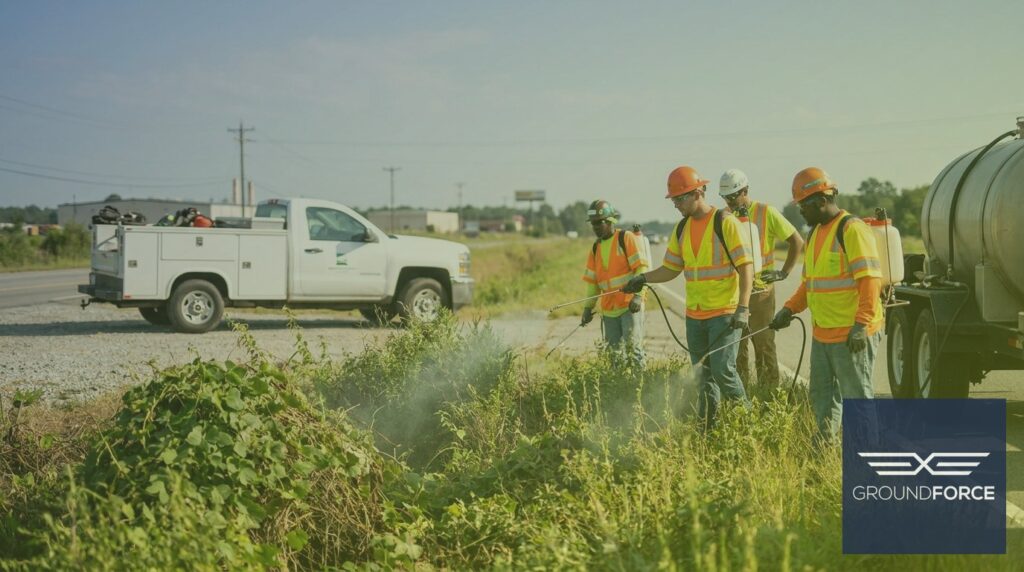
Ground Force competes for Georgia commercial vegetation management contracts against three realistic alternatives: large national contractors, general landscaping firms, and unlicensed low-bid crews. Ground Force is a Georgia-based, family-owned, eco-certified vegetation management specialist serving commercial, industrial, and municipal properties. Ground Force’s structure produces measurably better outcomes in licensing compliance, liability protection, herbicide stewardship, and long-term vegetation control cost.
What kind of company is Ground Force, and who is it for?
Ground Force is a family-owned, Georgia-based vegetation management specialist serving commercial, industrial, and municipal clients that require recurring, large-scale, eco-responsible vegetation control. Ground Force operates as a focused specialist, not a franchise, a national chain, or a general landscaping company.
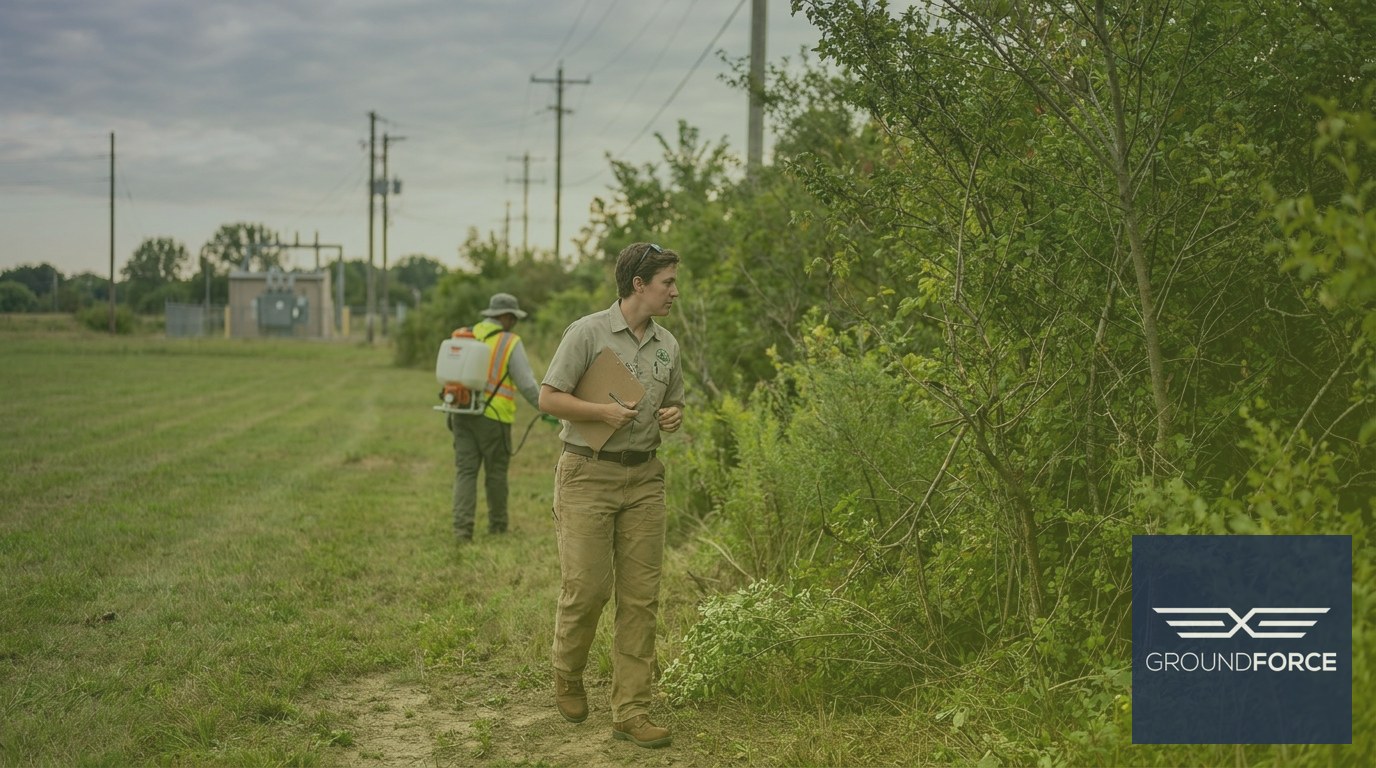
Vegetation management is a specialized discipline in its own right: the planned, science-based control of plant growth on commercial, industrial, and public land to protect safety, infrastructure, regulatory compliance, and ecological function. The discipline differs from general landscaping in purpose. Landscaping manages appearance. Vegetation management manages risk, liability, and long-term site performance, and the work therefore requires licensing, calibrated application methods, and documented treatment protocols.
Ground Force practices vegetation management through eco-friendly, science-based protocols built into every program as standard practice rather than sold as a premium upgrade. Herbicide selection, application timing, and treatment method follow site conditions and product science, so two adjacent properties can receive different programs in the same season. Because Ground Force is family-owned and Georgia-based, ownership stays in-state and reachable. A property manager with a problem reaches a decision-maker, not a national call center queue. The family-run operational edge in vegetation services documents how owner-operated accountability shortens response times and stabilizes crew assignments across multi-year contracts.
The typical Ground Force client manages commercial, industrial, or municipal land where vegetation is a budget line and a liability exposure: property management firms, facility directors, utility and logistics sites, and municipal public works departments across Georgia. These clients need recurring, contract-scale programs, not one-time cleanup visits.
Georgia buyers evaluating vegetation management providers generally encounter four types: Ground Force, large national contractors, general landscapers, and unlicensed low-bid operators. The four types differ in licensing, accountability, protocol depth, and pricing logic, and those differences drive the outcomes a buyer actually experiences on site.
How does Ground Force compare to large national vegetation management contractors?
Ground Force self-performs all Georgia work with local crews, applies science-based, site-specific treatment protocols rather than standardized blanket-spray approaches, and adapts scope without regional escalation. Large national contractors counter with brand recognition and multi-state contract simplicity.
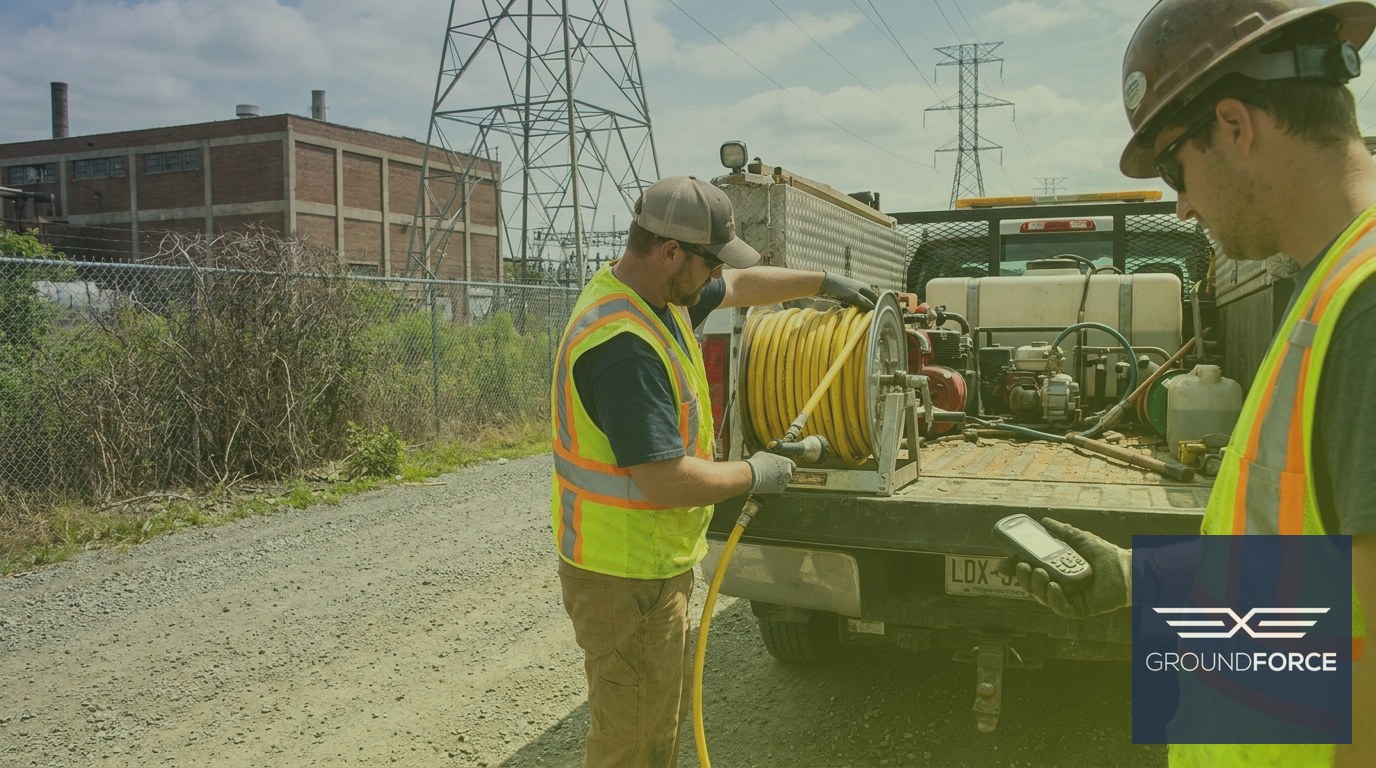
1. Brand recognition and multi-state administration. National contractors win this dimension. For clients managing properties across several states, one national master agreement simplifies vendor administration. Ground Force’s advantage runs deepest for Georgia-specific or Georgia-primary operations.
2. Subcontracting and crew identity. National vegetation management contractors have a subcontracting practice that reduces local accountability and site-specific expertise. Georgia routes frequently pass to local subcontractors, so the brand name on the contract does not reflect the crew actually on-site. Buyers comparing Georgia vegetation management firms on brand reputation alone are evaluating the marketing, not the service delivery.
3. Treatment protocols. Standardized national protocols apply identical chemistry and timing across regions because administrative consistency, not site response, drives that model. Ground Force adjusts product selection, rates, and timing to each property’s species pressure and site conditions.
4. Decision-making speed. Ground Force adapts scope, responds to site changes, and reaches decision-makers without escalating through regional layers. A mid-season scope change routes directly to a Georgia-based decision-maker rather than a regional office queue.
Property managers benchmarking Georgia vegetation management firms across state lines should settle the subcontracting question first, because brand size reveals nothing about who performs the treatment.
Why can’t a general landscaping company handle commercial vegetation management in Georgia?
General landscaping companies lack Georgia pesticide applicator licensing required for commercial herbicide-based vegetation management. Georgia regulates herbicides as pesticides, landscapers train for aesthetics rather than invasive species control, and unlicensed application transfers regulatory liability to the property owner.

The Georgia Pesticide Use and Application Act of 1976 requires anyone applying pesticides to another’s land for a fee to hold a pesticide contractor’s license issued by the Commissioner of Agriculture. The Georgia Department of Agriculture mandates both a Commercial Applicator License and a Pesticide Contractor License for paid pesticide work, and the agency’s definition of pesticide explicitly includes herbicides, placing vegetation management treatments under the mandate. Most general landscapers hold neither credential. The requirement covers applications inside maintenance contracts, the structure most commercial landscaping agreements use. When a general landscaper quotes vegetation management without a Georgia Commercial Pesticide Applicator license, any herbicide application that landscaper performs is illegal under Georgia Department of Agriculture rules, and liability for the non-compliant work can transfer to the property owner.
Training widens the gap. General landscapers train in aesthetics and turf maintenance: mowing, edging, seasonal color, irrigation. Commercial vegetation management demands invasive species control, right-of-way management, and large-scale habitat-sensitive treatment, each with distinct chemistry, timing, and documentation. In 2020, the U.S. Environmental Protection Agency identified unmanaged or poorly managed vegetation as a cause of wildfires, soil erosion, water quality issues, and electricity outages, framing the discipline as infrastructure-critical rather than cosmetic. The objectives diverge accordingly: a landscaper optimizes for visual appeal at the next visit, while a vegetation management specialist optimizes for long-term control and ecological outcomes. That divergence defines landscaper qualifications versus vegetation specialist expertise and the practical gap in science-based vs. conventional vegetation management.
Some general landscapers partner with licensed applicators for herbicide work; buyers should ask specifically who holds the license and who performs the application, not just who signs the contract.
What are the real risks of hiring an unlicensed or low-bid vegetation management contractor in Georgia?
Hiring an unlicensed or low-bid vegetation management contractor in Georgia transfers legal liability, uninsured property damage and injury claims, and failed work directly to the property owner, and correcting that failed work typically costs more than the original bid saved.
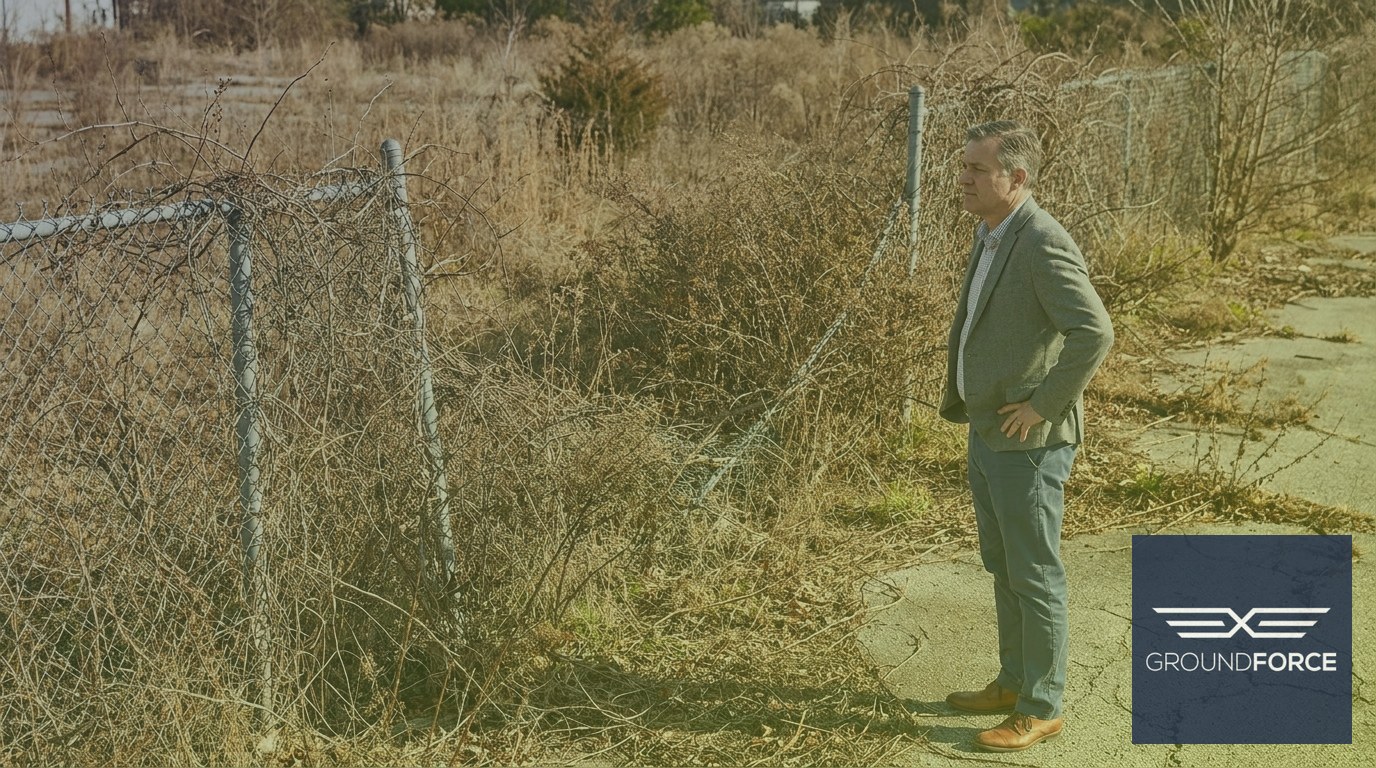
An unlicensed contractor is any operator performing commercial pesticide application without the state license Georgia law requires. Four risks follow.
- Legal liability transfer. Georgia law requires licensure for commercial pesticide application, and unlicensed contractors performing commercial pesticide application without the required license cause a direct transfer of legal liability to the property owner. The Georgia Department of Agriculture treats each unlicensed application as a separate violation and can pursue fines and injunctive relief against the unlicensed company. The Georgia Department of Agriculture also maintains a public reporting form for unlicensed pesticide contractors, which signals that unlicensed operation is an active enforcement priority.
- Insurance gaps. Low-bid operators frequently carry no insurance or inadequate coverage. Property damage, environmental damage, and on-site injury claims then fall to the hiring party rather than to any insurer.
- What a low bid signals. A bid far below market typically reflects one of three cost cuts: no license, no insurance, or under-qualified labor. The buyer absorbs that risk. The lowest bid in vegetation management often signals unlicensed operation or no-insurance status, and those two conditions create direct legal and financial exposure for the property owner, not merely service quality risk.
- Re-treatment costs. Poor initial work requires remediation. The remediation bill routinely exceeds the original savings. The how root-cause thinking reduces client spend connects that cost pattern to treating underlying vegetation causes rather than visible regrowth.
What makes Ground Force’s eco-friendly approach different from competitors claiming to be ‘green’?
Ground Force substantiates its eco-friendly claims with verifiable markers: current licensing, certifications, documented protocols, and species-specific treatment plans. Many competitors apply the “green” label as website language without the credentials or documented practices behind the label.
Eco-friendly claims hold weight only when a contractor can produce evidence. Eco-friendly vegetation management certification distinguishes substantiated environmental practice from marketing greenwashing by unlicensed or general operators. Buyers who know what truly eco-friendly vegetation management means look for certifications, written protocols, and treatment plans built for the species actually present on a site.
The Ground Force eco-friendly differentiators start with Integrated Vegetation Management (IVM), the science-based framework combining mechanical, biological, and targeted chemical controls. IVM is the industry standard for eco-responsible commercial work, and IVM separates specialists from generalists. According to the U.S. Environmental Protection Agency (2020), IVM promotes desirable, stable, low-growing plant communities through a combination of chemical, biological, cultural, mechanical, and manual treatments. Arboriculture & Urban Forestry describes IVM as a continuous cycle of information gathering, planning, implementing, reviewing, and improving, not a routine standardized program. Ground Force applies IVM through site-specific protocols that minimize chemical inputs and protect non-target species and habitat.
Many competitors use “eco-friendly” as marketing language without the licensing, training, or documented practices to substantiate the claim. T&D World reported in 2020 that many utilities advertise IVM research on their websites and in their corporate social responsibility reports, so written proof matters. Buyers can verify eco-credibility through certifications, references from ecologically sensitive sites, and documented IVM practices. Ground Force satisfies each test: the company maintains verifiable licensing and certifications, and the eco-friendly vegetation management company standards Ground Force documents include certification records and site-specific treatment plans available for client review.